Wednesday, December 05, 2007

Winter weather traps B.C. (British Columbia) town, storms hit East Coast


December 1, 2007
1830z
UNISYS Infrared Satellite of North and West Hemisphere

High winds create near blizzard conditions in some areas (click here)
Updated: 12/04/07 9:25 AM
The brunt of Monday's lake-enhanced snowstorm struck south and east of Buffalo, leaving about a dozen school districts closed today and dumping from 4 to 15 inches of snow on those outlying counties.
The severity of the current storm can't be measured just in the snowfall amounts, National Weather Service meteorologists said. Persistent wind gusts of more than 40 mph in some spots made even a moderate amount of snow treacherous.
"In this case, even 6 or 7 inches, along with the strong winds, produced near-blizzard conditions," National Weather Service meteorologist Dave Sage said at mid-morning. "It's still pretty brutal in parts of the Southern Tier."
The highest unofficial snowfall total was recorded in Warsaw, in Wyoming County, where about 15 inches of snow fell.


December 2, 2007
1830z
UNISYS Infrared Satellite of North and West Hemisphere


December 2, 2007
Manistique, Michigan
Photographer states :: The results of a blizzard at Indian Lake when a tree was blown down durding the storm at 12:15am (just past midnight) on Sunday. My poor Honda CRV.


Residents work to remove clear walkways and roads following the storm that's hitting Moncton, N.B. on Tuesday, Dec. 4, 2007.


Only a little scary. No lifeline. No medical evac. No heat.


Power returning to Atlantic region after storm (click here)
Updated Wed. Dec. 5 2007 2:55 PM ET
CTV.ca News Staff
A reprieve from icy winds and blowing snow allowed power crews to begin restoring service to tens of thousands of Atlantic Canadians on Wednesday.
New Brunswick Power reports approximately 4,700 customers are still without power, down from a peak of 23,000...
The ripples, other than the concentric circles, are from wind. Mild wind.

Interesting picture. Not because it is a Semi in water over it's axels, but, because the water it is submerged in is STILL water. It's not moving. THe ripples in the water reveal concentric circles as if minor motion, like dropping a pebble in a lake. The water isn't going anywhere. It is not receding, except in minor ways. This is a LAKE, not a flood ! Saturation, lots of ground saturation over a period of time.


This is NOT a marina !


The Pacific Northwest has been hit by hurricane-force winds and torrential rain

How do you spell trauma? A few drops of inappropriately melting ice? Or deaths in Washington State, USA?


Water droplets fall from a glacier in Ecuador


A woman walks past a huge paper globe set up by Greenpeace at the venue of the UN conference in Bali


Rachmat Witoelar

Storms hit the Pacific Northwest killing fiveBy Catherine Elsworth in Los Angeles (click here)
Last Updated: 7:09pm GMT 05/12/2007
Severe storms lashed the Pacific Northwest with hurricane-force winds and torrential rain, causing extensive flooding, power cuts, mass evacuations and killing at least five people.
The extreme weather system slammed into Oregon and Washington with 120 mph winds, dumping 13 inches of rain in 30 hours.
Trees were flattened and roads submerged, including a 20-mile stretch of the critical Interstate 5 highway linking Portland and Seattle, which was awash with more than 10 feet of muddy floodwater.
Hundreds of homes were submerged including one flooded Oregon town that was cut off by landslides.
The governors of the two states declared states of emergency after the two-day storm left tens of thousands without power and caused mudslides that halted train services between Portland and Vancouver, in British Columbia....

Bali climate talks throw focus on Kyoto offsets


Labor leader Kevin Rudd has urged the United States to ratify the Kyoto protocol, arguing that both Australia and the US are unable to properly tackle climate change until they do.
Mr Rudd, who is on his first visit to the US since becoming opposition leader late last year, has told an American research institute that Australia, China and the US must work together to cut greenhouse gas emissions.
Climate change was the great moral, environmental and economic challenge facing the world, he told the Brookings Institution in Washington.
"On this question, our respective national positions are compromised by our refusal so far to ratify the Kyoto protocol," Mr Rudd said....
5 de Diciembre del 2007
In a turnaround that leaves the United States as the only developed country refusing to sign the Kyoto Protocol on greenhouse gas emissions, Australia’s new prime minister, Kevin Rudd, signed the agreement on Monday only hours after taking office. "Australia's official declaration today that we will become a member of the Kyoto Protocol is a significant step forward in our country's efforts to fight climate change domestically and with the international community," said Rudd in his inaugural address before leaving for Bali to attend a UN climate change conference that began on Monday.The Kyoto Protocol dates back to 1997 and expires in 2012. It commits the member countries to reduce greenhouse gas emissions by five percent in the period between 2008 and 2012, in relation to their 1990 levels....

Washington told it's time to join the Kyoto party


TOTAL USA carbon emissions.

This gets real interesting to understand.


The shifting knowledge base.


See, one can play with the way USA Carbon Emissions is reported. With a growing population, now at over 300 million, the 'PER CAPITA' of carbon emissions in the USA looks less than the actual emissions noted above. Now mind you, these totals include the total emissions, including industry.


So, in an area with high carbon dioxide emissions from energy plants that burn some form of fossil fuel, IF, the population increases it would appear that the power plant is actually doing better 'PER CAPITA' on a local and regional level when in fact the carbon load is staying the same or increasing. I hate to say the obvious, but, with increased population there is increased energy demands AND exhaled carbon as well. Holding your breath does NOT decrease carbon dioxide emissions. Breath. Breath deep !


PER CAPITA Carbon Emissions.


KEVIN RUDD has called on the US to follow his example and ratify the Kyoto Protocol.
But Mr Rudd, who ratified the protocol this week in his first act as Prime Minister, sidestepped when asked if he would press the US President, George Bush, personally when he visits Washington next year.
Mr Rudd said the ratification of Kyoto, opposed for years by the Howard government, gave Australia a stronger position when helping to negotiate a post-Kyoto global agreement for greenhouse gas reduction.
"We need to see our friends in America as part and parcel of that process as well," he said.
The US Under-secretary of State for Political Affairs, Nicholas Burns, said in Canberra yesterday that the Bush Administration would not ratify Kyoto but this should not be regarded as a slight to Australia.
Mr Rudd yesterday defended his decision that questions in the lower house on climate change would be answered by the Treasurer, Wayne Swan, and not the Environment Minister, Peter Garrett.
He said climate change was primarily "a huge economic challenge".
Mr Swan and Treasury would be responsible for modelling the effects of a national emissions trading scheme, as well as any international agreement to which Australia would become a signatory, he said.
Phillip Coorey and Craig Skehan

Tuesday, December 04, 2007

The operative words are "....from having the knowledge necessary to make a nuclear weapon."... Pre-Emption will allow attack by 'fear mongers'


Natanz nuclear complex in Iran

The Law of Pre-emption needs to be repealed ! (click here) It has already proven to cause massive deaths, refugees and abject poverty in one sovereign country while allowing the enemy of the USA to flourish in the first and only war front necessary !

...Some participants stressed that the United States may be entering an era in which preemption can and should be contemplated to protect public goods – to combat, for example, massive violations of human rights and impending environmental disasters.

Discussants stressed the need to understand the advantages, risks, challenges, and constraints of preemption; and how it differs from, complements, and potentially conflicts with alternative strategies such as prevention, deterrence, and containment as well as how it affects the pursuit of national interests and the establishment of international law. Working from historical cases and drawing parallels with domestic and tort law, the group enunciated a well-established legal basis for preemption when employed in self-defense, requiring imminence and demonstrable exhaustion of peaceful alternatives....

The Law of Preemption is reeking havoc across all levels of our courts, impinging upon State legislation and court actions. It is a hostile legislative measure that crosses the boundary of historical American law and attacks constitutions, both state and federal at all levels. It is a dangerous legislative directive and needs to be repealed !

Reassessing the law of preemption (click entry to title)
Georgetown Law Journal, Jul 2000 by Dinh, Viet D

Notwithstanding its repeated claims to the contrary, the Supreme Court's numerous preemption cases follow no predictable jurisprudential or analytical pattern. Part of the explanation for such indeterminacy lies in the nature of preemption analysis. Because " '[t]he purpose of Congress is the ultimate touchstone' in every preemption case,"1 the Court's preemption decisions necessarily vary across the different statutory schemes at issue. But although individual judgments may vary, surely the basic analytical framework should not differ across cases presenting essentially the same question: whether and to what extent federal law has displaced state law. Problems arise, and accusations of judicial activism or results orientation fly, when the Court professes adherence to established analytical frameworks or jurisprudential principles and yet renders judgments seemingly inconsistent with those frameworks and principles-as it often appears to do in preemption cases. This article seeks to make sense of the preemption mess by going back to first principles: by defining preemption and supremacy within the constitutional structure; by critically assessing the validity and meaning of core assumptions and principles the Court professes to follow in preemption cases; and by explaining how preemption analysis, properly conceived, can rationalize seeming inconsistencies between what the Court says and what it does in these disparate cases.

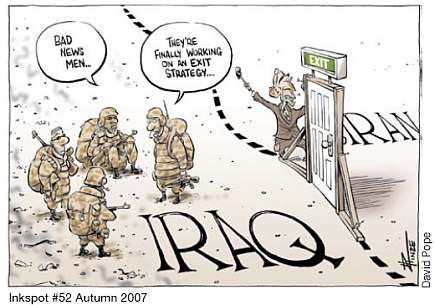
Bush blames Iran for USA policy in Iraq, separates Iranian Revolutionary Guard as sovereign threat. Bush scapegoat for failure.


Had to serch far and wide to find this article today in the Huston Chronicle (click here). I believe their lead story promotes honey as cough syrup for children. That's just in case you haven't got a perscription drug program called SCHIP !

...The findings come at a time of escalating tensions between the United States and Iran, which President Bush has labeled part of an "axis of evil," along with Iraq and North Korea. At an Oct. 17 news conference, Bush said, "If you're interested in avoiding World War III, it seems like you ought to be interested in preventing them (Iran) from having the knowledge necessary to make a nuclear weapon."...

Oliver North used World War 3 as a promotion for his book on FOX News. According to FOX today, Iran is just too good at keeping secrets. Bogus NIE !!

Impeach George Walker Bush and Richard Cheney, the media is turning the issue into Pablum

Impeach George Walker Bush and Richard Cheney, the media is scared skinny to even approach it !

Monday, December 03, 2007

Four years. Four completely unnecessary years of killing. No WMD when UN inspectors already verified same. No Iranian nuclear threat.

Posted by Picasa
Iraqi Children Pushed Into Work By War And Poverty
Photo by Wathiq Khuzaie

Post invasion Iraq. The deaths, refugees and abject poverty of nearly half the country of Iraq and the men that lead the illegal invasion are still in office with a continued misdirected war while Afghanistan teeters on the brink of the return of the Taliban and Pakistan is the REAL nuclear power to be worried will fall into terrorist possession.

It is long time past that impeachment should have taken place. The USA has been held hostage by fear and Neocons intent on war at any cost. This is simply outrageous. Bush/Cheney and their crony media have been 'puming up the public' for still a more expansive war and now the Middle East peace process is being trashed by Bush himself. This is more than an outrage, this is an atrocity needing remedy.

John McCann, "Bomb, bomb, bomb. Bomb, bomb Iran." No more Republicans. Neocons all and dangerous to life on Earth.


Shiite Muslims pray in the resting place of Imam Ali, son-in-law of the Prophet, seen in background, in holy city of Najaf on Satuday May, 3, 2003. The world's 120 million Shiites regard Najaf - a center of scientific, literary and theological studies - as their third-holiest site, behind Mecca and Medina.(AP Photo/Hasan Sarbakhshian)

Hadley's response is 'typical' politics and illustrates clearly the self-righteousness of the Neocons in assessing 'life and death' issues with the least brevity possible. They are obviously human rights violators.

The Neocons have degraded the importance of the IAEA as well as the EU in their attempts to levee sanctions. It will be interesting to see where the sanctions go now. Evidently, the TRUTH is there is no reason for them. Another victimization of the Shia, will it ever end?

I guess Russia wasn't lying either, huh? Jerks ! Cheney, in his 2005 inauguration speech thought it was the best thing to yell across an entire ocean and sea to Israel to prepare the bombs, it's okay with him. Is he still in office? WHY, Nancy, why ?


White House Reaction to Iran Report (click here)
Here is the text of a statement issued today by Stephen Hadley, President Bush’s national security adviser, concerning the new National Intelligence Estimate on Iran’s nuclear weapons program. The intelligence estimate says that, contrary to previous assessments, Iran halted the program in 2003 in response to international pressure and has probably not restarted it since then, though it has the capacity to do so.

Published: December 3, 2007
Here is the text of a statement issued today by Stephen Hadley, President Bush’s national security adviser, concerning the new National Intelligence Estimate on
Iran’s nuclear weapons program. The intelligence estimate says that, contrary to previous assessments, Iran halted the program in 2003 in response to international pressure and has probably not restarted it since then, though it has the capacity to do so.
Today’s National Intelligence Estimate offers some positive news. It confirms that we were right to be worried about Iran seeking to develop nuclear weapons. It tells us that we have made progress in trying to ensure that this does not happen.
But the intelligence also tells us that the risk of Iran acquiring a nuclear weapon remains a very serious problem. The estimate offers grounds for hope that the problem can be solved diplomatically — without the use of force — as the Administration has been trying to do. And it suggests that the President has the right strategy: intensified international pressure along with a willingness to negotiate a solution that serves Iranian interests while ensuring that the world will never have to face a nuclear armed Iran.
The bottom line is this: for that strategy to succeed, the international community has to turn up the pressure on Iran — with diplomatic isolation,
United Nations sanctions, and with other financial pressure — and Iran has to decide it wants to negotiate a solution.

McCann's cohorts (click here). Genocidal idiots all !

Sunday, December 02, 2007

It seems obvious to me the USA has no intentions of backing any peace process. The Bush White House longs for a confrontation with Russia and China. The USA Senate and House need to act to limit the President's ability to 'create' war.

The Middle East has to solve it's own problems. I believe they are capable of it.

Iraq needs to find stability in which ever methodology that applies. If forming decentralized governments in the provinces provides for a more trusted central authority, then it should be accomplished as soon as possible.

The region needs to be stabilized outside the potential for further destabilization by exploitation. A diligent agenda from every member country should be pursued, anything short will derail any potential, leading to greater war and any possibly of peace will be lost.

The lies by the Bush/Cheney White House can be measured easily by the lies they tell their own people. One of these articles are propaganda, perhaps it is easy to tell. Homeland Security has never proved a greater security to the USA and while the Middle East newspaper likes to embellish the 'greatness' of the USA, under this administration it can't even protect those once the focus of attack.


Defense Department role seen differently
Published: November 30, 2007
WASHINGTON, Nov. 30 (UPI) -- A top U.S. Defense Department official says the homeland defense office has learned valuable lessons and increased its mission since its inception in 2002.
Paul McHale, assistant secretary of defense for homeland defense and America's security affairs, says the Defense Department central role is in achieving security for the U.S. homeland, but he sees an evolving and increasingly important capability in providing assistance during natural or man-made disasters, the American Forces Press Service reported.
As the first person to hold the assistant secretary for homeland defense position, McHale says he has looked at the traditional role of the military and says part of his office's mission is to encourage the expansion of its support role for civil authorities.
McHale says as part of his office's continued emphasis on homeland defense missions, more than 60 members of his staff are embedded with various agencies at the Department of Homeland Security in an effort to better understand challenges.
"The American people cannot allow the capabilities inherent in civilian agencies to deteriorate. We fall into a trap if we allow our civilian capabilities to atrophy due to excessive reliance on military competencies," McHale said. "We need a partnership, and that partnership should be built on shared professionalism within and between the civilian and military organization of our government.
"Our founders realized that excessive reliance upon the military may achieve an operational success but ultimately will damage the civilian character of our country and our government. We hold as one of our bedrock principles the concept of civilian supremacy, and that concept is very much respected and adhered to in the Department of Defense."
© 2007 United Press International. All Rights Reserved.
This material may not be reproduced, redistributed, or manipulated in any form.

http://www.metimes.com/Security/2007/11/30/defense_department_role_seen_differently/0735/

Plan to Cut Antiterror Spending Is Criticized by State’s Leaders
THE ASSOCIATED PRESS
Published: December 2, 2007
A White House plan to slash antiterror grant programs by more than half would threaten the safety of American cities, New York politicians charged yesterday.
The latest news and reader discussions from around
the five boroughs and the region.
Go to City Room »
Senator
Charles E. Schumer blasted the Bush administration’s plan to eliminate some port and rail security programs and cut security grants for states and cities to $1.4 billion in 2009 from $3.4 billion in the 2007 fiscal year.
“To say, no port security, no transit security, when we know that our ports and transit lines are targets for terrorists makes no sense if you want to protect America,” Mr. Schumer said.
Other officials said the cuts would penalize a city attacked by terrorists on Sept. 11, 2001, and in 1993.
“It’s stunning that the federal government would consider cutting New York City’s homeland security funds from the already inadequate level that currently exists,” said John Gallagher, a spokesman for Mayor
Michael R. Bloomberg.
The federal government has given $23 billion in antiterror grants to states and municipalities since the Sept. 11 attacks, but some have criticized the programs as pork-barrel spending.
According to budget documents obtained by The Associated Press, the Bush administration is not convinced that the money has been well spent and thinks the nation’s highest-risk cities have largely satisfied their emergency need to improve security.
Officials with the White House
Office of Management and Budget said the president’s budget proposals had yet to be completed. Russ Knocke, a spokesman for the Department of Homeland Security, said Friday that the White House would strongly support any needed antiterror programs.
Still, Gov.
Eliot Spitzer’s spokeswoman, Christine Anderson, likened the White House proposal to a “‘bean counter’ approach to protecting our homeland when sound policy is what’s required.”
Mr. Schumer estimated that if the cuts were accepted by Congress, New York City’s share of the aid might drop to $70 million or $80 million from $134 million.

http://www.nytimes.com/2007/12/02/nyregion/02security.html?ref=nyregion

Good Night

And will the process after Annapolis end with faux promise and actual hatred?

EDITORIAL: EU out of Mideast peace deal?
By MIDDLE EAST TIMES
Published: November 30, 2007
EDITORIAL: One important but little-noticed feature of the Annapolis talks was that the Quartet of the United States, Russia, the European Union, and the United Nations no longer seems to have much of a role. The Americans have taken over.
"The United States will monitor and judge the fulfillment of the commitment of both sides of the road map," says the joint Israeli-Palestinian document committing them to pursue a peace deal by the end of next year. Note that potent word, "judge."”And note also that while excluding the Russians may be difficult, and excluding the U.N. may be foolish, excluding the EU could carry serious financial consequences.
The EU has long been the main financial supporter for the Palestinians. In 2007, the EU and its 27 member nations gave almost $1.5 billion in mostly humanitarian aid. To help make the Annapolis process work, British Prime Minister Gordon Brown said the EU should be prepared to raise another $500 million for job-creation projects. But will it?
Benita Ferrero-Waldner, the EU's external relations commissioner and Javier Solana, the EU security affairs chief suggest that future EU aid could also be made available for the Palestinian police force and to reform the Palestinians' health, education, and judicial systems. But there are no guarantees.
The EU'’s money is essential. Former British premier Tony Blair, who represented the Quartet at Annapolis, stressed at a press briefing in Jerusalem: "Without hope of prosperity, rising living standards, and an economic stake in the future for ordinary Palestinians, the politics will never succeed."
The effective sidelining of the Europeans has been noticed. Leila Shahid, the Palestinians' representative in Europe, expressed regret Wednesday that the EU had "dropped out" of the Middle East process "at a time when the Americans are coming back."
There are ominous signs that a kind of compassion fatigue is developing in the EU, after paying so much for so long for so little, and seeing Israeli bombs or Israeli border delays undermine the development it has tried to fund.
"The only role the EU seems to be able to play is that of a milking cow and a builder of projects,"” notes Barah Mikail of the Institute for International and Strategic Relations in Paris. "When the EU builds these projects and Israel destroys them, the EU never takes a firm stance condemning the destruction, so it does not win any respect," he said.
Moreover, the EU has other concerns beyond the Middle East. Between now and Christmas, EU troops could be facing violence in Kosovo (where it has 15,000 soldiers) and in Lebanon (where 8,000 EU troops are the core of the U.N. peace force). It is also poised to send another 4,000 troops to Chad to support the U.N. mission in the neighboring Darfur province of Sudan. Will it have the cash and political will to keep paying the bills in the Middle East, when it has no role in the policy?

http://www.metimes.com/Editorial/2007/11/30/editorial_eu_out_of_mideast_peace_deal/1599/


Abbas says Annapolis conference achieved its goal
Published: December 01, 2007
CAIRO (AFP) Palestinian president Mahmud Abbas said on Saturday that this week's Middle East peace conference in the United States met its goal of jumpstarting Israeli-Palestinian negotiations.
"The main goal of the Annapolis conference was to launch negotiations between Palestinians and Israelis and this is in fact what happened," Abbas told reporters in Cairo after meeting Egyptian President Hosni Mubarak.
"Some had been under the illusion that the negotiations would actually start in (Annapolis) or that a deal would be struck," he said.
At the meeting in Annapolis, Maryland, Abbas and Israeli Prime Minister Ehud Olmert formally restarted negotiations after a seven-year freeze in the peace process, aiming to conclude a comprehensive agreement by the end of 2008.
Abbas said a steering committee would be set up that would begin negotiations on December 12 including on the core issues such as the status of Jerusalem, the borders of a future Palestinian state and the fate of Palestinian refugees.
Former Palestinian prime minister Ahmed Qorei will head the Palestinian negotiating team, Abbas said.

http://www.metimes.com/Politics/2007/12/01/abbas_says_annapolis_conference_achieved_its_goal/afp/


Mideast peace conference follow-up meetings in Moscow and Paris: Abbas
The Associated Press
Published: December 1, 2007
CAIRO, Egypt: Palestinian President Mahmoud Abbas said Saturday that there will be meetings in Moscow and Paris to follow up on the Mideast peace conference in Annapolis.
Abbas gave his comments after meeting with President Hosni Mubarak in Cairo. He also said that a special negotiating team led by former Palestinian Prime Minister Ahmed Qureia, will handle negotiations with Israelis, which is due to launch Dec. 12.
"There was this myth that there were talks or a deal," in the U.S.-brokered Mideast summit in Annapolis, Abbas said. "The purpose of Annapolis meeting was to launch talks without going into details."
"There will be two stations after Annapolis: one in Paris and the second in Moscow where there will be another conference to review what the negotiations have achieved," he added, without elaborating.
Abbas did not say whether the Moscow meeting would focus on the Syrian-Israeli track as has been widely speculated.

http://www.iht.com/articles/ap/2007/12/01/africa/ME-GEN-Mideast-Palestinians.php


US anger as Russia pulls out of arms treaty
By Stephen Fidler and James Blitz in London
Published: December 1 2007 02:00 Last updated: December 1 2007 02:00
President Vladimir Putin signed a law yesterday suspending Russia's participation in a key post-cold war arms treaty, triggering an angry reaction from the US, which declared the move a "mistake".
In a significant new indication of the worsening diplomatic relationship between Moscow and Washington, Mr Putin personally ratified a law that means Moscow will suspend the Conventional Forces in Europe treaty (CFE) in a little under two weeks.
Western military experts believe the CFE, first signed in 1990, is a significant treaty that limits the number of battle tanks, heavy artillery, combat aircraft and attack helicopters deployed and stored between the Atlantic and Russia's Ural mountains.
It also contains a significant array of confidence-building measures, requiring all signatories to give other states advance notice of troop movements and missile launches.

http://www.ft.com/cms/s/0/3eb8ce68-9fb3-11dc-8031-0000779fd2ac.html


Bhutto warns of foreign intervention if militancy not curbed
Page 1 of 2
View as a single page 9:13AM Monday December 03, 2007
By Riaz Khan
PESHAWAR - Former Prime Minister Benazir Bhutto said on Sunday she would use economic as well as military means to defuse Pakistan's pro-Taleban insurgency, and warned that "foreign forces" could invade unless the government curbs spreading militancy.
Bhutto was speaking to journalists in Pakistan's troubled northwest, where she launched her campaign this weekend for January 8 parliamentary elections. She planned key talks Monday with another opposition leader, Nawaz Sharif, who is urging a boycott of the vote.
Bhutto also raised the spectre of militants moving on the capital, Islamabad, and gaining control of a crucial nuclear installation - widely seen as an unlikely scenario.

Pasted from <
http://www.nzherald.co.nz/section/2/story.cfm?c_id=2&objectid=10479756>


EDITORIAL: Pakistan's autocracy challenged
By MIDDLE EAST TIMES
Published: November 30, 2007
EDITORIAL: As Pakistan President Pervez Musharraf abandons his military façade yet maintains military rule, international critics accuse him of strategically stalling the Pakistani democratic process. With a tumultuous history that encompasses six generations of military misrule, repeated suspension of constitutional rights and internal instability, Pakistan seems an unlikely candidate for a flourishing civil society.
But recent events have proven otherwise. As Musharraf struggles to retain control over a fragmented state, the increasing number of Pakistanis protesting unconstitutional rule is a hopeful indication of the sort of political participation central to democracy.
Instead of accepting cooperation with the largely illegitimate military regime, prominent members of the judicial system, including chief justice Iftikhar Muhammad Chaudhry, have been dismissed, arrested or imprisoned by Musharraf. By doing so, the president demonstrated not only a continued disregard for the Pakistani constitution, but also a growing fear of a multitude of opposition groups.
Former Prime Minister Benazir Bhutto's second return to the country – in defiance of exile imposed once again by Musharraf – indicate the tenacity of the opposition to military rule and contributes to a veritable foundation of grassroots democracy in Pakistan.
Although martial law has been imposed before, tolerance of such flagrant disregard for public opinion is now at its nadir.
Chaudhry's repeated dismissal and Bhutto's return highlight not only the inconsistencies of Musharraf's policies but also that the fear so necessary to run an illegitimate state is no longer present among the people or his political rivals.
Now that Musharraf has become a general without an army, both literally and figuratively, the state is set for opposition groups to re-rout power to the people in an attempt to establish the representative government that Pakistan has long deserved.

http://www.metimes.com/Editorial/2007/11/30/editorial_pakistans_autocracy_challenged/5565/

And who could contribute more to the peace talks than Turkey?


Erdogan: ‘considering new ways and means’

Turkey warns Iraq over Kurd rebels
Turkish PM says Ankara’s patience with government in Baghdad ran out as Turkish soldier killed.
ANKARA - Turkey on Tuesday told Iraq to crack down on Kurdish rebels based in northern Iraq or face the consequences, as Baghdad called for urgent talks over Ankara's threat of a military incursion.
With Iraqi Vice President Tareq al-Hashemi in Turkey for a visit and the Turkish parliament preparing to vote on a motion allowing for cross-border raids, Prime Minister Recep Tayyip Erdogan made it clear that Ankara's patience with Baghdad had run out.
"The central government in Iraq and the regional government in northern Iraq must put a thick wall between themselves and the terrorist organization," said Erdogan, referring to the Kurdistan Workers' Party (PKK).

http://www.middle-east-online.com/english/?id=22688


The reason they Turks are 'warning' Iraq about any inkling of relations with PKK, is the Turks will then feel vindicated in attacking within Iraq without restraint. It must be wonderful to be an Iraqi these days. No sovereignty. No peace. No military.

Turkey has right to act inside Iraq: Gul
PKK leader acknowledges Turkey strike
ANKARA: Turkish President Abdullah Gul reaffirmed on Sunday Turkey’s readiness and right to intervene in northern Iraq one day after the Turkish army carried out an operation inside Iraq against Kurdish rebels. “The army was granted a mandate. This mandate is being used when the army deems it necessary,” Gul told reporters before flying to Pakistan for an official visit. A military official said around 100 special forces were sent into northern Iraq to hit PKK rebels on Saturday. The army also sent between four and six helicopters to bomb a camp used by the PKK.


EDITORIAL: Pakistan's autocracy challenged
By MIDDLE EAST TIMES
Published: November 30, 2007
EDITORIAL: As Pakistan President Pervez Musharraf abandons his military façade yet maintains military rule, international critics accuse him of strategically stalling the Pakistani democratic process. With a tumultuous history that encompasses six generations of military misrule, repeated suspension of constitutional rights and internal instability, Pakistan seems an unlikely candidate for a flourishing civil society.
But recent events have proven otherwise. As Musharraf struggles to retain control over a fragmented state, the increasing number of Pakistanis protesting unconstitutional rule is a hopeful indication of the sort of political participation central to democracy.
Instead of accepting cooperation with the largely illegitimate military regime, prominent members of the judicial system, including chief justice Iftikhar Muhammad Chaudhry, have been dismissed, arrested or imprisoned by Musharraf. By doing so, the president demonstrated not only a continued disregard for the Pakistani constitution, but also a growing fear of a multitude of opposition groups.
Former Prime Minister Benazir Bhutto's second return to the country – in defiance of exile imposed once again by Musharraf – indicate the tenacity of the opposition to military rule and contributes to a veritable foundation of grassroots democracy in Pakistan.
Although martial law has been imposed before, tolerance of such flagrant disregard for public opinion is now at its nadir.
Chaudhry's repeated dismissal and Bhutto's return highlight not only the inconsistencies of Musharraf's policies but also that the fear so necessary to run an illegitimate state is no longer present among the people or his political rivals.
Now that Musharraf has become a general without an army, both literally and figuratively, the state is set for opposition groups to re-rout power to the people in an attempt to establish the representative government that Pakistan has long deserved.

http://www.metimes.com/Editorial/2007/11/30/editorial_pakistans_autocracy_challenged/5565/

Bhutto warns of foreign intervention if militancy not curbed
9:13AM Monday December 03, 2007
By Riaz Khan
Benazir Bhutto at yesterday's press conference in northwest Pakistan. Photo / AP
PESHAWAR - Former Prime Minister Benazir Bhutto said on Sunday she would use economic as well as military means to defuse Pakistan's pro-Taleban insurgency, and warned that "foreign forces" could invade unless the government curbs spreading militancy.
Bhutto was speaking to journalists in Pakistan's troubled northwest, where she launched her campaign this weekend for January 8 parliamentary elections. She planned key talks Monday with another opposition leader, Nawaz Sharif, who is urging a boycott of the vote.
Bhutto also raised the spectre of militants moving on the capital, Islamabad, and gaining control of a crucial nuclear installation - widely seen as an unlikely scenario.

Let's see what the Pope thinks. According to the Bishop of Canterbury; that American foreign policy had created the 'worst of all worlds'


New cardinal Patriarch Emmanuel III Delly of Iraq greets Pope Benedict in Saint Peter's Basilica at the Vatican (click here)

New cardinal Patriarch Emmanuel III Delly of Iraq greets Pope Benedict XVI after he received the red biretta during the Consistory ceremony in Saint Peter's Basilica at the Vatican November 24, 2007. The 23 prelates elevated to the College of Cardinals by Pope Benedict on Saturday join the most exclusive group in the Roman Catholic Church, a kind of hand-picked Senate that elects the next pontiff. REUTERS/Tony Gentile (ITALY)


‘Out of love’
By Mahmoud Al Abed
AMMAN - Pope Benedict XVI has invited an array of Muslim scholars, led by HRH Prince Ghazi, to discuss a letter they sent to Christian leaders last month urging a search for common moral ground, according to a Thursday statement by the Vatican.
Replying to Prince Ghazi, who chairs the board of trustees at the Royal Aal al Bayt Institute for Islamic Thought, Cardinal Tarcisio Bertone said the pontiff felt deep appreciation for the initiative, "for the positive spirit which inspired the text and for the call for a common commitment to promoting peace".
The meeting is expected to add a new achievement to Jordan's track record in interfaith promotion, together with successes the Kingdom has recorded in the intrafaith arena: bringing Muslim groups together.
Efforts in both directions witnessed a high level of involvement by His Majesty King Abdullah. The first landmark achievement was the Amman Message, which defined basic principles of the way Islam should be introduced to others and the faith's outlook on the universe and its engagement with other partners in human society.

http://www.jordantimes.com/?news=4030


Building on a tradition of bedouin hospitality

A view of a campsite in Wadi Rum ( Photo courtesy UASAID/Siyaha)
By Dalya Dajani
AMMAN - A warm welcome, a cup of Arabic coffee, or glass of sweet tea and a plasce to sleep - these are the hallmarks of the time-honoured traditions of bedouin hospitality.
In the vast expanse of the Kingdom’s southern desert, where scenic landscapes and sunsets draw thousands each year, these simple traits are a magnet for travellers.
Bedouins, who for decades relied on raising livestock for their livelihoods, have now expanded on fulfilling visitors’ search for the “desert experience”.
It is a mission they take seriously, despite limited means and financial returns.
“It is an ingrained value in bedouin tradition that no visitor leaves unhappy,” said Nasser Zawaydeh, a camp owner who heads the tourism unit at Aqaba Special Economic Zone, which oversees the Wadi Rum Protected Area (WRPA).
But “it is something that may not be easily attained under the current conditions”, according to Zawaydeh, one of 37 campsite operators in the WRPA.
Although a potentially lucrative source of living for local residents, many camps in the area fall short of tourist expectations.

http://www.jordantimes.com/?news=4031

...and what of Iraq. Stable? Not hardly. Close to peace within it's own borders. No. How can any peace be achieved if it's participants are unable.

So. let's see. The timeline is running on the Benchmarks. The Surge has killed more people than anyone knows yet, resulting in refugees of over two million, widespread poverty and victimization of Iraqis, so now the people of Iraq need to 'take advantage of 'the space' (a temporal element I guess) to move their political stability to the point where no sectarian violence ever erupts again. According to Negropointe.

Yeah.

Right.

Good thinking John Boy.


Sunni leader and parliamentarian Adnan al-Dulaimi speaks during a press conference in Baghdad, May 2007. Iraq's faltering political process was thrown into fresh turmoil on Saturday when the main Sunni bloc walked out of parliament in protest at a security crackdown on its leader Dulaimi. (AFP Wisam Sami)


Iraq parliament hit by walkout over raid on Sunni leader
by Ammar Karim
Published: December 01, 2007
BAGHDAD (AFP) Iraq's faltering political process was thrown into fresh turmoil on Saturday when the main Sunni bloc walked out of parliament in protest at a security crackdown on its leader Adnan al-Dulaimi.
The latest political upheaval came as suspected Al-Qaeda militants killed 14 people in a raid on a Shiite village.
The National Concord Front, the main Sunni bloc with 44 MPs in the 275-member parliament, walked out of the assembly, saying it would return after Dulaimi himself comes back to the legislature.
"We announce our boycott of the parliament until Adnan al-Dulaimi returns to the assembly today or tomorrow," the bloc's Abdul Karim al-Samarraie told the assembly.
"When I went to meet him I was stopped and told that he is under house arrest. This is a violation of the rights of an MP who wants to come to the parliament," Samarraie said.
After his statement the bloc's MPs walked out of the assembly hall. Mahmud al-Mashhadani, the Sunni parliament speaker, joined them.
Shiite MP Haider al-Ibadi said the Dulaimi issue should not be discussed in the assembly.
"There is an investigation and parliament should not interfere in it," he said before the Sunnis walked out.
Iraqi government spokesman Ali al-Dabbagh denied that Dulaimi was under house arrest.
"What is being said about house arrest is not true. It is only protection given to Dulaimi until the situation is clear," Dabbagh told state television Al-Iraqiya.

http://www.metimes.com/Politics/2007/12/01/iraq_parliament_hit_by_walkout_over_raid_on_sunni_leader/afp/


No relief for Iraqi camp kids
By IWPR
Published: December 01, 2007
Seven-year-old Ali Hussein's toy is an old tire, which he pushes back and forth in a pond of dirty water.
Ali, a mud-caked, pale-faced little boy, is a Shiite from Baqouba, 50 kilometers north of Baghdad, who together with his family left the town after his father was killed by Sunni insurgents. The family was told they would also be killed if they stayed there.
"He was a very nice person and no one can replace him," said Ali.
Ali and his family now live in a camp in the al-Habibya area east of Baghdad. The conditions in the camp are poor, its residents are impoverished and the services are limited. Ali, a first grader, no longer attends school.
Recent reports of refugee and internally displaced families trickling back to their Baghdad neighborhoods have brought some semblance of hope that the security situation is improving in the capital.
But "the number being displaced still far exceeds the number of returnees," according to a November report by the International Organization for Migration (IOM) a Swiss-based intergovernmental organization focusing on refugees and displaced persons. And aid for internally displaced Iraqis is not meeting needs, aid organizations report.
Hundreds of thousands of families remain in camps throughout the country, where young Iraqis do not have access to education and are vulnerable to disease, according to aid agencies.
According to the U.N. children's agency, UNICEF, 15 percent of Iraq's population - about 4 million people - has fled their homes since 2003. Fifty percent are children.
The IOM in Iraq reports that 2.25 million Iraqis are internally displaced. In September 2007, Amnesty International said that Iraq had the "the fastest growing displacement crisis in the world."
"Inside Iraq, conditions for displaced children and the communities hosting them are grave," UNICEF maintained in a report earlier this year. "The need to act is urgent."
The camps lack basic services such as clean water, sewage, and electricity. In one camp in the capital's al-Madaen neighborhood, 65 families are living in mud houses and children are suffering from diarrhea, skin diseases, and malnutrition, according to the IOM. Children are working to support their families and are not attending school.
Efforts to raise money for children have achieved little.
UNICEF launched an appeal in late May for nearly $42 million to support displaced Iraqi children and women in Iraq, Syria, and Jordan. But the agency has yet to receive any funds, according to a Nov. 23 report by the U.N. Office for the Coordination of Humanitarian Affairs.

http://www.metimes.com/International/2007/12/01/no_relief_for_iraqi_camp_kids/2976/


EDITORIAL: Annapolis – why now?

By MIDDLE EAST TIMES
Published: November 23, 2007
There is never a good time to hold a conference to try and settle the Israeli-Palestinian conflict, only lesser bad times. Or, as Robert Malley of the International Crisis Group put it recently, "It depends whether you see the glass as one-third full or two-thirds empty."
There have been plenty of skeptical assessments of the prospects for success at Annapolis. In fact, the expectations have dropped so low that the Annapolis meeting itself is probably immune to failure. Instead it will be judged later on whether it launches a productive peace process.
There are plenty of obstacles to that happening but there is also a real set of interests in achieving a settlement at this time that go beyond the desire to secure a legacy for U.S. President George W. Bush. The interests involved are those of the United States, Israel, the Palestinian Authority, and the Arab states, especially Saudi Arabia and the Gulf states. It is worth taking stock of them.
When U.S. Vice President Dick Cheney toured Arab capitals in 2002 trying to drum up support for the overthrow of Iraqi President Saddam Hussein, the refrain he heard in response to his "Iraq, Iraq," was "Palestine, Palestine." Cheney was a little hard of hearing at the time and the neocon foreign policy gurus responded that the road to Jerusalem went through Baghdad.
It has taken a while but the administration seems to have learned that the opposite is the case. The road to cleaning up some of the negative consequences of Iraq runs through Jerusalem. In particular, success in this initiative would improve the abysmal public perception of the U.S. in the region and the dangerous idea that the U.S. is the enemy of Islam.
In Israel, the broad center of Israeli society now accepts that the occupation of the Palestinian territories has been a drain on resources and morale and become unsustainable. The creation of the Kadima party and, in a way, the building of the separation barrier reflects that consensus. The challenge is to find a way to end the occupation that does not increase, but hopefully diminishes, the security threat to Israel.
With Hamas controlling Gaza and acting as the wolf at the door in the West Bank, the Palestinian Authority has a strong interest in achieving a settlement acceptable to a majority of Palestinians. President Mahmoud Abbas understands that failure in this regard will undermine his credibility with the Palestinian people. Equally important, Israel and the U.S. understand this too.
Hamas, and beyond it, the specter of Iran is focusing the minds of the Arab states too. Islamist movements like Hamas threaten the hold on power of the regions' authoritarian regimes. Iran's regional aspirations, with or without nuclear weapons, make Saudi Arabia, with a large Shiite minority in its eastern oil-producing region, or Bahrain with a majority Shiite population, extremely nervous. A peace settlement in Palestine would remove one area where Iran can make trouble.
None of this means that the parties will actually find ground on which they can agree. The domestic political pressures are great. And agreement is not the same as implementation. Hamas may exercise a veto through action on any agreement. Nevertheless, if agreement were achieved it would change the context in which implementation and the role of Hamas were addressed by the international community.

http://www.metimes.com/Editorial/2007/11/23/editorial_annapolis_why_now/6305/


Iraq Sunni Arab leader 'under house arrest'
Agencies
Published: December 01, 2007, 14:22
Baghdad: Iraq's top Sunni Arab leader said on Saturday he has been placed under house arrest, a day after his son and bodyguards were arrested in government raids.
The Iraqi government said they asked Adnan Al Dulaimi to stay at home for his own safety after Iraqi troops arrested dozens of his bodyguards under suspicion of terrorism.
A government spokesman said the measures were temporary and did not amount to house arrest.
At least 35 of Dulaimi's bodyguards and his son were arrested on Thursday and Friday after police found a car bomb near his office. Dulaimi denied the car was near his office.
Dulaimi said troops prevented him from leaving his compound on Saturday.

http://www.gulfnews.com/region/Iraq/10171602.html


Sunnis walk out over leader 'house arrest'
Reuters
Published: December 02, 2007, 01:07
Baghdad: Iraq's largest Sunni political bloc walked out of parliament on Saturday and its leader said he had been placed under house arrest after his son and dozens of members of his entourage were detained.
Saleem Al Jubouri, spokesman for the Accordance Front, said the group would not return to parliament until its leader, Adnan Al Dulaimi, was allowed to leave his home.
"We walked out [yesterday] and announced we will not attend the session [yesterday] or [today] unless the pressure is lifted off Dr Al Dulaimi and he is allowed to move wherever he likes," Al Jubouri told Reuters at parliament.
The standoff could worsen sectarian tension between the minority Sunni community and the Shiite-led government at a time when violence in Iraq has been falling.

http://www.gulfnews.com/region/Iraq/10171740.html


Roadside bomb kills two policemen in Baghdad
Agencies
Published: December 02, 2007, 13:19
Baghdad: Two police officers were killed in a Sunni-dominated neighbourhood of Baghdad on Sunday after a roadside bomb targeting a police patrol exploded.
A third officer in the neighbourhood was shot to death on his way to work, police said, while a further roadside bomb struck an Iraqi army patrol north of Baghdad, killing three soldiers.
Also in Baghdad, an Iraqi civilian was killed when a roadside bomb planted beneath a parked car exploded near the heavily fortified Buratha Shiite mosque, a frequent target of Sunni extremists.

http://www.gulfnews.com/region/Iraq/10171860.html


Son of Iraqi official held over bomb find
Agencies
Published: December 01, 2007, 11:48
Baghdad: Security forces have arrested the son of a top Iraqi politician along with at least 35 other people after police found a car bomb in the MP’s compound.
MP Adnan Al Dulaimi denied any links to terrorism and said that the car was not in the compound. He said he is a victim of an assassination plot.
Al Dulaimi said that up to 50 of his bodyguards and his son Mekki had been detained since Thursday evening.
However, Baghdad security spokesman Qassim Al Moussawi said that the car bomb was found when security forces chased a suspected fugitive into the compound.
Al Moussawi said that weapons and army and police uniforms had also been found at the MP's home.
"Dulaimi's bodyguards are suspected of having links to car bombs and killings," he said.

http://www.gulfnews.com/region/Iraq/10171590.html

Today, Lebanon is among the best ready for peace and stability.


Army commander, Gen. Michel Suleiman salutes during a ceremony in the Christian town of Jounieh, Lebanon in this Saturday, Oct. 6, 2007 file photo. The largest bloc in Lebanon's deadlocked parliament has dropped its opposition to the army chief becoming the next president, bringing Gen. Michel Suleiman one step closer to being the new head of state and ending Lebanon's year-long political crisis, a lawmaker said Wednesday Nov. 28, 2007. Associated Press © 2007


Lebanon Lawmakers Back Army Chief
from The Associated Press

BEIRUT, Lebanon November 28, 2007, 9:05 a.m. ET · The largest bloc in Lebanon's deadlocked parliament has dropped its opposition to the army chief becoming president, bringing Gen. Michel Suleiman a step closer to being the new head of state and ending a yearlong political crisis, a lawmaker said Wednesday.
The apparent breakthrough, announced by legislator Ammar Houry after weeks of political deadlock, came just one day after the Mideast peace conference in Annapolis, Md., a meeting that Lebanon's powerful neighbor, Syria, had chosen to attend.
It had been widely expected that tension between the United States and Syria would ease after Syria's participation at Annapolis. That was expected to affect the Lebanon political crisis, because the Syrian-U.S. tension has, in part, played itself out through Lebanon's complex politics.
Suleiman is seen as a uniting figure, whom both the U.S.-backed majority in Lebanon and the pro-Syrian opposition — as well as outside players — can back. All sides appear to view him, at least for now, as a relatively neutral player who can guarantee that no side in Lebanon's fractured politics dominates the other....


Lebanon opposition sit-in enters second year
by Ines Bel Aiba
Published: December 01, 2007
BEIRUT (AFP) Hundreds of supporters of Lebanon's Hezbollah-led opposition marked in Beirut on Saturday, the anniversary of their open-ended sit-in to bring down the government.
They gathered in Riad Solh Square in the city centre where the opposition, supported by Syria and Iran, has a protest camp outside the offices of Western-backed Prime Minister Fuad Siniora.
They waved Lebanese flags as well as the banners of Hezbollah and ally Amal, both Shiite groups, the Free Patriotic Movement of Christian leader Michel Aoun and a number of pro-Syrian parties.
"One year on the sit-in for national unity," said one placard. "One year on, against monopoly," read another.
The protest continues as Lebanon grapples with a dangerous political vacuum that has left the presidency vacant because of a standoff between pro- and anti-Syrian factions.
"The Lebanese nationalist opposition is ready for a settlement through a consensual president and a government of partnership," Hezbollah MP Hussein Hajj Hassan told the rally.

http://www.metimes.com/Politics/2007/12/01/lebanon_opposition_sitin_enters_second_year/afp/


EDITORIAL: Ramallah-Annapolis via Beirut
By MIDDLE EAST TIMES
Published: November 25, 2007
Syria announced it will participate in the Annapolis Middle East peace summit called at the behest of the United States to try and revive the all but dead Palestinian-Israeli peace initiative.
However, Damascus said it would be sending its deputy foreign minister rather than the country's top diplomat, an indication that Damascus is not entirely satisfied with the agenda. Syria had pegged its participation on condition that the question of the Golan Heights occupied by Israel in June 1967 would figure on the agenda. This is probably one of the reasons that no official agenda has been established yet, with about 24 hours to go before the conference convenes.
And it's probably no coincidence either that the election of the Lebanese president, who's deadline expired midnight Friday, Nov. 23, has been postponed for the fifth time. This latest postponement gives the Syrians an extra card to play at Annapolis.
Upon leaving the presidential palace just before midnight – and with no consensus reached by the country's parliamentarians on who they could elect to be the next president –- Lahoud handed the task of maintaining Lebanon's security to the army.
The delay in Beirut serves the interests of Syria more so than anyone else in the region. It gives Damascus an additional bargaining point at Annapolis, something Syria's President Bashar Assad badly needs.
The Syrians realize they hold no aces other than the Lebanon card.
The danger is that plans can go astray and that Washington may not see the situation through the same lens as Damascus. The "temporary measure," decreed in Lebanon may end up lasting longer than originally anticipated. This sort of thing tends to happen in Lebanon. As was so adequately pointed out by Paul Khalife, a correspondent for Radio France International, the morning after President Emile Lahoud left the presidential palace in his dispatch: In 1948 the Lebanese were told that the thousands of Palestinian refugees flooding into Lebanon was "temporary." Sixty years later their numbers swelled to 400,000 and they make up 12 percent of Lebanon's population.
In 1990, at the end of the 15-year Lebanese civil war, tens of thousands of refugees were told they could return within a short while to their villages in southern Lebanon; it took 18 years to make that a reality.
The Saudi-sponsored Taif Accords in 1990, which put an end to the civil war, included a clause calling for the immediate withdrawal of Syrian troops from Lebanon. That took 13 years to materialize. The Lebanese presidential election which has been postponed five consecutive times was to take place at the latest Saturday, Nov. 24. This date, too, has been postponed by another week.
As the French radio correspondent pointed out, "the Lebanese have come to realize that in Lebanon only the temporary is permanent."
The one hope for a quick resolution of the Lebanese crisis is the inclusion of the Golan question on the agenda at Annapolis. The road to peace in Ramallah, Jerusalem, and Beirut needs to detour via the Golan.

http://www.metimes.com/Editorial/2007/11/25/editorial_ramallah-annapolis_via_beirut/3266/


Lebanon's majority names candidate (click here)
Mon, 03 Dec 2007 04:55:38
Former Lebanese President Amin GemayelLebanon's parliamentary majority has formally declared the nomination of the army commander, Gen. Michel Suleiman, for the presidency. The announcement was made on Sunday by former President Amin Gemayel after a meeting with top leaders of US-backed Prime Minister Fouad Siniora's coalition. "The decision was to put an end to the collapse of the state and in order to fill the vacuum in the presidency. For this the 14th March forces declare the nomination of Gen. Michel Suleiman and launch the required constitutional mechanism for that,'' said Gemayel. On Saturday Hezbollah's second ranking official, Naim Qassem, said that the Islamic movement holds Suleiman in high regard, hinting at his candidacy. Though the majority nomination of Gen. Michel Suleiman does not guarantee him the position, his emergence as a compromise candidate proposes a potential resolution to the conflict between the ruling party and the opposition party....

...and what of Hamas in all this?


There can't be a sustainable peace in the Middle East so long as extremist populous continues to feel ostracized, including, Hamas, Hezbollah, Islamic Jihad and the Brotherhood. A signed peace 'pact' means nothing if the violence continues.


Israel awaiting High Court ruling before cutting power to Gaza Strip
By
Yuval Yoaz, Haaretz Correspondent
The defense establishment does not intend to begin reducing electricity from Israel to the Gaza Strip until it receives a green light from the High Court of Justice, legal officials said over the weekend.
The statement came after the High Court ruling on Friday that the state must provide clarifications and additional information before the court considers approving power cuts.
Although the High Court stopped short of issuing an injunction forcing the state to wait before implementing a power cut, the justices said they "assumed that until the required additional information and necessary clarifications are received, the plan to limit electricity to the Gaza Strip will not begin to be implemented."
Advertisement
The High Court ruling means a delay of at least three weeks before Israel reduces electricity to Gaza, because the state has 12 days to provide the information. Those who oppose the move then have a week to file their briefs with the court before justices Dorit Beinisch, Esther Hayut and Joseph Elon make their final ruling.

http://www.haaretz.com/hasen/spages/930046.html


One PA - with Hamas
By
Zvi Bar'el
As much as the Annapolis conference sought to be "in favor" of the peace process, it measured its success in its ability to be "against" - against Iran, against Hezbollah, against Syria and against Hamas. This is an ostensibly simple and convincing method of measurement. The more Arab leaders at the conference's gala dinner, the greater the victory of the "against" forces: Iran became more isolated, Hamas was pushed into a corner and Hezbollah remained alone. This is one way to assess the conference, but it will turn out to be meaningless when the time comes soon to pay the Annapolis IOUs.
Take, for example, the question of isolating Hamas. This chapter should particularly interest Israel because Hamas is the key to Palestinian Authority President Mahmoud Abbas' ability to demonstrate his "partnerability." According to the "Bush test," which requires "destroying the infrastructures of terror," there is no gray area: Hamas must be dismantled. Abbas not only needs to disarm the Hamas army, crush the Qassam cells and jail the wanted men. He must also take apart Hamas' organizational framework, its civic infrastructure, schools and health clinics. He will be judged by these steps, which Israel will require as initial proof of implementing the road map.

http://www.haaretz.com/hasen/spages/930033.html


IDF kills 5 Hamas members, another armed man in Gaza
By Avi Issacharoff, Yuval Azoulay and
Jonathan Lis
Tags:
Security, Hamas, Gaza, IDF
Six armed Palestinians were killed by the Israel Defense Forces in two incidents in the Gaza Strip yesterday. Five of the dead were Hamas members.
In the first incident, which occured east of Khan Yunis in the southern Gaza Strip, the five Hamas members were hit by IDF missiles. The five belonged to Murabitun, the Hamas border guard. The five were located at a number of positions near the border, and according to the IDF were "involved in terror action" when they were attacked from the air.
The sixth Palestinian, apparently a member of a terror organization, was killed close to the Jabaliya refugee camp near Gaza City when an IDF unit was attacked by armed men and returned fire.
Advertisement
The IDF has killed more than 25 Palestinians clashes since Thursday. The IDF said all were armed and intended to carry out attacks on soldiers or other Israeli targets.

http://www.haaretz.com/hasen/spages/930021.html


Hamas slams security forces' detention of its members in West Bank
www.chinaview.cn
RAMALLAH, Dec. 1 (Xinhua) -- Islamic Hamas movement on Saturday slammed the detention of nine of its members by security forces loyal to Palestinian President Mahmoud Abbas in West Bank cities.
In a statement sent to the press, Hamas said that among the arrested, three each from Hebron, Nablus and Jenin.
Meanwhile, five Hamas militants were killed in predawn Israeli airstrikes in southern Gaza Strip, which has been under the rule of Hamas since it routed the pro-Abbas security forces in June.
Commenting on the two incidents, Hamas said West Bank detentions by pro-Fatah security services and the Israeli air attacks in Gaza showed part of the collaboration between the moderate Fatah movement and Israel after the U.S.-sponsored Annapolis conference on Mideast.

http://news.xinhuanet.com/english/2007-12/01/content_7180492.htm


Hamas boycotts Palestinian census
Published: December 01, 2007
RAMALLAH, West Bank (AFP) The Islamist movement Hamas, which controls the Gaza Strip, blocked the launch there on Saturday of a census by the Palestinian Authority, the head of the Palestinian statistics office said.
"We have not been able to begin census-taking in the Gaza Strip because Hamas has prevented us from doing so," said Loai Shabana, in the West Bank city of Ramallah.
In contrast, the census did begin in the West Bank, and is expected to last 16 days.
"It is a shame that we cannot carry out our work, which is purely professional and has nothing to do with politics," Shabana added.
Hamas seized control of Gaza in June after bloody battles with supporters of Palestinian president Mahmud Abbas, who subsequently sacked Hamas premier Ismail Haniya and appointed a new government.
Since then, the rule of the Abbas-headed Palestinian Authority been restricted to the West Bank, with Hamas having set up a parallel a de facto government of its own in Gaza.
The most recent Palestinian census numbers, published two years ago, put the total population of the West Bank and Gaza at 3,762,000 people. Of that, 2,372,000 people lived in the West Bank and 1,390,000 in Gaza.
Nearly half of the population -- 46 percent -- was less than 15 years old, and 42 percent lived below the poverty line.
© 2007 Agence France-Presse

http://www.metimes.com/Politics/2007/12/01/hamas_boycotts_palestinian_census/afp/

NO HUMAN RIGHTS VIOLATIONS. That in no way indicates a willingness to peace.