Monday, March 04, 2019

Rachel Maddow! 

Great show tonight!

Thank you!

There was a break down in communication between the Emergency Warning System and the people of Alabama.

According to local news reports out of Alabama, the people had no warning. There were three warnings issued, one early in the day, the other two was while the storm front was approaching and producing tornadoes.

Reports to the Florida Panhandle were published. What happened in Alabama that the people were obviously compromised and allowed to be in the path of danger?

March 3, 2019

"Tornado Watch Issued for Panhandle" (click here)

The National Weather Service has issued a tornado watch for Escambia, Okaloosa and Santa Rosa counties.
The hazardous weather outlook said scattered thunderstorms could bring the potential for damaging winds and quarter-sized hail.
Davel Johnson, a forecaster for the National Weather Service in Mobile, Alabama, said the tornado watch will remain in effect until around 6 p.m.
The problem as I see it is this: 

The tornado warning sirens are used in TESTING of the alerts. The people grow used to the testing which is not necessarily announced. Usually what occurs in conjunction with the tornado sirens when there is a real danger is an announcement stating there is a tornado watch that is in effect and to take shelter, etc.

In one video after the tornado struck and there was heavy damage, the siren was blaring. It is unclear that the siren went off as it was supposed to before the tornado hit. At any rate, if the siren sounded and the people had no other warning besides that many could have dismissed it as a test of the system. 

The other issue is, let's say people took shelter, here again, as in most of the Oklahoma tornadoes the shelter they take is grossly inadequate to the danger. This danger of inadequate shelter from tornadoes is typical throughout the south where basements are not used in the construction of homes.

No matter the issue, there is inadequate protection of the people in this region of the country and now in addition to this, there was a breakdown in communication between the emergency warning system and the people. There needs to be an investigation of the deaths of these people.

At least a dozen tornadoes (click here) are reported across Alabama and Georgia, leading to a number of fatalities and multiple people injured.

Thank you, Congressman Nadler.

Be it the Special Council, SDNY or the US House the questions regarding Trump, Trump Company and Trump charities has always been about the state of the country and the foundation of our laws.

March 4, 2019
By Michael Tomasky

The House Judiciary Committee chairman’s legal reasoning has always been precise and unassailable. With Trump now in his sights, the defense of the Constitution finally begins.


Today, it starts getting serious. (click here) House Judiciary Committee Chairman Jerry Nadler is sending out letters to around 60 people in the Trump administration and the president’s general orbit (Don Jr., Allen Weisselberg) seeking documents and other information to “begin investigations to present the case to the American people about obstruction of justice, corruption and abuse of power,” as he put it on ABC’s This Week.

I’ve known Nadler since 1987, back in my cub reporter days. He was in the New York State Assembly then, and it didn’t take long for me to figure out he was one of the smartest politicians I’d encountered. He knew history, ideas, and the law. I won’t bore you with the details, in part because I’m not sure I remember them all, but there was a little controversy in Greenwich Village politics in those days involving the competition between the two Village Democratic clubs, one pretty left-leaning (and opposed to then-Mayor Ed Koch), the other a pro-Koch club.

Nadler was himself anti-Koch, but he spoke up in defense of the pro-Koch club, which wasn’t sitting very well with me at first, but I remember when I interviewed him about it I put down the phone admitting to myself that his legal reasoning was precise and unassailable. I was impressed with his insistence on due process even when it didn’t lead to the end point that would have been more politically popular with his constituents....

By the way, Whitaker is reported to have left the DOJ. He may have serious legal issues due to deferring his authority to the president.

March 4, 2019
By Alex Henderson

Senate Majority Leader Mitch McConnell (click here) has announced that he expects a resolution blocking President Trump’s emergency declaration on the U.S./Mexico border to pass in the United States Senate. The Kentucky Republican told reporters, however, that he doesn’t believe the Senate has enough votes to override a presidential veto.

On Monday, McConnell told reporters, “I think what is clear in the Senate is that there will be enough votes to pass the resolution of disapproval, which will then be vetoed by the president—and then, in all likelihood, the veto will be upheld in the House.”

The resolution of disapproval is expected to come up for a vote in the Senate before Friday, March 15, when members of Congress will take a week-long recess. And it appears to have at least 51 votes, which is enough to pass in the Senate but not enough to override a presidential veto....

February 15, 2019
By Li Zhou and Emily Stewart

As Vox’s Sean Illing, (click here) who spoke with 11 experts about the legality of Trump’s declaration, laid out, there’s enough ambiguity in the law to let Trump declare an emergency. But the maneuver may not stand up to legal scrutiny once challenged in court. He is effectively trying to circumvent Congress — which is supposed to have the “power of the purse” and has decided against funding his border wall — and it’s not clear whether Trump can actually use the armed forces for the project. And his claim that there’s an emergency at the border that necessitates a border wall is dubious.

House Speaker Nancy Pelosi and Senate Minority Leader Chuck Schumer announced Friday that they were prepared to take multiple routes to try to block Trump’s efforts. “The Congress will defend our constitutional authorities in the Congress, in the Courts, and in the public, using every remedy available,” they said in a statement.

There are several different paths to challenging the declaration. Here are some of the most likely....

l.  A joint Congressional resolution 
2. A lawsuit against the White House due to Executive Branch Overreach
3. Landowners along the border can file a lawsuit against the White House
4. Groups, such as the ACLU, can sue the White House for human rights and civil rights violations
5. Effected states can sue the White House for Executive Overreach and the disregard of States Rights.

There are currently sixteen states that have filed lawsuits against the White House declaring their States Rights are being violated by an incompetent idea that leaves them less safe.

The alternatives include needed deployment of National Guard troops under the direction of the Governor. Texas has used it's National Guard successfully before when 1000 were sent to the Texas border when there was an influx of children a few years ago. I believe it was the city of Houston that extended their hospitality to those children and sponsored them. So the States have alternative methods they prefer.

In the case of California, human rights violations may play a big part in it's decision. The State of California has a long history of receiving the Undocumented at times when asylum was being sought. California has barriers, three of them and they are not necessarily happy with the condition of people as they cross those barriers either to defeat the wire or risking entrance into the ocean to go around the wall.

Other States may have varying reasons to oppose the national emergency declaration and considering these states have coped with border crossers for more than a century, they have very good standing to argue the infringement of federal authority along it's borders when it is not necessary at all.

"Good Night, Moon"

The waning crescent moon

27.3 days old

5.6 percent lit

Is there another planet in our solar system?

February 28, 2019
By Rafi Letzter

There could be a planet hiding (click here) out on the distant frontiers of our solar system. And astronomers have published new details about what it probably looks like, if it really exists.
Planet 9, according to a new paper published online Feb. 10 in the journal Physics Reports, is probably five to 10 times the mass of Earth. And it probably travels along an elongated orbit that peaks at 400 times Earth's distance from the sun. That orbit is also likely 15 to 25 degrees off the main orbital plain of our solar system where most planets orbit.

The existence of Planet Nine, as Live Science sister site Space.com previously reported, is an idea that's become popular among astronomers ever since it was first seriously proposed back in 2014. Researchers suspect the planet's existence because of patterns of objects in the Kuiper Belt, a ring of debris in the outer solar system. Those objects tend to clump together in ways that suggest that gravity from something big out there is tugging on them....


Sunday, March 03, 2019

The Rarest Penguin On Earth | Dynasties Saturdays at 9pm | BBCg America (click here for news article - thank you)

A genetic anomaly or a mutant? The rare monotone color Emperor Penguin almost looks like he did when he was young. To the left are young penguins before they get their waterproof feathers which include white on their bellies.

He is interesting. I don't know if this was just a stubborn recessive gene or whether this is the future for the Emperor Penguins. Perhaps with warmer times now and ahead, they don't need all those insulating feathers. Time will tell.

Let's be responsible and take on the challenges of our lifetime.


Not all the news about our Earth is worrisome, some is good news.

November 4. 2018
By Seth Borenstein

Earth's protective ozone layer (click here) is finally healing from damage caused by aerosol sprays and coolants, a new United Nations report said.

The ozone layer had been thinning since the late 1970s. Scientist raised the alarm and ozone-depleting chemicals were phased out worldwide....

The planetary ozone is showing sustained improvement. I will remind all this was discovered by science conducted in Antarctica. The planetary ozone is healing because the international community took scientists seriously and abided by an international treaty that ended the abuses of a particular type of greenhouse gas. We explored all those over the past two years.

If an international community can heal an ozone layer, it can heal the currently hot troposphere. We can achieve a rollback of all greenhouse gases and ultimately have zero emissions.

We can do this. It is proven we can. 

As a matter of record, Louisiana had more tornadoes than any other state in 2018.

However, the majority of tornadoes so far in 2019 have hit most heavily in Alabama and Mississippi. There have been 43 tornadoes so far this year, 19 in January and 24 in February. There are two so far in March. It doesn't look as though it is slowing. There were also tornadoes in December of 2018. It is becoming a year-round event if it isn't already.

March 2, 2019
By James Grymes

Baton Rouge - The latest “preliminary" numbers (click here) from the National Weather Service Storm Prediction Center lists 86 tornadoes in Louisiana during 2018, more than double the normal and second only to the 87 reported in 2017.

A “final” count could be months away, but any changes are likely to be minimal.

But here is the real eye-opener: at this point, Louisiana has more recorded tornadoes in 2018 than any other state in the US.

Iowa is currently listed as the second most active state for 2018 with 84 twisters, while neighboring Texas only recorded 52, barely more than a third of the Lone Star State’s annual average. For the nation as a whole, the current total of 1,169 tornadoes for 2018 is a shade below average...

My sincerest sympathies for the fatalities and injuries in Alabama tonight. I am going to return to a couple of articles about Antarctica.

Kindly note the map to the left of Antarctica. The Peninsula is at 10 o'clock. The Ross Sea is at 7 o'clock and the area discussed in this article from NASA is a section of East Antarctica at 4 o'clock. Each study listed here are separate and different with autonomous authors, yet each one is picking up vastly changing conditions in Antarctica's ice.

December 10, 2018

A group of four glaciers in an area of East Antarctica called Vincennes Bay, west of the massive Totten Glacier, have lowered their surface height by about 9 feet since 2008, hinting at widespread changes in the ocean. The data used for this map is an early version of the NASA MEaSUREs ITS_LIVE project and was produced by Alex Gardner, NASA-JPL.

East Antarctica (click here) has the potential to reshape coastlines around the world through sea level rise, but scientists have long considered it more stable than its neighbor, West Antarctica. Now, new detailed NASA maps of ice velocity and elevation show that a group of glaciers spanning one-eighth of East Antarctica’s coast have begun to lose ice over the past decade, hinting at widespread changes in the ocean.

In recent years, researchers have warned that Totten Glacier, a behemoth that contains enough ice to raise sea levels by at least 11 feet, appears to be retreating because of warming ocean waters. Now, researchers have found that a group of four glaciers sitting to the west of Totten, plus a handful of smaller glaciers farther east, are also losing ice.
"Totten is the biggest glacier in East Antarctica, so it attracts most of the research focus," said Catherine Walker, a glaciologist at NASA’s Goddard Space Flight Center in Greenbelt, Maryland, who presented her findings at a press conference on Monday at the American Geophysical Union meeting in Washington. "But once you start asking what else is happening in this region, it turns out that other nearby glaciers are responding in a similar way to Totten."
For her research, Walker used new maps of ice velocity and surface height elevation that are being created as part of a new NASA project called Inter-mission Time Series of Land Ice Velocity and Elevation....

There were damaging tornadoes in Alabama in January 2019 as well.

January 19, 2019
By Kara Coleman Fields

A suspected tornado (click here) swept through Elmore, Dallas, Autauga and Coosa counties on Saturday, causing significant damage to downtown Wetumpka on Saturday and leaving buildings on the ground.

Wetumpka Mayor Jerry Willis told the Montgomery Advertiser that a senior center and the police department were among buildings damaged from the storm.

“It’s bad, when you love a place as much as we love Wetumpka, to see this devastation,” he said.
One injury was reported, but it wasn’t serious, Willis told the Advertiser.

A message from the Alabama Emergency Management Agency said a 6 p.m. curfew was established for the town Saturday, adding that only emergency personnel would be permitted in the area to assist residents.

“Citizens are urged to stay clear of downtown Wetumpka and areas affected along the track of the storm,” the news release read. “Unnecessary travel is hindering emergency personnel from clearing roadways of downed power lines, trees, and debris.”...

Beauregard/Smith Station, AL Tornado 3/3/2019 (click here for news article - thank you)

There is devastation, injuries and so far 14 dead. They are going to need help.

February 6, 2019
By Umair Irfan

The Stange ice shelf in the Ronne Entrance, Southern Bellingshausen Sea along the Antarctic Peninsula.

Nearly 2.4 billion people, or 40 percent of the world’s population, live within 60 miles of the ocean. And so it’s clearly not good that higher average temperatures are causing water in the ocean to expand. Hotter weather is also melting ice on land, increasing the volume of water in the ocean.

Scientists are now paying particularly close attention to warming in Antarctica, home to 90 percent of our planet’s ice. If it were all to melt, it would raise sea levels by 190 feet. Oceans have already risen more than 8 inches since 1880, and between 1992 and 2017, Antarctica lost 2.71 trillion metric tons of ice. This is roughly the volume of three Olympic-size swimming pools every second. Half of these losses came in the last five years, a sign of an accelerating melt rate....

...Average global temperatures are closely related to the amount of heat-trapping gases like carbon dioxide people pump into the sky, and climate researchers use this mechanism to anticipate future warming. However, predicting sea level rise as the climate changes is much more difficult because there are so many local and global factors at play. “There’s always been quite a lot of uncertainty in sea level rise because it’s hard to figure out how ice sheets behave,” said Tamsin Edwards, a lecturer in physical geography at King’s College London in the United Kingdom.

Edwards, the lead author of one of the Nature papers published Wednesday, decided to examine a particular kind of ice loss in Antarctica known as marine ice-cliff instability to try to get more clarity. Ice cliffs are the craggy sides of the ice sheet that can tower more than 300 feet high.

An alarming 2016 paper theorized that when these cliffs extrude over coastal waters, warming air and warming water could cause them to catastrophically collapse under their own weight. The fractured ice would then thaw and contribute to sea level rise, which would then melt more ice....

This is more or less a thought experiment.

On this blog some many years ago I wrote that if Antarctica became unstable there is a good chance a large amount of ice would slide into the sea and cause tsunamis. We have all had some knowledge of tsunamis and they are a very serious thing.

In modern history of the past decades, people have witnessed some of the worst tsunamis known. The Indian Ocean tsunami called "The Christmas Tsunami." (click here) It occurred the day after Christmas in 2004. It was caused by an earthquake so strong it changed the tilt of Earth.

Then in 2011 the Japanese Tsunami after a 9.0 earthquake (click here). This was the Pacific Ocean. 

Recently there have been strange reports of ocean animals found about 50 feet inland without a clear understanding as to how they got there.


February 3, 2019
By Michael Ross Florentino

An enormous hoodwinker sunfish, (click here) also known as Mola tecta, mysteriously washed up on a California beach over 10,000 kilometres from its usual habitat off the coast of New Zealand.

Weighing up to two-tons and two metres in length, the rarely spotted Mola tecta are thought to be the world's largest bony fish....

The date of the death of the Humpback Whale below is not yet determined. But, it was found nearly 45 feet inland from any waterways. There is no evidence this enormous mammal was dragged inland either.

This is complete speculation, however, what if there was a sizeable tsunami due to ice shelf degradation and ice fall into the Antarctica waters. It could carry large animals a distance and then flood the coastal lands and deposit them inland. Now, I have no evidence as of yet that points in that direction, but, it is possible and should be investigated.

I found it very odd that in opposite oceans large animals were found inland as if there was a big splash coming up from Antarctica. It could go undetected. I know that doesn't sound reasonable, but, Antarctica has no buoys to detect such things and the coastal waters where these animals were found do not have homes or roads where people would observe such rising of water.

A sunfish is a surface dweller. So are humpbacks. I find it odd there should be two mysteries about the same time of animals about the same size and weight.

February 26, 2019
By Jeremiah Rodriguez
A dead humpback whale (click here) is baffling researchers after it was found in Brazil’s Amazon jungle, near the mouth of the Amazon River.

The whale was found approximately 15 metres from the shore of Araruna Beach along the Marajó Bay in Soure, Brazil. Local authorities say spotting a whale in the region at this time of year is quite rare.

According to the Brazilian non-profit environmental group Bicho D’água, the 10-ton whale was eight metres long. But local officials said it was slightly larger, estimating it was 11 metres long....


"The Atlantic" had a glorious picture article of Antarctica. The link is below. Do visit it. Definitely.

This is what Antarctica (click here) looks like. Flat, white, and covered with sastrugi (concrete-hard snow drifts) for thousands of miles in every direction. This photo was taken on the polar plateau at an elevation of almost two miles above sea level on January 7, 2018

The 88th Parallel.

Researchers capture audio of Antarctic ice ‘singing’ as reported in "The Guardian" (click here for news article - thank you)

Icebergs were part of an ice shelf before it breaks off. They also float higher than the ice shelf once it has broken off.

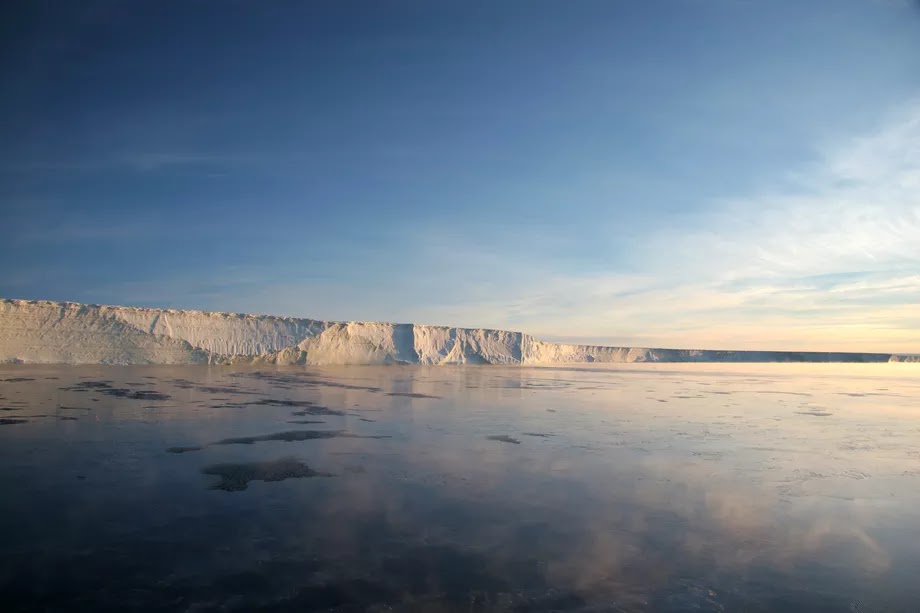
A tabular iceberg gets stuck in thin, seasonal sea ice.

I think I mentioned the ice shelf soon to have a large piece of it break off. It is from the Brunt Ice Shelf and it is enormous (click here). 

There is now a new concern and it from dedicated scientists in Antarctica. This article was written a few months ago.

October 17, 2018
By Katherine Ellen Foley

What started as a quest (click here) to watch the activity of the largest ice shelf in Antarctica turned into one to hear it instead.

On Tuesday (Oct. 16), researchers led by a team at Colorado State University published a letter describing an accidental discovery (paywall) on the Ross Ice Shelf: while using sensitive seismometers to study the ground below the huge ice shelf (about the size of Spain), they found they could also pick up a sound frequency emitted by the snow as it vibrated due to wind and melting activity.

“We discovered that the shelf nearly continuously sings at frequencies of five or more cycles per second,” the researchers write (emphasis theirs). Although these frequencies are too low for humans to hear naturally, when the sounds are sped up, they sound like the warbly, ominous introduction of a monster in a horror movie....

...Toward the end of the two-year time period, the team noticed a drop in pitch of the sounds, corresponding with a warm spell, in which some of the snow melted. Afterward, the pitch remained lower, suggesting that damage from these warmer spells can be long-lasting. The team believes monitoring vibrations could provide a real-time look at ice-shelf activity to help predict if it’s on the verge of calving. Historically, scientists have had difficulty predicting when icebergs will break from their shelves.

“Melting of the firn is broadly considered one of the most important factors in the destabilization of an ice shelf, which then accelerates the streaming of ice into the ocean from abutting ice sheets,” Chaput told Earther. Monitoring the firn’s melt-rate acoustically could be a way to (literally) alarm scientists when the shelf may be becoming unstable....

The study from Colorado State University discovered the sounds of cold in Antarctica. It only makes sense such dynamics exist. Do ice cubes in a glass not crack and creak when something to drink is poured over them? So, when it comes to huge amounts of frozen water aged over time, there is going to be sound when the effects of wind and snow act on them.

The Colorado study is separate and independent of the study below out of Corvallis, Oregon. Basically, one validates the other.

Now, to bring the brevity of this to hit home realize this is not WAIS (West Antarctica Ice Sheet) anymore, this is opposite side Antarctica. Up to now, the primary concerns of huge icebergs and disappearing ice shelves has been in regard to the Peninsual of the Weddell Sea. These studies are discussing rapidly changing conditions in regard to the Ross Ice Shelf of the Ross Sea. There has been no serious concerns about the Ross Sea Ice Shelf, but, it is obvious there are significant changes that have been occurring and continue to occur.

January 14, 2019
By Nala Rogers

(Inside Science) — Most of the worry over melting ice in Antarctica (click here) has focused on the rapidly melting western shore, where there is enough ice to raise worldwide sea levels by up to 4.3 feet. But new research suggests that the massive Ross Ice Shelf, which has long been considered stable, might be at risk as well — potentially leading to a slower sea level rise of up to 38 feet as glaciers that were once held back by the shelf slide more quickly into the ocean. The researchers suspect that other crucial ice shelves could also be at risk.
“My primary concerns would be that the potential for melting and collapse of the big ice shelves is not being taken seriously enough,” said Laurie Padman, a physical oceanographer based in Corvallis, Oregon who works at a Seattle-based nonprofit called Earth and Space Research. “They’re being treated as less important because they are not presently showing much signs of change. But on a 100-year timescale, they have the potential for large changes.”...

Still yet another misguided bureaucrat as Secretary of the Trump Administration.

On February 28, 2019, (click here) the U.S. Senate confirmed Andrew Wheeler as the fifteenth Administrator of the Environmental Protection Agency.  President Donald J. Trump had announced his appointment as the Acting EPA Administrator on July 5, 2018. Mr. Wheeler had previously been confirmed by the U.S. Senate as the EPA Deputy Administrator on April 12, 2018....

Andrew Wheeler has been a paper pusher most of his life. He knows little to nothing about the science of air quality. He understands a bureaucracy and how it works and the one he is leading now was primarily created by him.

The most important standards regarding air quality are the NAAQS Table (click here). With that scientists involved with advocacy groups need to review the exist table and be sure it continues to be a valid measure of high quality breathable air in the USA.

Secretary Wheeler will probably be receptive to information coming from the American people. I would encourage all those concerned about air quality and COMPLIANCE with air quality standards to write to him and be specific as to the failings of any standard not fully implemented or enforced.

The same would hold true with water quality, however, Secretary Wheeler is a coal lobbyist and he is the one that would seek to weaken air quality to allow for dangerous emissions that cause acid rain and of course greenhouse gases currently emitted at higher amounts under Trump.

While I would expect Secretary Wheeler to be a good listener, the real issue is being sure compliance and enforcement of CORRECT air quality standards are at work.
It's Sunday Night

Trustworthy (click here for their official website - thank you)

"Trustworthy" by Dynamite Boy

When you were away
I did some thinking about us
I had some feelings of mistrust
I felt so free 
When you were away 
When you were away


When you were away 
When you were away


When you were away
I did nothing but sit around
You won't believe what i just found
Inside of me 
When you were away 

When you were away 
When you were away

When you were away

And i know that i am strong 
And i know you've done me wrong 
So don't pretend that you're naive and just stay away


When you were away 
When you were away

When you were away 
When you were away
When you were away 
When you were away
When you were away 
When you were away