A very interesting group of scientists with research projects in Australia. They seek to return abundance to living carbon in the seas.
Improved hatchery and grow-out technology for grouper aquaculture in the Asia-Pacific region
Some have taken their study further. This article is not on the web currently. It's too recent.
Richard M. Knuckey, Gale L. Semmesns, Robert J. Mayer, Michael A. Rimmer. "Developement of an optimal microalgal diet for the cultural of the calanoid copepode Acartia sinjiensis: Effect of algal species and feed concentration on copepod development." Aquaculture, 249 (2005) 339-351.
Basically, the four aquaculturists, did extensive research in a very elaborate 'in vitro' format that found advantageous food chains to enhance the advancement of aquaculture without using pelleted foods that are dangerous and unnatural.
There is a reason I find this so interesting. I believe accelerating the repeal of Global Warming is possible with aggresive mariculture and aquaculture.
I outlined a project years ago that would use similar protocols to literally feed baleens back from extinction along with any other fish that wouild benefit from the project. If I run across it in my files I'll publish it here, but, otherwise I won't elaborate. But, this is very heartening. Evidently, the idea is more than viable. It's all very good news.
Saturday, February 18, 2006

The Belly of the Whale Lyrics by Newsboys
Up to my ears
In bitter tears.
Can't believe I've sunk this low
As I walk the plankton
Inner sanctum.
Got outta Dodge,
Sailed on a bon-lessBon voyage.
You said North,
I headed South.
Tossed overboard.
Good Lord, that's a really large mouth...
I'm sleeping with fishes here,
In the belly of the whale.
I 'm highly nutritious here,
In the belly of the whale.
Bad food, lousy atmosphere.
I don't wanna bellyache.
How long is this gonna take?
Woke up this morning kinda blue,
Thinking through that age-old question:
How to exit a whale's digestion?
It might behoove me to be heaved.
Head out like a human comet.*
Larry the Cucumber*
Uh, guys? You might not wanna rhyme with comet!
I'm sleeping with fishes here,
In the belly of the whale.
I'm highly nutritious here,
In the belly of the whale.
I'm ready to reappear.
I don't wanna bellyache.
Lord, how long's this gonna take?
End times, they come rolling around.
Enzymes, they come breaking us down to the core.
The good Lord grants we all get a second chance.
I'm one of the dishes here,
In the belly of the whale.
They say I'm delicious here,
In the belly of the whale.
Lord, please make him chuck it all.
It's a gut callIn the belly of the whale.
I'm in the belly of the whale.
In the belly of the whale.
I'm in the belly.
In the belly of the whale.
I'm in the belly of the whale.
In the belly of the whale.
I'm in the belly...
In the belly of the whale
In an underwater jail
It's a tight squeeze.
It's a-gettin' to me,
But it's roomier
Than the tail.
Hey, sailor,
Got my flow free
Like a salmon to the sea
From the L.A. Symphony.
I'm a paddleboat
Paddlin' in their wake,
A fake free-styler,
But my unemployment pays.
I'm avoiding cliches
Like "whale of a tale" say
Or "you can't keep
A good man down,"
'Cause you can
And I've been there, man.
But I've been expectorated.
I'm elated!
I'm free like Willie!
Happy Day!
Oops,
That's a bit of a cliche.
In the belly...
In bitter tears.
Can't believe I've sunk this low
As I walk the plankton
Inner sanctum.
Got outta Dodge,
Sailed on a bon-lessBon voyage.
You said North,
I headed South.
Tossed overboard.
Good Lord, that's a really large mouth...
I'm sleeping with fishes here,
In the belly of the whale.
I 'm highly nutritious here,
In the belly of the whale.
Bad food, lousy atmosphere.
I don't wanna bellyache.
How long is this gonna take?
Woke up this morning kinda blue,
Thinking through that age-old question:
How to exit a whale's digestion?
It might behoove me to be heaved.
Head out like a human comet.*
Larry the Cucumber*
Uh, guys? You might not wanna rhyme with comet!
I'm sleeping with fishes here,
In the belly of the whale.
I'm highly nutritious here,
In the belly of the whale.
I'm ready to reappear.
I don't wanna bellyache.
Lord, how long's this gonna take?
End times, they come rolling around.
Enzymes, they come breaking us down to the core.
The good Lord grants we all get a second chance.
I'm one of the dishes here,
In the belly of the whale.
They say I'm delicious here,
In the belly of the whale.
Lord, please make him chuck it all.
It's a gut callIn the belly of the whale.
I'm in the belly of the whale.
In the belly of the whale.
I'm in the belly.
In the belly of the whale.
I'm in the belly of the whale.
In the belly of the whale.
I'm in the belly...
In the belly of the whale
In an underwater jail
It's a tight squeeze.
It's a-gettin' to me,
But it's roomier
Than the tail.
Hey, sailor,
Got my flow free
Like a salmon to the sea
From the L.A. Symphony.
I'm a paddleboat
Paddlin' in their wake,
A fake free-styler,
But my unemployment pays.
I'm avoiding cliches
Like "whale of a tale" say
Or "you can't keep
A good man down,"
'Cause you can
And I've been there, man.
But I've been expectorated.
I'm elated!
I'm free like Willie!
Happy Day!
Oops,
That's a bit of a cliche.
In the belly...


I'm comin'
I am trying to decide what to write about.
I was going to address Bush and his administration to date from the point of view of corruption and the disregard for the constitution. I'll do that yet.
Then I was going to talk about 'the cartoon network' and it's hair trigger response when prompted on the Islamic street. Now, all the way to Libya. That is a bin Laden programming note to establishing anarchy globally. It is not paid attention to.
Then I ran across this research in aquaculture.
Recent stuff about feeding fish to abundance.
That's we'll go tonight.
I have to call my son first.
Soon.........
I was going to address Bush and his administration to date from the point of view of corruption and the disregard for the constitution. I'll do that yet.
Then I was going to talk about 'the cartoon network' and it's hair trigger response when prompted on the Islamic street. Now, all the way to Libya. That is a bin Laden programming note to establishing anarchy globally. It is not paid attention to.
Then I ran across this research in aquaculture.
Recent stuff about feeding fish to abundance.
That's we'll go tonight.
I have to call my son first.
Soon.........
Friday, February 17, 2006
It is high time Evangelicals did find a strength in Environmental Justice.
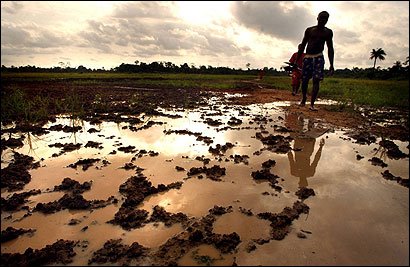
The frequent and devastating Nigerian Oil Spill.
People get cancer from being exposed to crude oil on their skin.
It is carbon.
It is absorbed by the body. The carbon of oil is absorbed through the skin readily.
If Evangelicals are finding purpose in environmental issues, I am not surprised. After all we live on God's Green Earth. Earth is currently under assault by human misuse and greed. I suppose that is stating misuse twice, now isn't it.
The following are articles that are worthy of attention to people who morally value Earth. We don't need oil. We need a healthy planet and a benevolent way of living with it knowing there are over 6 billion people alive today. The expired carbon dioxide of those respirations need to be respected and not the profits of oil companies that thrive in war torn and police state areas.

A Series by The Boson Globe
About this series
The fate of Africa's huge crude oil reserves is important not just for Africans, but also for Americans, who use millions of barrels of oil imported from Africa every day. In this three-part series, the Globe's Africa bureau chief, John Donnelly, examines the issue.
http://www.boston.com/news/specials/oil_in_africa/
Burdens of oil weigh on Nigerians
Ecological harm, corruption hit hard
By John Donnelly, Globe Staff October 3, 2005
First in a series of occasional articles.
OBEDUM, Nigeria -- Under the vast swamps of Nigeria's coastal delta sit some of the world's most productive oil reserves, a treasure coveted by the energy-hungry United States and other nations.
Nigeria produces 10 percent of the oil consumed in the United States, and the Bush administration hopes for a greater bounty soon: US energy officials forecast that oil from Nigeria and the rest of the Gulf of Guinea region will provide one-quarter of America's oil in the next decade, equal to that of the Gulf of Mexico today. Already, 30 percent of the world's newly discovered oil reserves in the past five years have come from this stretch of Africa's west coast.
But here in the serpentine creeks and boggy coastal land lie daunting obstacles to those hopes -- pirates, corruption, violent youth militias, and environmental catastrophes.
http://www.boston.com/news/world/africa/articles/2005/10/03/burdens_of_oil_weigh_on_nigerians/
Oil spills in the delta region of Nigeria have devastated the ecosystem, killing marine life. One spill in 2003 polluted about 615 acres. (Paul Taggart/ World Picture News for the Boston Globe)
AFRICA AND ITS OIL
Burdens of oil weigh on Nigerians
Ecological harm, corruption hit hard
By John Donnelly, Globe Staff October 3, 2005
First in a series of occasional articles.
OBEDUM, Nigeria -- Under the vast swamps of Nigeria's coastal delta sit some of the world's most productive oil reserves, a treasure coveted by the energy-hungry United States and other nations.
Nigeria produces 10 percent of the oil consumed in the United States, and the Bush administration hopes for a greater bounty soon: US energy officials forecast that oil from Nigeria and the rest of the Gulf of Guinea region will provide one-quarter of America's oil in the next decade, equal to that of the Gulf of Mexico today. Already, 30 percent of the world's newly discovered oil reserves in the past five years have come from this stretch of Africa's west coast.
But here in the serpentine creeks and boggy coastal land lie daunting obstacles to those hopes -- pirates, corruption, violent youth militias, and environmental catastrophes.
Tens of thousands of ordinary villagers try to scrape a life out of the marshes, amid the oil rigs and pipelines. Among them is a man named Endurance Godbless, who is brokenhearted and angry at what he calls oil's curse.
Godbless, 18, waded through a tributary of Kolo Creek on a recent day, parting translucent orange-red waters polluted by an oil spill. He lifted a fishing net, revealing a dead fish caught in the webbing. ''Poison," he said, tossing the fish into the weeds.
This summer, two unrelated spills entering the tributaries of the Kolo from the north and south converged in the waters surrounding this village of 1,000 people, killing life in the creek. ''I feel like crying," Godbless said, walking out of the water, his pants shiny from the oil residue. ''I can only fish. But there are no fish anymore."
The story is similar from Nigeria to Angola, along Africa's restive west coast: Oil and natural gas reserves are drawing the developed world's interest and raising expectations for the region's poor of a better future through investment and growth. But environmental damage and often-violent jockeying for the spoils are fueling instability and popular resentment into a combustible anger.
This web of conflicts in oil- producing Africa is causing great concern in Washington. With oil supplies struggling to keep up with demands for energy, even a short-term disruption of African oil would trigger spikes in prices at gas stations across America.
Global ramifications
Nigeria, despite its president's aggressive fight against corruption, presents the most daunting problems on the continent and has the greatest potential to inflict havoc on global oil markets. Nigeria also accounts for about half of the Gulf of Guinea's oil.
In the southeastern part of the country, where much of the oil lies under marshland, the recent arrest of two prominent leaders of the Ijaw tribe, including the governor of one state on corruption charges and militia leader Alhaji Mujahid Dokubo-Asari on charges of sedition, has exacerbated tensions among Ijaw militant young people, oil companies, and the federal government.
Last month, Asari's followers seized two oil flow stations and sent an e-mail to news organizations threatening to ''kill every iota of oil operations in the Niger Delta" unless he was released. Authorities recaptured the stations, but the situation remains tense.
Such conflict has boiled over before, shaking world oil markets. A year ago, two rival militant groups, one of them Asari's, battled each other for greater shares of oil revenues, leaving several hundred people dead, shutting down much of the oil operations in the Niger Delta, and causing oil prices to rise worldwide. President Olusegun Obasanjo entered the fray, and after talks with Asari, reached a truce.
''It is so dangerous now," said Aryakwee Nsirimovu, 44, executive director of the Institute of Human Rights and Humanitarian Law in Port Harcourt. ''For the last five years, you've had a buildup of weapons among the militia, and you have a weak military. So if things blow up, they will be incredibly difficult to control."
For many peasants, Nsirimovu said, oil is a curse. ''We have poverty in the midst of plenty, and everyone sees that wealth every day."
After oil was discovered in the delta in 1957, Nigeria began transforming from an agriculture-based society to an oil-dependent economy. The country now has to import food, and its troubles have become so numerous and so intertwined that resolving them could take years.
Obasanjo's government has initiated ambitious changes aimed at curbing endemic corruption that analysts say reaches from the highest levels of government to low-ranking officials in the field. Without such theft, Nigerian officials said, tens of billions of dollars in spending for education, healthcare, and infrastructure could reach the poor.
Large-scale theft takes place in the open, carried out by low-level operatives who work for sophisticated crime syndicates with ties to senior government, military, and police officials.
Nigeria's crude oil is pumped to the surface in the marshlands and then to flow stations, where machines remove water and add gas. The gas helps propel the oil along pipelines to coastal farms of giant tanks. At Bonny, one of Shell Oil Co.'s two large coastal terminals, operators in a control room flick switches, which allows oil in the tanks to flow in pipelines heading out to sea and then to be pumped into waiting oil tankers.
The thefts take place in the marshlands, before the oil reaches the huge coastal terminals. Thieves use high-tech equipment to tap into the lines and divert the oil into waiting barges. The barges then bring the stolen oil to other tankers waiting offshore. Those tankers are believed to bring the oil to other West African countries.
Unmarked barges anchor in coastal creeks for days and, as local armed men stand guard, thieves tap into pipelines and take vast amounts of oil. From the air, the barges can be spotted near Port Harcourt, the commercial and traffic-choked regional hub 390 miles southeast of Lagos, Nigeria's commercial capital.
One day last month, helicopter pilot Captain Joseph McGlynn, a New Jersey native, headed over intensely green marshes that were interlaced with creeks and rivers.
''I don't want to get too low because we'll get shot at," McGlynn said. ''A year or two ago, they were out in the open; now they are much more sneaky," he added, referring to the thieves.
He and his copilot, Jacob Oommen, easily found two likely spots where oil was being stolen. At one point, three barges were anchored end-to-end in a narrow creek, partly camouflaged by trees.
''Look," McGlynn said. ''They're less than a mile from the Shell facility! They'll tap into the lines at night. After 6 p.m., the ants come out to play."
Shell officials and the Nigerian government said the Nigerian Navy has become more aggressive in stopping the thefts, called ''bunkering," a nautical term for supplying a ship with fuel.
In the delta, stolen oil is loaded into the barges, which then are towed out to a waiting tanker offshore. Shell officials say that an average of 100,000 barrels of oil per day were stolen from their pipelines in 2003, but that so far this year the pilferage dropped to 20,000 barrels a day. Shell produces half of Nigeria's oil.
However, US military officials who travel to the Niger Delta think the total national theft is much greater -- 200,000 barrels a day, which at $65 a barrel is a $13 million daily heist.
''Oil bunkering is extensive, pervasive -- it's part of the culture," said a senior US Department of Defense official with oversight of the region, speaking on condition of anonymity.
He said he asked his counterparts in the Nigerian Navy why they have not done more to crack down on the theft, and the Nigerians told him: ''We don't have the right boats." Nigerian Navy officials in the Port Harcourt region did not return phone calls seeking comment.
''They don't have the will to do it," the US official said of the Nigerian Navy. ''Some of the very senior members of the Navy are profiting from oil bunkering. . . . It's a Wild West atmosphere with lots of money to be made."
Two Nigerian Navy admirals were convicted this year of facilitating the theft of an oil tanker, and the former police inspector general, Tafa Balogun, is accused of stealing $98 million, some of which is allegedly related to oil profiteering.
Fighting corruption
Nigeria's new anti-graft watchdog, the Economic and Financial Crimes Commission, estimates that 45 percent of the nation's oil revenues are stolen, wasted, or siphoned away in the marshes.
That means few delta residents realize any oil benefits. A World Bank report last year estimated that as much as 80 percent of Nigeria's oil revenues benefited 1 percent of the country's population. Last year, Nigeria received $27 billion in oil revenues; this year, with the price of oil skyrocketing, the revenue could double, analysts say.
Much of the burden of fighting corruption falls on several crusaders in Abuja, the capital, including Obiageli Ezekwesili, a Harvard-educated member of Obasanjo's Cabinet and an evangelical Christian. She chairs the National Extractive Industries Transparency Initiative, a government program that audits and publishes data on oil revenues and spending. Still, the anti-corruption process is in its infancy.
''What do you expect? A silver bullet?" Ezekwesili said. ''We are making progress at every level of our initiative to fight corruption."
But some communities are so disillusioned that they want oil companies to cap their wells and leave. One is the community of Bille, about 20 miles south of Port Harcourt, where the first oil flow station was installed in the 1950s.
''We have no electricity, no running water, no hospital," said Socrates Dokubo, 37, a fashion designer. ''For more than 48 years, they have been fooling us with promises. No more. We want them to leave."
Most, though, hold out hope they can reap an oil windfall.
In August, members of five communities near Port Harcourt seized Shell's Agbada I station. The protesters said they knew of no other way to get fair compensation for a spill that polluted their land in December 2003. The protesters, who carried no weapons, occupied and shut down the Shell Petroleum Development Co. station for six days, blocking about 267,000 barrels of oil from reaching Shell's terminals -- a loss of almost $17.4 million at today's oil prices.
Villagers remain angry. The 2003 spill, which was found to be accidental, polluted about 615 acres. Shell said it spent $1.4 million on cleanup efforts. It offered the five communities about $500 each for the damage to the land. Shell spokesman Donald S. Boham defended the amount, saying that communal land covered a tiny portion of the land and Shell planned to negotiate with individual landowners later.
But local leaders contended that much of the land was communal agricultural land and fisheries.
''Our fish, our land for vegetables, our major source of living, has been devastated," said Azunda Aaron, 40, chairman of Reukpokwu's community development council, standing on the polluted land, which still smells strongly of oil. ''We will not be violent. We shut down the flow stations because what we heard from Shell was so distressing, that they would pay us so little in compensation."
But another villager, Tike Wopara, 25, whispered that many residents planned to sabotage Shell's pipes because of the low compensation offer. ''That's why I'm here, day and night," said Wopara, who is being paid by Shell to oversee part of the cleanup. ''The place needs to be secured. The anger against Shell is so great."
Even greater anger flowed from the recent arrest of Asari, the Ijaw tribal militia leader who has attracted several thousand followers with his populist rhetoric and his willingness to distribute weapons and small amounts of cash. Last year, he declared he would wage ''all-out war" on the state from his hide-out in the bush. He eventually reached a truce with the government, but his arrest has reignited the conflict.
In an interview with the Globe a month before his arrest, Asari, 41, seemed more agitated at the lack of contracts for his numerous start-up companies than the plight of poor villagers. Sitting in his Port Harcourt mansion, Asari said he has at least two construction companies, a consulting firm, and a telecommunications company.
''Government promised me six contracts!" he said. ''But only two contracts are moving. If government cannot kill me outright, they will try to kill me economically."
Asari denied that he was involved in stealing oil from the pipelines, as many have asserted. But he said the practice was not illegal.
''People have the right to take what belongs to them. But who is doing the bunkering? Who pays for the vessels that take the oil away? Villagers? People doing it sit in Abuja," he said.
Nicolas V. Gortzounian, a Tufts University student, helped research this report. John Donnelly can be reached at donnelly@globe.com
http://www.boston.com/news/world/africa/articles/2005/10/03/burdens_of_oil_weigh_on_nigerians?mode=PF
In oil-rich nation, charges of skimming
Congolese officials said to reap profits
By John Donnelly, Globe Staff November 25, 2005
Second in a series of occasional articles.
DJENO, Republic of Congo -- It was one of hundreds of such transactions along the oil-rich Gulf of Guinea this year -- a shipment of 950,677 barrels of high-grade crude, loaded at this steamy port on the African equator and bound for the United States.
On June 29, the Nikator, a supertanker registered in Greece, left Djeno for Philadelphia.
The seller was identified as a private company called Africa Oil & Gas Corp. The middleman, Geneva-based Vitol S.A., bought the shipment for nearly $53 million.
Of that amount, the government of Congo received $48.8 million, according to an international auditing firm. Africa Oil & Gas pocketed as much as $4.2 million, according to US private creditors who are trying to collect unpaid debts from the Congo government.
This might have been run-of-the-mill corporate profit taking, except that the person who runs Africa Oil & Gas is no ordinary businessman. He is Denis A. M. Gokana, head of Congo's national oil company and special adviser to President Denis Sassou-Nguesso, according to court and government documents. And the bill of sale ended up listing the seller as the government's National Oil Company of Congo, not Africa Oil & Gas.
Gokana declined an interview request made at his oil headquarters in Brazzaville and did not return telephone calls seeking comment on where the $4.2 million went.
From gold to diamonds, copper to uranium, corruption involving Africa's natural resources has a long, sordid history. African leaders, their cronies, European traders, foreign heads of state, and American middlemen, among others, have reaped billions from the continent's oil resources over the last four decades.
West Africa supplies the United States with about 15 percent of the oil it consumes, and the US National Intelligence Council estimates that the region could provide 25 percent in a decade.
Such resource riches could help West Africa climb out of poverty by funding better education, healthcare, roads, and other essential services. But financial specialists warn that as the United States, Europe, China, and other energy-seeking nations pour money into the region in a global competition for oil contracts, billions more dollars could simply disappear into the web of skimming and self-dealing.
Ironically, the Republic of Congo -- often referred to as Congo-Brazzaville to distinguish it from its larger neighbor, the Democratic Republic of the Congo, formerly Zaire -- had seemed to be the first African nation poised to break the cycle of oil corruption that enriches only the ruling class.
The International Monetary Fund last year called Congo-Brazzaville's efforts at greater public disclosure on oil deals a ''model" for the rest of the continent. The government has published hundreds of documents on oil transactions over the Internet, hoping that financial openness would persuade the IMF, World Banks, and others to cancel billions of dollars in debt.
Instead, the disclosures seemed to confirm that corrupt practices were still taking place. US creditors and the Publish What You Pay campaign, a coalition of 270 organizations that promote transparency of oil revenue and spending, say their investigations indicate that dozens of recent oil transactions, including the payment for the Nikator oil shipment, have enriched senior Congolese officials.
International creditors had been on the verge of rewarding Congo for its steps toward public disclosure. On Aug. 1, a month after the Nikator deal, the IMF Executive Board in Washington laid the groundwork for possible cancellation of as much as three-quarters of Congo's public debt, which had been estimated at $8.6 billion in 2003. A final decision is expected in the next few months.
At the August board meeting, Agustin Carstens, IMF deputy managing director, cited Congo's ''steps to enhance transparency with regard to oil sector transactions" and declared, ''There has been a welcome improvement in governance."
IMF officials think granting debt relief will spur further reforms in the Congo as well as encourage nearby countries such as Angola and Equatorial Guinea to start transparency efforts. But private creditors and activists say Congo-Brazzaville has only become more clever in hiding oil revenues and warn that once it secures debt relief it will have little incentive to change its ways.
According to creditors and Publish What You Pay, about $300 million in oil revenues identified by independent auditors last year did not show up in the country's budgets. That was nearly one-third of Congo's $974 million in oil money. This year, because of the rise in oil prices, the government is expected to take in about $1.5 billion.
A senior Congolese official reacted angrily to suggestions that government officials were stealing oil money.
''I don't know of any country in this world that has done what we have done in publishing our information," said Michel Okoko, an adviser to the finance minister. ''It is easy to fire on a country like the Congo. We are doing the best we can."
In an interview in Brazzaville, Serge M.A. Ndeko, Congo's director general of hydrocarbons, said the government has ''nothing to hide." He added that the public disclosures of oil transactions on the Internet could simply be confusing people.
''Sometimes people are lost because we have put so much out there," Ndeko said.
But KPMG, the auditor assigned by the IMF and Congolese government to review financial documents related to oil, has battled Congolese officials for more documents.
After finding that the records of the national oil company -- Société Nationale des Pétroles du Congo -- were progressively improving from the company's inception in 1998 until 2001, KPMG said no noticeable improvements have occurred since then.
The auditor has not certified the 2002 and 2003 accounts of the national oil company because of multiple problems, including the company's refusal to release bank statements and other documents, Alexis Majnoni d'Intignano, a KPMG director who has overseen the Congolese audits, said in an interview in Johannesburg. KPMG found the accounts in 2003 were not auditable for multiple reasons, among them a ''grave incoherence between the accounting books and the financial statements" as well as ''major weaknesses in internal controls regarding bank accounts."
These red flags raised by KPMG seem tame compared with findings by two New York-based private creditors -- FG Hemisphere Associates and Kensington International -- which are trying to collect a combined $300 million in debt from the government.
The creditors say the thousands of pages of documents they have compiled reveal hidden identities, multiple sham traders for every deal, and the son of President Sassou-Nguesso overseeing most of the sales as a private businessman. The transactions were designed to ''loot the Congolese national economy," according to a lawsuit filed by Kensington in New York this past May.
In a highly unusual approach, Kensington bases its case on the civil Racketeer Influenced and Corrupt Organizations Act, or RICO, which generally is used to fight organized crime in the United States. It essentially charges that Congolese senior officials are running the oil business as a mob would -- cornering the market and creating dummy companies to launder profits, for instance.
The case was brought against Congo's national oil company; the oil company's former president, Bruno Jean-Richard Itoua, now Congo's Minister of Energy and Hydraulics; and BNP Paribas, a French bank involved in financing some Congo oil deals. Lawyers for the three accused parties have filed motions to dismiss the claim, saying the charges were groundless and that the US court has no jurisdiction.
In the meantime, the national oil company has tried to sidestep the creditors by expanding its deals to a growing number of companies, almost all of which are registered in the British Virgin Islands, which has laws that allow corporations to keep their ownership secret.
Some of the transactions, though, have become public, thanks to the creditors' investigators.
Gokana, the special adviser to the president, draws much of the creditors' attention because many of the transactions involve three of his companies -- Africa Oil & Gas Corp., Sphynx Bermuda Ltd., and Sphynx UK Ltd.
In a court case in London brought by creditors and heard this month, Gokana acknowledged that he owns and controls all three companies.
The paper trail on Sphynx reveals great profits for Gokana's companies.
In 2003, Sphynx purchased six cargos of Congolese oil at an average of $2.65 per barrel less than the government's fixed price, resulting in a $15.3 million loss in revenues to Congo, according to KPMG and Congolese documents published on the Internet.
Sphynx also provided short-term advances to the government, at an annualized borrowing rate of 81 percent, which cost the government an additional $4.9 million that year, according to documents.
Kensington, FG Hemisphere, and Publish What You Pay earlier this year separately wrote to IMF officials about the alleged misappropriation of public money. None has received a response.
''The IMF effort is inherently flawed -- they are not getting any verifiable information to back up their conclusions," Peter J. Grossman, a managing director of FG Hemisphere, said in a telephone interview from New York. ''If the information is analyzed by anyone genuinely interested in the bottom line, they will see that hundreds of millions of dollars of Congo's oil revenues are not accounted for. So where is the money?"
Asked in a telephone interview whether the missing millions in revenue was a result of corruption or sloppiness, Dhaneswar Ghura, the IMF's mission chief for the Republic of Congo, replied, ''We really can't answer this question; the audit reports didn't look into this angle."
He said the Congolese government is working to deal with the weaknesses exposed by its new openness. ''The point here is that the government is taking the bull by the horns and doing its best to correct these problems," Ghura said.
But in Pointe-Noire, Congo's oil capital on the Atlantic coast, former national treasurer Joseph Mandzoungou has said he had little hope that oil money would ever help most people in his country.
In this port village, nearly 2,000 people live among the overpowering smell of the enormous tanks that hold oil the rest of the world covets.
The people of Djeno get little benefit from the billion-dollar business, Mandzoungou said.
''Oil has brought poverty among our people," he observed one day recently in his office at a vocational school, which he runs. ''Oil has brought corruption, hate, arrogance. Oil is at the base of our misery."
Globe correspondent Laura Hambleton contributed to this report. John Donnelly can be reached at donnelly@globe.com A previous article in this series appeared Oct. 3.
http://www.boston.com/news/world/africa/articles/2005/11/25/in_oil_rich_nation_charges_of_skimming?mode=PF
Oil wealth helping few of Angola's poor
Vast reserves cannot undo legacy of war, corruption
By John Donnelly, Globe Staff December 11, 2005
Last in a series of occasional articles
LUANDA, Angola -- Here is Africa at its richest, visible from a hilltop balcony: 11 giant construction cranes swiveling in midair, a gawky ballet of steel and concrete, building skyscrapers story by story. On a street below, carpenters shoot wood through a power saw, quickly finishing an apartment building where three penthouses have just been rented for $26,000 a month each.
Here, too, is Africa at its poorest, just a mile away, as night falls outside the emergency room at Luanda Pediatric Hospital: 81 children and their parents waiting to see the lone doctor on duty. Some babies are softly crying, many are feverishly hot, and a few unlucky ones have waited more than 14 hours. Just a day before, 18 children died at this hospital, all from preventable diseases.
And here is a chance to narrow the extremes of Angola: Unprecedented billions of dollars in oil money are filling government coffers. The most pressing questions are whether the country can wisely spend and save this windfall.
Many doubt it. Because of wars, dictatorships, and thieves, Angola and other oil-rich African nations have failed so far to turn their natural wealth into better lives for their citizens.
Angola's history is particularly bleak. During a quarter-century of war, the national oil company acted as a national bank, disbursing millions to ministries and ministers. One nongovernmental group, London-based Global Witness, says $8.4 billion in public money from 1997 to 2001 remains unaccounted for.
But even skeptics believe that these countries rich in oil have great opportunities to build their economies, as the price of crude oil soars. The United States and other developed nations will depend even more on Africa's oil in the next decade; some predict that a quarter of US oil imports will come from Africa in the next decade, up from the current 15 percent.
Angola's situation, in particular, is ripe for change. Its relatively small population of 13 million means that the oil wealth per person is far greater than that of Nigeria, Africa's largest oil producer, which has more than 135 million people. Angola's infrastructure is in such bad shape from the war, which ended in 2002, that basic improvements will help win the hearts of many. And it will have the cash, reaping as much as $10 billion this year in oil revenues, which would be $4 billion above projections.
Almost overnight, Angola's capital, Luanda, has become a boomtown reminiscent of scenes from the television show ''Dallas," which reflected the historic oil boom that helped build gleaming towers of steel in several US cities. Just five years ago, Angola produced 700,000 barrels of oil a day. Today the figure is at 1.3 million barrels, and in two years it could be 2 million, thanks to a series of deep-water offshore discoveries.
The country's gross domestic product grew by 16 percent last year and is projected to grow by 25 percent this year.
In Luanda, hotel occupancy is pegged at 96 percent, but it may even be higher. A visitor last month could only find rooms that were let out by the hour, settling for a single that cost $40 an hour.
But such prosperity does not reach the majority of Angolans. Seventy percent of its population lives on less than $2 a day. Roads in the countryside are ruined. The railway system has collapsed, and the agricultural base is in tatters. The country imports almost all its sugar, after once being one of the world's largest exporters.
''It is rare to see a country that has so many challenges and also has so many possibilities of dealing with those challenges," Finance Minister José Pedro de Morais said, loosening his pink tie, during in a late-night interview in his office. ''The two extremes are here."
The questions for Angola echo in every African country with oil: Can it reform corrupt practices, expand the pool of wealth, and improve schools, health clinics, and roads? Can it grow from a highly dependent oil economy into one that also boosts agriculture and other industries, allowing a broad-based expansion to continue far into the future?
''It's like a household that wins the lottery," Charles P. McPherson, the World Bank's senior adviser in its Oil, Gas, Mining & Chemicals Department, said in an interview in Luanda. ''Do they spend the money right away and buy a luxury car? Or do they save it? They need to park part of it, so they can meet the day when they don't have the oil."
Asked whether other oil-rich countries in Africa have planned well for the future, McPherson replied, ''There are no good examples of this, although there are promising signs."
De Morais, the finance minister, compared his country to a four-wheel-drive vehicle with only the front two wheels doing the work. ''Ten years from now, we will have four-wheel-drive. People here need everything: housing, food, education, medicine. The challenges are immense."
President José Eduardo Dos Santos, who may next year call the country's first elections since 1992, is making almost all the decisions on rebuilding. Government outsiders, from the World Bank to activists in the country, are rarely listened to.
Kinsukulu Landu Kama, the coordinator of an organization that promotes openness in the government, held up a draft of a letter to a senior government official, demanding a meeting.
''They won't meet with us," Kama said. ''We want full disclosure of the oil money. We are trying to find out how the money is being used, but they won't tell us anything."
But in Luanda's swanky hotels, bits and pieces of information are passed over coffee and cocktails to those with the right connections. The lobbies are full of South Africans, Brazilians, Portuguese, and a smattering of Americans, all looking for Angolan partners to strike deals.
At Tropico Hotel one night recently, Isaac F. Maria dos Anjos, a former minister of agriculture and ambassador to South Africa and now a member of Parliament, couldn't string together three sentences without being interrupted by friends and acquaintances: oil executives, diamond explorers, and government officials.
''I've been traveling around the country for the last three months, and I couldn't believe what I saw," said dos Anjos, putting down his espresso and raising his hands in excitement. ''There are the Chinese building roads, bridges, houses. Former generals in the army are actively looking for farms. Everyone is looking for farms!"
He stood to hug a friend. ''Do you know who that is?" he whispered, sitting down. It was an Angolan oilman. ''BP," he said, referring to the man's affiliation with the oil giant. ''They're doing great."
Dos Anjos, though, was more interested in his own plan. He hopes to start a 345,000-acre eucalyptus timber plantation in the interior highlands.
''I will sell them for power-line posts or timber for homes," he said. ''I can get a long-term concession for the land; the government gives it free of charge for 50 years! And in five, seven, or 10 years, the roads and railways will be rebuilt. It's perfect!"
But Dos Anjos became defensive when the discussion turned to the country's overall economic prospects and, in particular, the fruitless negotiations between the government and the International Monetary Fund. The government wants an IMF seal of approval that the country's economics are sound so that it can attract investors, while the IMF wants more openness in the country's oil business.
''Even if we have a lot of corruption in this country, we pay back all the loans we get from overseas, so give us a chance," Dos Anjos said. ''If the IMF closes the doors on us, other guys will open the doors."
The others already are. Last year, the Chinese export bank extended a $2 billion line of credit, in exchange for 10,000 barrels of oil a day. Angolan officials are now wrapping up a $2.25 billion loan from a French bank that will allow the country to restructure debt payments with lower interest.
The Chinese loan is funding projects around the country, including housing developments, roads, railways, and hospitals.
But Luis Bernardino, director of the Luanda Pediatric Hospital, said that while the country needs hospitals, it needs small health clinics even more.
Around his hospital, there are no small clinics that offer free care. As a result, parents often do not obtain basic prevention for their children, such as childhood immunizations, and they seek medical care for the young at the hospital only when they are severely sick.
In the crowded emergency room later that day, a single doctor faced a crowd of patients. ''Can't you see I am doing triage?" she snapped, waving a visitor out of her room.
Outside, several mothers despaired at their children's illnesses and the long wait. Julianna Dominguos, 37, said she had arrived with her 19-month-old daughter, Cacia, at 4 a.m., or 13 hours before, and had finally seen the doctor. But the doctor said she couldn't do much for the child, who has had heart problems.
The doctor said a cardiologist must see the child, ''so I made an appointment," Dominguos said, pulling out a piece of paper. ''They said come next year. Look, it says Sept. 12, 10 months from now! In this country, we are nothing."
Next to her, another mother, Phillippa Maito, 25, joined in. ''We can't ask for anything in this country," she said, clutching her child, Luzned, 18 months. ''We have no money, and this country is full of money. Why is that?"
She turned toward the doctor's examination room, pleading softly: ''Call me. Call me, please."
Outside the Luanda Pediatric Hospital, BMWs, Hummers, and Toyota Land Cruisers bounce along potholed streets, carrying the moneymen, engineers, and nouveaux riches of modern Angola.
In an energy-hungry world, oil resources are Africa's great hope for breaking out of endemic poverty. Maito and millions like her can only quietly pray that one day the oil boom will make their lives better, too.
Previous articles in this series appeared Oct. 3 and Nov. 25. John Donnelly can be reached at donnelly@globe.com.
http://www.boston.com/news/world/africa/articles/2005/12/11/oil_wealth_helping_few_of_angolas_poor?mode=PF
The fate of Africa's huge crude oil reserves is important not just for Africans, but also for Americans, who use millions of barrels of oil imported from Africa every day. In this three-part series, the Globe's Africa bureau chief, John Donnelly, examines the issue.
http://www.boston.com/news/specials/oil_in_africa/
Burdens of oil weigh on Nigerians
Ecological harm, corruption hit hard
By John Donnelly, Globe Staff October 3, 2005
First in a series of occasional articles.
OBEDUM, Nigeria -- Under the vast swamps of Nigeria's coastal delta sit some of the world's most productive oil reserves, a treasure coveted by the energy-hungry United States and other nations.
Nigeria produces 10 percent of the oil consumed in the United States, and the Bush administration hopes for a greater bounty soon: US energy officials forecast that oil from Nigeria and the rest of the Gulf of Guinea region will provide one-quarter of America's oil in the next decade, equal to that of the Gulf of Mexico today. Already, 30 percent of the world's newly discovered oil reserves in the past five years have come from this stretch of Africa's west coast.
But here in the serpentine creeks and boggy coastal land lie daunting obstacles to those hopes -- pirates, corruption, violent youth militias, and environmental catastrophes.
http://www.boston.com/news/world/africa/articles/2005/10/03/burdens_of_oil_weigh_on_nigerians/
Oil spills in the delta region of Nigeria have devastated the ecosystem, killing marine life. One spill in 2003 polluted about 615 acres. (Paul Taggart/ World Picture News for the Boston Globe)
AFRICA AND ITS OIL
Burdens of oil weigh on Nigerians
Ecological harm, corruption hit hard
By John Donnelly, Globe Staff October 3, 2005
First in a series of occasional articles.
OBEDUM, Nigeria -- Under the vast swamps of Nigeria's coastal delta sit some of the world's most productive oil reserves, a treasure coveted by the energy-hungry United States and other nations.
Nigeria produces 10 percent of the oil consumed in the United States, and the Bush administration hopes for a greater bounty soon: US energy officials forecast that oil from Nigeria and the rest of the Gulf of Guinea region will provide one-quarter of America's oil in the next decade, equal to that of the Gulf of Mexico today. Already, 30 percent of the world's newly discovered oil reserves in the past five years have come from this stretch of Africa's west coast.
But here in the serpentine creeks and boggy coastal land lie daunting obstacles to those hopes -- pirates, corruption, violent youth militias, and environmental catastrophes.
Tens of thousands of ordinary villagers try to scrape a life out of the marshes, amid the oil rigs and pipelines. Among them is a man named Endurance Godbless, who is brokenhearted and angry at what he calls oil's curse.
Godbless, 18, waded through a tributary of Kolo Creek on a recent day, parting translucent orange-red waters polluted by an oil spill. He lifted a fishing net, revealing a dead fish caught in the webbing. ''Poison," he said, tossing the fish into the weeds.
This summer, two unrelated spills entering the tributaries of the Kolo from the north and south converged in the waters surrounding this village of 1,000 people, killing life in the creek. ''I feel like crying," Godbless said, walking out of the water, his pants shiny from the oil residue. ''I can only fish. But there are no fish anymore."
The story is similar from Nigeria to Angola, along Africa's restive west coast: Oil and natural gas reserves are drawing the developed world's interest and raising expectations for the region's poor of a better future through investment and growth. But environmental damage and often-violent jockeying for the spoils are fueling instability and popular resentment into a combustible anger.
This web of conflicts in oil- producing Africa is causing great concern in Washington. With oil supplies struggling to keep up with demands for energy, even a short-term disruption of African oil would trigger spikes in prices at gas stations across America.
Global ramifications
Nigeria, despite its president's aggressive fight against corruption, presents the most daunting problems on the continent and has the greatest potential to inflict havoc on global oil markets. Nigeria also accounts for about half of the Gulf of Guinea's oil.
In the southeastern part of the country, where much of the oil lies under marshland, the recent arrest of two prominent leaders of the Ijaw tribe, including the governor of one state on corruption charges and militia leader Alhaji Mujahid Dokubo-Asari on charges of sedition, has exacerbated tensions among Ijaw militant young people, oil companies, and the federal government.
Last month, Asari's followers seized two oil flow stations and sent an e-mail to news organizations threatening to ''kill every iota of oil operations in the Niger Delta" unless he was released. Authorities recaptured the stations, but the situation remains tense.
Such conflict has boiled over before, shaking world oil markets. A year ago, two rival militant groups, one of them Asari's, battled each other for greater shares of oil revenues, leaving several hundred people dead, shutting down much of the oil operations in the Niger Delta, and causing oil prices to rise worldwide. President Olusegun Obasanjo entered the fray, and after talks with Asari, reached a truce.
''It is so dangerous now," said Aryakwee Nsirimovu, 44, executive director of the Institute of Human Rights and Humanitarian Law in Port Harcourt. ''For the last five years, you've had a buildup of weapons among the militia, and you have a weak military. So if things blow up, they will be incredibly difficult to control."
For many peasants, Nsirimovu said, oil is a curse. ''We have poverty in the midst of plenty, and everyone sees that wealth every day."
After oil was discovered in the delta in 1957, Nigeria began transforming from an agriculture-based society to an oil-dependent economy. The country now has to import food, and its troubles have become so numerous and so intertwined that resolving them could take years.
Obasanjo's government has initiated ambitious changes aimed at curbing endemic corruption that analysts say reaches from the highest levels of government to low-ranking officials in the field. Without such theft, Nigerian officials said, tens of billions of dollars in spending for education, healthcare, and infrastructure could reach the poor.
Large-scale theft takes place in the open, carried out by low-level operatives who work for sophisticated crime syndicates with ties to senior government, military, and police officials.
Nigeria's crude oil is pumped to the surface in the marshlands and then to flow stations, where machines remove water and add gas. The gas helps propel the oil along pipelines to coastal farms of giant tanks. At Bonny, one of Shell Oil Co.'s two large coastal terminals, operators in a control room flick switches, which allows oil in the tanks to flow in pipelines heading out to sea and then to be pumped into waiting oil tankers.
The thefts take place in the marshlands, before the oil reaches the huge coastal terminals. Thieves use high-tech equipment to tap into the lines and divert the oil into waiting barges. The barges then bring the stolen oil to other tankers waiting offshore. Those tankers are believed to bring the oil to other West African countries.
Unmarked barges anchor in coastal creeks for days and, as local armed men stand guard, thieves tap into pipelines and take vast amounts of oil. From the air, the barges can be spotted near Port Harcourt, the commercial and traffic-choked regional hub 390 miles southeast of Lagos, Nigeria's commercial capital.
One day last month, helicopter pilot Captain Joseph McGlynn, a New Jersey native, headed over intensely green marshes that were interlaced with creeks and rivers.
''I don't want to get too low because we'll get shot at," McGlynn said. ''A year or two ago, they were out in the open; now they are much more sneaky," he added, referring to the thieves.
He and his copilot, Jacob Oommen, easily found two likely spots where oil was being stolen. At one point, three barges were anchored end-to-end in a narrow creek, partly camouflaged by trees.
''Look," McGlynn said. ''They're less than a mile from the Shell facility! They'll tap into the lines at night. After 6 p.m., the ants come out to play."
Shell officials and the Nigerian government said the Nigerian Navy has become more aggressive in stopping the thefts, called ''bunkering," a nautical term for supplying a ship with fuel.
In the delta, stolen oil is loaded into the barges, which then are towed out to a waiting tanker offshore. Shell officials say that an average of 100,000 barrels of oil per day were stolen from their pipelines in 2003, but that so far this year the pilferage dropped to 20,000 barrels a day. Shell produces half of Nigeria's oil.
However, US military officials who travel to the Niger Delta think the total national theft is much greater -- 200,000 barrels a day, which at $65 a barrel is a $13 million daily heist.
''Oil bunkering is extensive, pervasive -- it's part of the culture," said a senior US Department of Defense official with oversight of the region, speaking on condition of anonymity.
He said he asked his counterparts in the Nigerian Navy why they have not done more to crack down on the theft, and the Nigerians told him: ''We don't have the right boats." Nigerian Navy officials in the Port Harcourt region did not return phone calls seeking comment.
''They don't have the will to do it," the US official said of the Nigerian Navy. ''Some of the very senior members of the Navy are profiting from oil bunkering. . . . It's a Wild West atmosphere with lots of money to be made."
Two Nigerian Navy admirals were convicted this year of facilitating the theft of an oil tanker, and the former police inspector general, Tafa Balogun, is accused of stealing $98 million, some of which is allegedly related to oil profiteering.
Fighting corruption
Nigeria's new anti-graft watchdog, the Economic and Financial Crimes Commission, estimates that 45 percent of the nation's oil revenues are stolen, wasted, or siphoned away in the marshes.
That means few delta residents realize any oil benefits. A World Bank report last year estimated that as much as 80 percent of Nigeria's oil revenues benefited 1 percent of the country's population. Last year, Nigeria received $27 billion in oil revenues; this year, with the price of oil skyrocketing, the revenue could double, analysts say.
Much of the burden of fighting corruption falls on several crusaders in Abuja, the capital, including Obiageli Ezekwesili, a Harvard-educated member of Obasanjo's Cabinet and an evangelical Christian. She chairs the National Extractive Industries Transparency Initiative, a government program that audits and publishes data on oil revenues and spending. Still, the anti-corruption process is in its infancy.
''What do you expect? A silver bullet?" Ezekwesili said. ''We are making progress at every level of our initiative to fight corruption."
But some communities are so disillusioned that they want oil companies to cap their wells and leave. One is the community of Bille, about 20 miles south of Port Harcourt, where the first oil flow station was installed in the 1950s.
''We have no electricity, no running water, no hospital," said Socrates Dokubo, 37, a fashion designer. ''For more than 48 years, they have been fooling us with promises. No more. We want them to leave."
Most, though, hold out hope they can reap an oil windfall.
In August, members of five communities near Port Harcourt seized Shell's Agbada I station. The protesters said they knew of no other way to get fair compensation for a spill that polluted their land in December 2003. The protesters, who carried no weapons, occupied and shut down the Shell Petroleum Development Co. station for six days, blocking about 267,000 barrels of oil from reaching Shell's terminals -- a loss of almost $17.4 million at today's oil prices.
Villagers remain angry. The 2003 spill, which was found to be accidental, polluted about 615 acres. Shell said it spent $1.4 million on cleanup efforts. It offered the five communities about $500 each for the damage to the land. Shell spokesman Donald S. Boham defended the amount, saying that communal land covered a tiny portion of the land and Shell planned to negotiate with individual landowners later.
But local leaders contended that much of the land was communal agricultural land and fisheries.
''Our fish, our land for vegetables, our major source of living, has been devastated," said Azunda Aaron, 40, chairman of Reukpokwu's community development council, standing on the polluted land, which still smells strongly of oil. ''We will not be violent. We shut down the flow stations because what we heard from Shell was so distressing, that they would pay us so little in compensation."
But another villager, Tike Wopara, 25, whispered that many residents planned to sabotage Shell's pipes because of the low compensation offer. ''That's why I'm here, day and night," said Wopara, who is being paid by Shell to oversee part of the cleanup. ''The place needs to be secured. The anger against Shell is so great."
Even greater anger flowed from the recent arrest of Asari, the Ijaw tribal militia leader who has attracted several thousand followers with his populist rhetoric and his willingness to distribute weapons and small amounts of cash. Last year, he declared he would wage ''all-out war" on the state from his hide-out in the bush. He eventually reached a truce with the government, but his arrest has reignited the conflict.
In an interview with the Globe a month before his arrest, Asari, 41, seemed more agitated at the lack of contracts for his numerous start-up companies than the plight of poor villagers. Sitting in his Port Harcourt mansion, Asari said he has at least two construction companies, a consulting firm, and a telecommunications company.
''Government promised me six contracts!" he said. ''But only two contracts are moving. If government cannot kill me outright, they will try to kill me economically."
Asari denied that he was involved in stealing oil from the pipelines, as many have asserted. But he said the practice was not illegal.
''People have the right to take what belongs to them. But who is doing the bunkering? Who pays for the vessels that take the oil away? Villagers? People doing it sit in Abuja," he said.
Nicolas V. Gortzounian, a Tufts University student, helped research this report. John Donnelly can be reached at donnelly@globe.com
http://www.boston.com/news/world/africa/articles/2005/10/03/burdens_of_oil_weigh_on_nigerians?mode=PF
In oil-rich nation, charges of skimming
Congolese officials said to reap profits
By John Donnelly, Globe Staff November 25, 2005
Second in a series of occasional articles.
DJENO, Republic of Congo -- It was one of hundreds of such transactions along the oil-rich Gulf of Guinea this year -- a shipment of 950,677 barrels of high-grade crude, loaded at this steamy port on the African equator and bound for the United States.
On June 29, the Nikator, a supertanker registered in Greece, left Djeno for Philadelphia.
The seller was identified as a private company called Africa Oil & Gas Corp. The middleman, Geneva-based Vitol S.A., bought the shipment for nearly $53 million.
Of that amount, the government of Congo received $48.8 million, according to an international auditing firm. Africa Oil & Gas pocketed as much as $4.2 million, according to US private creditors who are trying to collect unpaid debts from the Congo government.
This might have been run-of-the-mill corporate profit taking, except that the person who runs Africa Oil & Gas is no ordinary businessman. He is Denis A. M. Gokana, head of Congo's national oil company and special adviser to President Denis Sassou-Nguesso, according to court and government documents. And the bill of sale ended up listing the seller as the government's National Oil Company of Congo, not Africa Oil & Gas.
Gokana declined an interview request made at his oil headquarters in Brazzaville and did not return telephone calls seeking comment on where the $4.2 million went.
From gold to diamonds, copper to uranium, corruption involving Africa's natural resources has a long, sordid history. African leaders, their cronies, European traders, foreign heads of state, and American middlemen, among others, have reaped billions from the continent's oil resources over the last four decades.
West Africa supplies the United States with about 15 percent of the oil it consumes, and the US National Intelligence Council estimates that the region could provide 25 percent in a decade.
Such resource riches could help West Africa climb out of poverty by funding better education, healthcare, roads, and other essential services. But financial specialists warn that as the United States, Europe, China, and other energy-seeking nations pour money into the region in a global competition for oil contracts, billions more dollars could simply disappear into the web of skimming and self-dealing.
Ironically, the Republic of Congo -- often referred to as Congo-Brazzaville to distinguish it from its larger neighbor, the Democratic Republic of the Congo, formerly Zaire -- had seemed to be the first African nation poised to break the cycle of oil corruption that enriches only the ruling class.
The International Monetary Fund last year called Congo-Brazzaville's efforts at greater public disclosure on oil deals a ''model" for the rest of the continent. The government has published hundreds of documents on oil transactions over the Internet, hoping that financial openness would persuade the IMF, World Banks, and others to cancel billions of dollars in debt.
Instead, the disclosures seemed to confirm that corrupt practices were still taking place. US creditors and the Publish What You Pay campaign, a coalition of 270 organizations that promote transparency of oil revenue and spending, say their investigations indicate that dozens of recent oil transactions, including the payment for the Nikator oil shipment, have enriched senior Congolese officials.
International creditors had been on the verge of rewarding Congo for its steps toward public disclosure. On Aug. 1, a month after the Nikator deal, the IMF Executive Board in Washington laid the groundwork for possible cancellation of as much as three-quarters of Congo's public debt, which had been estimated at $8.6 billion in 2003. A final decision is expected in the next few months.
At the August board meeting, Agustin Carstens, IMF deputy managing director, cited Congo's ''steps to enhance transparency with regard to oil sector transactions" and declared, ''There has been a welcome improvement in governance."
IMF officials think granting debt relief will spur further reforms in the Congo as well as encourage nearby countries such as Angola and Equatorial Guinea to start transparency efforts. But private creditors and activists say Congo-Brazzaville has only become more clever in hiding oil revenues and warn that once it secures debt relief it will have little incentive to change its ways.
According to creditors and Publish What You Pay, about $300 million in oil revenues identified by independent auditors last year did not show up in the country's budgets. That was nearly one-third of Congo's $974 million in oil money. This year, because of the rise in oil prices, the government is expected to take in about $1.5 billion.
A senior Congolese official reacted angrily to suggestions that government officials were stealing oil money.
''I don't know of any country in this world that has done what we have done in publishing our information," said Michel Okoko, an adviser to the finance minister. ''It is easy to fire on a country like the Congo. We are doing the best we can."
In an interview in Brazzaville, Serge M.A. Ndeko, Congo's director general of hydrocarbons, said the government has ''nothing to hide." He added that the public disclosures of oil transactions on the Internet could simply be confusing people.
''Sometimes people are lost because we have put so much out there," Ndeko said.
But KPMG, the auditor assigned by the IMF and Congolese government to review financial documents related to oil, has battled Congolese officials for more documents.
After finding that the records of the national oil company -- Société Nationale des Pétroles du Congo -- were progressively improving from the company's inception in 1998 until 2001, KPMG said no noticeable improvements have occurred since then.
The auditor has not certified the 2002 and 2003 accounts of the national oil company because of multiple problems, including the company's refusal to release bank statements and other documents, Alexis Majnoni d'Intignano, a KPMG director who has overseen the Congolese audits, said in an interview in Johannesburg. KPMG found the accounts in 2003 were not auditable for multiple reasons, among them a ''grave incoherence between the accounting books and the financial statements" as well as ''major weaknesses in internal controls regarding bank accounts."
These red flags raised by KPMG seem tame compared with findings by two New York-based private creditors -- FG Hemisphere Associates and Kensington International -- which are trying to collect a combined $300 million in debt from the government.
The creditors say the thousands of pages of documents they have compiled reveal hidden identities, multiple sham traders for every deal, and the son of President Sassou-Nguesso overseeing most of the sales as a private businessman. The transactions were designed to ''loot the Congolese national economy," according to a lawsuit filed by Kensington in New York this past May.
In a highly unusual approach, Kensington bases its case on the civil Racketeer Influenced and Corrupt Organizations Act, or RICO, which generally is used to fight organized crime in the United States. It essentially charges that Congolese senior officials are running the oil business as a mob would -- cornering the market and creating dummy companies to launder profits, for instance.
The case was brought against Congo's national oil company; the oil company's former president, Bruno Jean-Richard Itoua, now Congo's Minister of Energy and Hydraulics; and BNP Paribas, a French bank involved in financing some Congo oil deals. Lawyers for the three accused parties have filed motions to dismiss the claim, saying the charges were groundless and that the US court has no jurisdiction.
In the meantime, the national oil company has tried to sidestep the creditors by expanding its deals to a growing number of companies, almost all of which are registered in the British Virgin Islands, which has laws that allow corporations to keep their ownership secret.
Some of the transactions, though, have become public, thanks to the creditors' investigators.
Gokana, the special adviser to the president, draws much of the creditors' attention because many of the transactions involve three of his companies -- Africa Oil & Gas Corp., Sphynx Bermuda Ltd., and Sphynx UK Ltd.
In a court case in London brought by creditors and heard this month, Gokana acknowledged that he owns and controls all three companies.
The paper trail on Sphynx reveals great profits for Gokana's companies.
In 2003, Sphynx purchased six cargos of Congolese oil at an average of $2.65 per barrel less than the government's fixed price, resulting in a $15.3 million loss in revenues to Congo, according to KPMG and Congolese documents published on the Internet.
Sphynx also provided short-term advances to the government, at an annualized borrowing rate of 81 percent, which cost the government an additional $4.9 million that year, according to documents.
Kensington, FG Hemisphere, and Publish What You Pay earlier this year separately wrote to IMF officials about the alleged misappropriation of public money. None has received a response.
''The IMF effort is inherently flawed -- they are not getting any verifiable information to back up their conclusions," Peter J. Grossman, a managing director of FG Hemisphere, said in a telephone interview from New York. ''If the information is analyzed by anyone genuinely interested in the bottom line, they will see that hundreds of millions of dollars of Congo's oil revenues are not accounted for. So where is the money?"
Asked in a telephone interview whether the missing millions in revenue was a result of corruption or sloppiness, Dhaneswar Ghura, the IMF's mission chief for the Republic of Congo, replied, ''We really can't answer this question; the audit reports didn't look into this angle."
He said the Congolese government is working to deal with the weaknesses exposed by its new openness. ''The point here is that the government is taking the bull by the horns and doing its best to correct these problems," Ghura said.
But in Pointe-Noire, Congo's oil capital on the Atlantic coast, former national treasurer Joseph Mandzoungou has said he had little hope that oil money would ever help most people in his country.
In this port village, nearly 2,000 people live among the overpowering smell of the enormous tanks that hold oil the rest of the world covets.
The people of Djeno get little benefit from the billion-dollar business, Mandzoungou said.
''Oil has brought poverty among our people," he observed one day recently in his office at a vocational school, which he runs. ''Oil has brought corruption, hate, arrogance. Oil is at the base of our misery."
Globe correspondent Laura Hambleton contributed to this report. John Donnelly can be reached at donnelly@globe.com A previous article in this series appeared Oct. 3.
http://www.boston.com/news/world/africa/articles/2005/11/25/in_oil_rich_nation_charges_of_skimming?mode=PF
Oil wealth helping few of Angola's poor
Vast reserves cannot undo legacy of war, corruption
By John Donnelly, Globe Staff December 11, 2005
Last in a series of occasional articles
LUANDA, Angola -- Here is Africa at its richest, visible from a hilltop balcony: 11 giant construction cranes swiveling in midair, a gawky ballet of steel and concrete, building skyscrapers story by story. On a street below, carpenters shoot wood through a power saw, quickly finishing an apartment building where three penthouses have just been rented for $26,000 a month each.
Here, too, is Africa at its poorest, just a mile away, as night falls outside the emergency room at Luanda Pediatric Hospital: 81 children and their parents waiting to see the lone doctor on duty. Some babies are softly crying, many are feverishly hot, and a few unlucky ones have waited more than 14 hours. Just a day before, 18 children died at this hospital, all from preventable diseases.
And here is a chance to narrow the extremes of Angola: Unprecedented billions of dollars in oil money are filling government coffers. The most pressing questions are whether the country can wisely spend and save this windfall.
Many doubt it. Because of wars, dictatorships, and thieves, Angola and other oil-rich African nations have failed so far to turn their natural wealth into better lives for their citizens.
Angola's history is particularly bleak. During a quarter-century of war, the national oil company acted as a national bank, disbursing millions to ministries and ministers. One nongovernmental group, London-based Global Witness, says $8.4 billion in public money from 1997 to 2001 remains unaccounted for.
But even skeptics believe that these countries rich in oil have great opportunities to build their economies, as the price of crude oil soars. The United States and other developed nations will depend even more on Africa's oil in the next decade; some predict that a quarter of US oil imports will come from Africa in the next decade, up from the current 15 percent.
Angola's situation, in particular, is ripe for change. Its relatively small population of 13 million means that the oil wealth per person is far greater than that of Nigeria, Africa's largest oil producer, which has more than 135 million people. Angola's infrastructure is in such bad shape from the war, which ended in 2002, that basic improvements will help win the hearts of many. And it will have the cash, reaping as much as $10 billion this year in oil revenues, which would be $4 billion above projections.
Almost overnight, Angola's capital, Luanda, has become a boomtown reminiscent of scenes from the television show ''Dallas," which reflected the historic oil boom that helped build gleaming towers of steel in several US cities. Just five years ago, Angola produced 700,000 barrels of oil a day. Today the figure is at 1.3 million barrels, and in two years it could be 2 million, thanks to a series of deep-water offshore discoveries.
The country's gross domestic product grew by 16 percent last year and is projected to grow by 25 percent this year.
In Luanda, hotel occupancy is pegged at 96 percent, but it may even be higher. A visitor last month could only find rooms that were let out by the hour, settling for a single that cost $40 an hour.
But such prosperity does not reach the majority of Angolans. Seventy percent of its population lives on less than $2 a day. Roads in the countryside are ruined. The railway system has collapsed, and the agricultural base is in tatters. The country imports almost all its sugar, after once being one of the world's largest exporters.
''It is rare to see a country that has so many challenges and also has so many possibilities of dealing with those challenges," Finance Minister José Pedro de Morais said, loosening his pink tie, during in a late-night interview in his office. ''The two extremes are here."
The questions for Angola echo in every African country with oil: Can it reform corrupt practices, expand the pool of wealth, and improve schools, health clinics, and roads? Can it grow from a highly dependent oil economy into one that also boosts agriculture and other industries, allowing a broad-based expansion to continue far into the future?
''It's like a household that wins the lottery," Charles P. McPherson, the World Bank's senior adviser in its Oil, Gas, Mining & Chemicals Department, said in an interview in Luanda. ''Do they spend the money right away and buy a luxury car? Or do they save it? They need to park part of it, so they can meet the day when they don't have the oil."
Asked whether other oil-rich countries in Africa have planned well for the future, McPherson replied, ''There are no good examples of this, although there are promising signs."
De Morais, the finance minister, compared his country to a four-wheel-drive vehicle with only the front two wheels doing the work. ''Ten years from now, we will have four-wheel-drive. People here need everything: housing, food, education, medicine. The challenges are immense."
President José Eduardo Dos Santos, who may next year call the country's first elections since 1992, is making almost all the decisions on rebuilding. Government outsiders, from the World Bank to activists in the country, are rarely listened to.
Kinsukulu Landu Kama, the coordinator of an organization that promotes openness in the government, held up a draft of a letter to a senior government official, demanding a meeting.
''They won't meet with us," Kama said. ''We want full disclosure of the oil money. We are trying to find out how the money is being used, but they won't tell us anything."
But in Luanda's swanky hotels, bits and pieces of information are passed over coffee and cocktails to those with the right connections. The lobbies are full of South Africans, Brazilians, Portuguese, and a smattering of Americans, all looking for Angolan partners to strike deals.
At Tropico Hotel one night recently, Isaac F. Maria dos Anjos, a former minister of agriculture and ambassador to South Africa and now a member of Parliament, couldn't string together three sentences without being interrupted by friends and acquaintances: oil executives, diamond explorers, and government officials.
''I've been traveling around the country for the last three months, and I couldn't believe what I saw," said dos Anjos, putting down his espresso and raising his hands in excitement. ''There are the Chinese building roads, bridges, houses. Former generals in the army are actively looking for farms. Everyone is looking for farms!"
He stood to hug a friend. ''Do you know who that is?" he whispered, sitting down. It was an Angolan oilman. ''BP," he said, referring to the man's affiliation with the oil giant. ''They're doing great."
Dos Anjos, though, was more interested in his own plan. He hopes to start a 345,000-acre eucalyptus timber plantation in the interior highlands.
''I will sell them for power-line posts or timber for homes," he said. ''I can get a long-term concession for the land; the government gives it free of charge for 50 years! And in five, seven, or 10 years, the roads and railways will be rebuilt. It's perfect!"
But Dos Anjos became defensive when the discussion turned to the country's overall economic prospects and, in particular, the fruitless negotiations between the government and the International Monetary Fund. The government wants an IMF seal of approval that the country's economics are sound so that it can attract investors, while the IMF wants more openness in the country's oil business.
''Even if we have a lot of corruption in this country, we pay back all the loans we get from overseas, so give us a chance," Dos Anjos said. ''If the IMF closes the doors on us, other guys will open the doors."
The others already are. Last year, the Chinese export bank extended a $2 billion line of credit, in exchange for 10,000 barrels of oil a day. Angolan officials are now wrapping up a $2.25 billion loan from a French bank that will allow the country to restructure debt payments with lower interest.
The Chinese loan is funding projects around the country, including housing developments, roads, railways, and hospitals.
But Luis Bernardino, director of the Luanda Pediatric Hospital, said that while the country needs hospitals, it needs small health clinics even more.
Around his hospital, there are no small clinics that offer free care. As a result, parents often do not obtain basic prevention for their children, such as childhood immunizations, and they seek medical care for the young at the hospital only when they are severely sick.
In the crowded emergency room later that day, a single doctor faced a crowd of patients. ''Can't you see I am doing triage?" she snapped, waving a visitor out of her room.
Outside, several mothers despaired at their children's illnesses and the long wait. Julianna Dominguos, 37, said she had arrived with her 19-month-old daughter, Cacia, at 4 a.m., or 13 hours before, and had finally seen the doctor. But the doctor said she couldn't do much for the child, who has had heart problems.
The doctor said a cardiologist must see the child, ''so I made an appointment," Dominguos said, pulling out a piece of paper. ''They said come next year. Look, it says Sept. 12, 10 months from now! In this country, we are nothing."
Next to her, another mother, Phillippa Maito, 25, joined in. ''We can't ask for anything in this country," she said, clutching her child, Luzned, 18 months. ''We have no money, and this country is full of money. Why is that?"
She turned toward the doctor's examination room, pleading softly: ''Call me. Call me, please."
Outside the Luanda Pediatric Hospital, BMWs, Hummers, and Toyota Land Cruisers bounce along potholed streets, carrying the moneymen, engineers, and nouveaux riches of modern Angola.
In an energy-hungry world, oil resources are Africa's great hope for breaking out of endemic poverty. Maito and millions like her can only quietly pray that one day the oil boom will make their lives better, too.
Previous articles in this series appeared Oct. 3 and Nov. 25. John Donnelly can be reached at donnelly@globe.com.
http://www.boston.com/news/world/africa/articles/2005/12/11/oil_wealth_helping_few_of_angolas_poor?mode=PF
Katrina was a Global Warming 'eddy' of a North Polar Ocean vortex.

A Texas Army National Guard helicopter deposits a 6,000 pound-plus bag of sand and gravel to try to close the breach in the 17th Street Canal, Sept. 4, 2005. U.S. Army Corp of Engineers photo by Alan Dooley
Evangelical Leaders Join Global Warming Initiative
Despite opposition from some of their colleagues, 86 evangelical Christian leaders have decided to back a major initiative to fight global warming, saying "millions of people could die in this century because of climate change, most of them our poorest global neighbors."
Among signers of the statement, which will be released in Washington on Wednesday, are the presidents of 39 evangelical colleges, leaders of aid groups and churches, like the Salvation Army, and pastors of megachurches, including Rick Warren, author of the best seller "The Purpose-Driven Life."
"For most of us, until recently this has not been treated as a pressing issue or major priority," the statement said. "Indeed, many of us have required considerable convincing before becoming persuaded that climate change is a real problem and that it ought to matter to us as Christians. But now we have seen and heard enough."
The statement calls for federal legislation that would require reductions in carbon dioxide emissions through "cost-effective, market-based mechanisms" — a phrase lifted from a Senate resolution last year and one that could appeal to evangelicals, who tend to be pro-business. The statement, to be announced in Washington, is only the first stage of an "Evangelical Climate Initiative" including television and radio spots in states with influential legislators, informational campaigns in churches, and educational events at Christian colleges.
"We have not paid as much attention to climate change as we should, and that's why I'm willing to step up," said Duane Litfin, president of Wheaton College, an influential evangelical institution in Illinois. "The evangelical community is quite capable of having some blind spots, and my take is this has fallen into that category."
Some of the nation's most high-profile evangelical leaders, however, have tried to derail such action. Twenty-two of them signed a letter in January declaring, "Global warming is not a consensus issue." Among the signers were Charles W. Colson, the founder of Prison Fellowship Ministries; James C. Dobson, founder of Focus on the Family; and Richard Land, president of the Ethics and Religious Liberty Commission of the Southern Baptist Convention.
Their letter was addressed to the National Association of Evangelicals, an umbrella group of churches and ministries, which last year had started to move in the direction of taking a stand on global warming. The letter from the 22 leaders asked the National Association of Evangelicals not to issue any statement on global warming or to allow its officers or staff members to take a position.
E. Calvin Beisner, associate professor of historical theology at Knox Theological Seminary in Fort Lauderdale, Fla., helped organize the opposition into a group called the Interfaith Stewardship Alliance. He said Tuesday that "the science is not settled" on whether global warming was actually a problem or even that human beings were causing it. And he said that the solutions advocated by global warming opponents would only cause the cost of energy to rise, with the burden falling most heavily on the poor.
In response to the critics, the president of the National Association of Evangelicals, the Rev. Ted Haggard, did not join the 86 leaders in the statement on global warming, even though he had been in the forefront of the issue a year ago. Neither did the Rev. Richard Cizik, the National Association's Washington lobbyist, even though he helped persuade other leaders to sign the global warming initiative.
On Tuesday, Mr. Haggard, the pastor of New Life Church in Colorado Springs, said in a telephone interview that he did not sign because it would be interpreted as an endorsement by the entire National Association of Evangelicals. But he said that speaking just for himself, "There is no doubt about it in my mind that climate change is happening, and there is no doubt about it that it would be wise for us to stop doing the foolish things we're doing that could potentially be causing this. In my mind there is no downside to being cautious."
Of those who did sign, said the Rev. Jim Ball, executive director of the Evangelical Environmental Network: "It's a very centrist evangelical list, and that was intentional. When people look at the names, they're going to say, this is a real solid group here. These leaders are not flighty, going after the latest cause. And they know they're probably going to take a little flak."
The list includes prominent black leaders like Bishop Charles E. Blake Sr. of the West Angeles Church of God in Christ in Los Angeles, the Rev. Floyd Flake of the Greater Allen A.M.E. Cathedral in New York City, and Bishop Wellington Boone of the Father's House and Wellington Boone Ministries in Norcross, Ga.; as well as Hispanic leaders like the Rev. Jesse Miranda, president of AMEN in Costa Mesa, Calif.
The evangelical leaders are meeting Wednesday with senators or their staff members concerned with legislation on energy and the environment. Their letter commends senators who last year passed a resolution by Senators Pete V. Domenici, a Republican, and Jeff Bingaman, a Democrat, both of New Mexico, which called for regulatory measures like a cap and trade program, a system in which industries would buy or trade permits to emit greenhouse gases.
In their statement, the evangelicals praised companies like BP, Shell, General Electric, Cinergy, Duke Energy and DuPont that it said "have moved ahead of the pace of government action through innovative measures" to reduce emissions.
The television spot links images of drought, starvation and Hurricane Katrina to global warming. In it, the Rev. Joel Hunter, pastor of a megachurch in Longwood, Fla., says: "As Christians, our faith in Jesus Christ compels us to love our neighbors and to be stewards of God's creation. The good news is that with God's help, we can stop global warming, for our kids, our world and for the Lord."
The advertisements are to be shown in Arkansas, Florida, Kansas, New Mexico, North Carolina, South Carolina, South Dakota, Tennessee and Virginia.
The Evangelical Climate Initiative, at a cost of several hundred thousand dollars, is being supported by individuals and foundations, including the Pew Charitable Trusts, the Hewlett Foundation and the Rockefeller Brothers Foundation.
The initiative is one indication of a growing urgency about climate change among religious groups, said Paul Gorman, executive director of the National Religious Partnership for the Environment, a clearinghouse in Amherst, Mass., for environmental initiatives by religious groups.
Interfaith climate campaigns in 15 states are pressing for regional standards to reduce greenhouse gases, Mr. Gorman said. Jewish, Roman Catholic and Eastern Orthodox leaders also have campaigns under way.
Among signers of the statement, which will be released in Washington on Wednesday, are the presidents of 39 evangelical colleges, leaders of aid groups and churches, like the Salvation Army, and pastors of megachurches, including Rick Warren, author of the best seller "The Purpose-Driven Life."
"For most of us, until recently this has not been treated as a pressing issue or major priority," the statement said. "Indeed, many of us have required considerable convincing before becoming persuaded that climate change is a real problem and that it ought to matter to us as Christians. But now we have seen and heard enough."
The statement calls for federal legislation that would require reductions in carbon dioxide emissions through "cost-effective, market-based mechanisms" — a phrase lifted from a Senate resolution last year and one that could appeal to evangelicals, who tend to be pro-business. The statement, to be announced in Washington, is only the first stage of an "Evangelical Climate Initiative" including television and radio spots in states with influential legislators, informational campaigns in churches, and educational events at Christian colleges.
"We have not paid as much attention to climate change as we should, and that's why I'm willing to step up," said Duane Litfin, president of Wheaton College, an influential evangelical institution in Illinois. "The evangelical community is quite capable of having some blind spots, and my take is this has fallen into that category."
Some of the nation's most high-profile evangelical leaders, however, have tried to derail such action. Twenty-two of them signed a letter in January declaring, "Global warming is not a consensus issue." Among the signers were Charles W. Colson, the founder of Prison Fellowship Ministries; James C. Dobson, founder of Focus on the Family; and Richard Land, president of the Ethics and Religious Liberty Commission of the Southern Baptist Convention.
Their letter was addressed to the National Association of Evangelicals, an umbrella group of churches and ministries, which last year had started to move in the direction of taking a stand on global warming. The letter from the 22 leaders asked the National Association of Evangelicals not to issue any statement on global warming or to allow its officers or staff members to take a position.
E. Calvin Beisner, associate professor of historical theology at Knox Theological Seminary in Fort Lauderdale, Fla., helped organize the opposition into a group called the Interfaith Stewardship Alliance. He said Tuesday that "the science is not settled" on whether global warming was actually a problem or even that human beings were causing it. And he said that the solutions advocated by global warming opponents would only cause the cost of energy to rise, with the burden falling most heavily on the poor.
In response to the critics, the president of the National Association of Evangelicals, the Rev. Ted Haggard, did not join the 86 leaders in the statement on global warming, even though he had been in the forefront of the issue a year ago. Neither did the Rev. Richard Cizik, the National Association's Washington lobbyist, even though he helped persuade other leaders to sign the global warming initiative.
On Tuesday, Mr. Haggard, the pastor of New Life Church in Colorado Springs, said in a telephone interview that he did not sign because it would be interpreted as an endorsement by the entire National Association of Evangelicals. But he said that speaking just for himself, "There is no doubt about it in my mind that climate change is happening, and there is no doubt about it that it would be wise for us to stop doing the foolish things we're doing that could potentially be causing this. In my mind there is no downside to being cautious."
Of those who did sign, said the Rev. Jim Ball, executive director of the Evangelical Environmental Network: "It's a very centrist evangelical list, and that was intentional. When people look at the names, they're going to say, this is a real solid group here. These leaders are not flighty, going after the latest cause. And they know they're probably going to take a little flak."
The list includes prominent black leaders like Bishop Charles E. Blake Sr. of the West Angeles Church of God in Christ in Los Angeles, the Rev. Floyd Flake of the Greater Allen A.M.E. Cathedral in New York City, and Bishop Wellington Boone of the Father's House and Wellington Boone Ministries in Norcross, Ga.; as well as Hispanic leaders like the Rev. Jesse Miranda, president of AMEN in Costa Mesa, Calif.
The evangelical leaders are meeting Wednesday with senators or their staff members concerned with legislation on energy and the environment. Their letter commends senators who last year passed a resolution by Senators Pete V. Domenici, a Republican, and Jeff Bingaman, a Democrat, both of New Mexico, which called for regulatory measures like a cap and trade program, a system in which industries would buy or trade permits to emit greenhouse gases.
In their statement, the evangelicals praised companies like BP, Shell, General Electric, Cinergy, Duke Energy and DuPont that it said "have moved ahead of the pace of government action through innovative measures" to reduce emissions.
The television spot links images of drought, starvation and Hurricane Katrina to global warming. In it, the Rev. Joel Hunter, pastor of a megachurch in Longwood, Fla., says: "As Christians, our faith in Jesus Christ compels us to love our neighbors and to be stewards of God's creation. The good news is that with God's help, we can stop global warming, for our kids, our world and for the Lord."
The advertisements are to be shown in Arkansas, Florida, Kansas, New Mexico, North Carolina, South Carolina, South Dakota, Tennessee and Virginia.
The Evangelical Climate Initiative, at a cost of several hundred thousand dollars, is being supported by individuals and foundations, including the Pew Charitable Trusts, the Hewlett Foundation and the Rockefeller Brothers Foundation.
The initiative is one indication of a growing urgency about climate change among religious groups, said Paul Gorman, executive director of the National Religious Partnership for the Environment, a clearinghouse in Amherst, Mass., for environmental initiatives by religious groups.
Interfaith climate campaigns in 15 states are pressing for regional standards to reduce greenhouse gases, Mr. Gorman said. Jewish, Roman Catholic and Eastern Orthodox leaders also have campaigns under way.
Thursday, February 16, 2006

Save the Whales

In a photo released by the National Oceanic & Atmospheric Administration, a snarled humpback whale can be seen dragging line and a plastic buoy, that was lodged in its mouth which is part of the debris that wildlife scientists freed from the whale, Sunday, Feb. 12, 2006, near Lanai, Hawaii. Each year, an estimated five thousand humpbacks migrate to warmer Hawaiian waters from their North Pacific feeding grounds to give birth, mate and socialize. (AP Photo/NOAA, Ed Lyman)
Morning Papers - It's Origins
The Olympics
United States
http://www.torino2006.org/ENG/IDF/MDL/MDL_NOC_USA.html
Russian Fed.
http://www.torino2006.org/ENG/IDF/MDL/MDL_NOC_RUS.html
Germany
http://www.torino2006.org/ENG/IDF/MDL/MDL_NOC_GER.html
Austria
http://www.torino2006.org/ENG/IDF/MDL/MDL_NOC_AUT.html
Torino 2006, The virtual village
http://www.olympic.org/uk/games/torino2006/index_uk.asp
The Boston Globe
Fish and Game says ice remains dangerous
February 15, 2006
LACONIA, N.H. --It's been colder in New Hampshire this week, but the Fish and Game Department says don't be fooled -- the lakes and ponds still are not frozen solid.
Fish and Game Lt. Jim Goss says the ice on the largest lake, Winnipesaukee, is the worst he has seen.
Conservation officers are concerned that potentially thousands of anglers will head for the ice for the weekend's Great Rotary Fishing Derby with a false sense of security.
The ice has thickened in some areas, but Goss says conditions are unpredictable and dangerous, with areas of open water.
http://www.boston.com/news/local/new_hampshire/articles/2006/02/15/fish_and_game_says_ice_remains_dangerous/
Official: Irrawaddy dolphins may disappear
By Ker Munthit, Associated Press Writer February 15, 2006
PHNOM PENH, Cambodia --Cambodia's population of Irrawaddy dolphins could vanish within a decade unless strict enforcement is undertaken to protect the endangered species, a conservation official warned Wednesday.
Phai Somany, senior officer of the Cambodian Mekong Dolphin Conservation Project, raised the alarm after receiving news about the deaths of two baby dolphins.
Their demise brought to 14 the number that have died since the beginning of this year, including four this week, he said.
"This is a very sad news. We are declaring an emergency on this, asking all local authorities to cooperate in trying to reduce the mortality rate," Phai Somany said. "Without strengthening our conservation work, I dare to say that the dolphins will disappear from the Mekong River in the near future, in 10 years at the longest."
The two latest deaths followed those of two other calves -- aged between 4 weeks and 2 months -- that were discovered floating in the river on Monday.
The cause of their deaths was not immediately known, but officials have said environmental pollution and illegal fishing nets were probably behind the recent deaths of at least eight other Irrawaddy dolphins in Cambodian waters.
The World Wildlife Fund has also called the deaths a "serious situation" that threatens the future of the animals.
It was estimated earlier this month that only 80-100 Irrawaddy dolphins are left in the Mekong River, which runs through China, Myanmar, Laos, Thailand, Cambodia and Vietnam.
The WWF said the remaining dolphins are restricted to a 120-mile stretch of the river between the Cambodia-Laos border and the Cambodian town of Kratie, upstream from the capital, Phnom Penh.
Sam Kim Lorn, chief fisheries officer in Kratie province, said the dolphin death toll this year has already surpassed last year's total of eight.
He said illegal fishing nets were the cause of most dolphin deaths and that authorities were conducting day-and-night patrols of the river to crack down on the problem.
River pollution and disease could also have been factors in the recent deaths, he said.
The WWF has no estimates of how many Irrawaddy dolphins are left in the world. The animals are also found in waters around the Philippines, Thailand, Myanmar, Indonesia and Australia.
Samples from some of Cambodia's dead dolphins have been sent for testing in Canada to try to determine the exact causes of their deaths, but the results are not yet available, Phai Somany said.
http://www.boston.com/news/science/articles/2006/02/15/official_irrawaddy_dolphins_may_disappear/
Gov't extends comment period on bear plan
February 15, 2006
YELLOWSTONE NATIONAL PARK --The U.S. Fish and Wildlife Service said Wednesday that it will give the public more time to comment on the agency's proposal to lift special protections for grizzly bears around Yellowstone National Park.
The comment period, which was to have expired Wednesday, now will run through March 20.
Chris Servheen, Fish and Wildlife's grizzly bear recovery coordinator in Missoula, said the agency received several requests for extensions, including some who said the proposal was too complex. So far, the agency has received more than 120,000 comments, many of those e-mail form letters.
Last fall, Fish and Wildlife declared the Yellowstone-area grizzlies recovered and proposed removing them from protections under the Endangered Species Act. The agency says the bear population has grown from 4 percent to 7 percent a year since the mid-'90s and that more than 600 grizzlies now live in that region.
Some environmentalists worry that not enough has been done, or is yet known, to ensure a thriving population if protections were lifted.
Janet Barwick, of the Natural Resources Defense Council, welcomed the extension, saying there are several technical documents related to the proposal that need to be examined.
http://www.boston.com/news/science/articles/2006/02/15/govt_extends_comment_period_on_bear_plan/
Tangled whale freed off Hawaiian island
LANAI CITY, Hawaii --A 40-foot humpback whale wiggled off into the deep without a look back after ocean researchers and volunteers freed it from a tangle of abandoned fishing lines and other debris, possibly saving its life.
Whale watchers were looking for another dangerously entangled whale in waters around Hawaii on Wednesday, but experts warned against anyone trying to do the job themselves. Disentangling whales requires a special permit.
The rescue on Monday, using poles to untangle fishing lines and debris, occurred in waters off the island of Lanai, about 60 miles southeast of Honolulu, according to the National Oceanic and Atmospheric Association (NOAA).
http://www.boston.com/news/science/articles/2006/02/15/tangled_whale_freed_off_hawaiian_island/
Alaska ordinance to prevent eagle feeding
HOMER, Alaska --Hundreds of bald eagles that gather at the Homer spit each winter for handouts won't be so lucky now that the city council has passed an ordinance barring the feeding of eagles.
The city council adopted the ordinance on Monday. It passed on a 4-2 vote.
Homer acted one month after the state Board of Game declined to regulate the practice of eagle feeding. The state regulators said the problems were local and the jurisdiction federal.
The new law bars deliberate feeding of eagles, ravens, crows and gulls beginning next winter. It provides an exception for 82-year-old Jean Keene, the famous "Eagle Lady" who has been feeding eagles on the Spit for 25 years. But even Keene's program must end by 2010, the City Council ruled.
"We're still going to have eagles in Homer," said Councilman Val McLay, who consulted with Keene in working out the final compromise.
The first groups to be affected will be guided photography "safaris" that come to Homer in late winter and sometimes draw eagles into wide-angle camera range with baitfish. McLay said he delayed enforcement of the ordinance so that photographers with reservations could still come this year.
"You don't have to have hundreds of eagles to take a photograph," said McLay, who heard protests from out-of-town photographers about his proposal.
Opposition in Homer to eagle feeding has grown in recent years. Critics say eagles waiting for handouts are unnatural and demeaning. They say the crowding is unhealthy for the eagles -- not to mention unsafe for small pets and birds such as sea ducks.
Government biologists generally frowned on the practice but stopped short of calling for regulation.
Supporters called the eagle feeding a novelty whose alleged harms have never been studied, much less proved. They also pointed to the small economic boost to winter tourism.
http://www.boston.com/news/science/articles/2006/02/15/alaska_ordinance_to_prevent_eagle_feeding/
Brazil's president creates forest reserves
By Michael Astor, Associated Press Writer February 15, 2006
RIO DE JANEIRO, Brazil --President Luiz Inacio Lula da Silva has created two new national parks in the Amazon rain forest and expanded another to protect an environmentally sensitive region where the government plans a major highway project.
Silva signed a decree placing 3.7 million acres of rain forest off limits for development.
"This is very important and should be celebrated," said Environment Minister Marina Silva, who is not related to the president.
President Silva also created four national forests where sustainable logging will be permitted and an environmental protection zone where development is allowed under strict regulation.
In total, the decree granted some form of environmental protection to 16 million acres -- an area roughly twice the size of Massachusetts -- on the western side of the so-far unpaved BR-163 highway.
http://www.boston.com/news/science/articles/2006/02/15/brazils_president_creates_forest_reserves/
Scientists may have found new fish species
By Miranda Leitsinger, Associated Press Writer February 15, 2006
SAN JUAN, Puerto Rico --Scientists have discovered what they believe is a new fish species and at least 20 types of previously unknown seaweeds during a recent expedition to one of the Caribbean's most diverse marine areas -- a coral-covered underwater mountain off the Dutch island of Saba.
It could take a year before researchers confirm the findings, which local fishermen, working with the Dutch Antilles government, are hoping to use to lobby authorities to steer oil tankers away from the Saba Bank Atoll to protect their livelihoods and the rich underwater life.
During their two weeks at the atoll, divers braved 12-foot seas to plunge 100 feet underwater twice daily to collect marine samples. Their efforts turned up unique striped patterns on the seaweeds and one fish that researchers believe is new to science: a goby with orange spots.
http://www.boston.com/news/science/articles/2006/02/15/scientists_may_have_found_new_fish_species/
Study links power plants to deaths, asthma
By Alex Dominguez, Associated Press Writer February 15, 2006
BALTIMORE --Emissions from six Maryland power plants, three of them owned by an Atlanta-based company, are responsible each year for about 700 premature deaths nationwide, according to a report released Wednesday by the Maryland Nurses Association.
The association, which is supporting one of two competing clean-air proposals pending before state lawmakers, announced the findings along with officials from several other health and environmental groups that are supporting the Healthy Air Act.
Jonathan Levy, the Harvard University School of Public Health assistant professor who conducted the study, said he used previous research to estimate the health impact of the six plants based on 2004 emissions estimates and census data.
http://www.boston.com/yourlife/health/diseases/articles/2006/02/15/study_links_power_plants_to_deaths_asthma/
Ohio evolution lesson plan eliminated
By Carrie Spencer Ghose, Associated Press Writer February 15, 2006
COLUMBUS, Ohio --Disputed teaching material used by Ohio public school students that questions evolutionary theory is headed back to the state committee that wrote the first version.
The Ohio Board of Education voted 11-4 Tuesday to delete a science standard and correlating lesson plan that encourages students to seek evidence for and against evolution. Critics had called the material an opening to teach intelligent design, which holds that life is so complex it must have been created by a higher authority.
"It is deeply unfair to the children of this state to mislead them about science," said board member Martha Wise, who pushed to eliminate the material.
The 2002 science standards said students should be able to "describe how scientists continue to investigate and critically analyze aspects of evolutionary theory." The standards included a disclaimer that they do not require the teaching of intelligent design.
http://www.boston.com/news/education/k_12/articles/2006/02/15/ohio_evolution_lesson_plan_eliminated/
Entwistle due in U.S. to face charges in deaths of wife, baby
By Denise Lavoie, AP Legal Affairs Writer February 15, 2006
BOSTON --A British man accused of killing his wife and infant daughter in their suburban Boston home was expected to arrive in the United States on Wednesday afternoon to face murder charges.
A plane carrying Neil Entwistle, 27, left London's Gatwick Airport earlier Tuesday and was expected to stop briefly in Bangor, Maine, to pass through U.S. Customs. It will then continue on to Hanscom Air Force Base in Bedford, northwest of Boston, said Phil Orlandella, a spokesman for the Massachusetts Port Authority, which runs the civilian air field at Hanscom.
http://www.boston.com/news/local/massachusetts/articles/2006/02/15/massachusetts_murder_suspect_flown_out_of_britain/
Entwistle's lawyer used to the spotlight, high profile cases
By Brooke Donald, Associated Press Writer February 15, 2006
BOSTON --The lawyer representing accused killer Neil Entwistle has made a career out of representing high profile defendants.
Veteran Boston defense attorney Elliot Weinstein defended one of four men sentenced to life in prison in the 2001 slaying of a Harvard Square homeless woman. He also represented a Cambodian immigrant charged with kidnapping, raping and murdering a 5-year-old girl. Another case had him defending a Quincy man accused of killing and dismembering his wife.
http://www.boston.com/news/local/massachusetts/articles/2006/02/15/entwistles_lawyer_used_to_the_spotlight_high_profile_cases/
Sago Mine survivor learning to speak again
By Vicki Smith, Associated Press Writer February 15, 2006
CHARLESTON, W.Va. --The survivor of the Sago Mine disaster is slowly learning to speak again, answering questions and learning to articulate words at a rehabilitation hospital, a family spokeswoman said Wednesday.
Randal L. McCloy Jr., 26, sometimes responds with a single word, but also uses phrases to answer relatives and therapists, said Aly Goodwin Gregg, a spokeswoman for McCloy's family. Some of his communication is clear, but much is still difficult to understand.
"His family is ecstatic with what's coming now," Gregg said. "It's wonderful to say, 'Do you want more chicken fingers?' and for him to be able to say no."
http://www.boston.com/news/nation/articles/2006/02/15/sago_mine_survivor_learning_to_speak_again/
Iraqi TV airs appeal for US reporter's release
February 15, 2006
BOSTON (Reuters) - Iraqi state television has aired video clips put together by the Christian Science Monitor urging the release of its reporter Jill Carroll, less than a week after her captors renewed threats to kill her, the newspaper said on Wednesday.
The Boston-based newspaper said the broadcasts on al-Iraqiya television began airing on Tuesday and included interviews with Iraqis who say they are concerned about her capture and regard the 28-year-old as one of their daughters.
"We've tried to get information out in Baghdad," said David Cook, Washington bureau chief of The Christian Science Monitor. "This is one more way for us to communicate with the people in the city, in essence saying 'please help us find Jill'."
http://www.boston.com/news/world/middleeast/articles/2006/02/15/iraqi_tv_airs_appeal_for_us_reporters_release/
Caracas seeks UN Security Council seat, irking US
By Irwin Arieff February 15, 2006
UNITED NATIONS (Reuters) - Venezuela is stepping up a previously low-key drive for a seat on the U.N. Security Council beginning next year, U.N. diplomats said on Wednesday, prompting criticism from U.S. Ambassador John Bolton.
"I don't think it would be conducive to an effective and well-functioning Security Council," Bolton told reporters when asked about the campaign by Venezuela, whose president, Hugo Chavez, has been positioning himself as the standard-bearer for growing anti-U.S. sentiment in Latin America.
Candidates for a seat on the 15-nation council, the pre-eminent U.N. body on matters of war, peace and international security, are often unopposed as they are selected in advance by U.N. regional groupings.
The 191-nation U.N. General Assembly formally elects five nations to two-year terms on the council every year. The United States is one of five permanent members, with Britain, France, Russia and China.
Venezuela, in shifting its drive for a council seat into high gear in recent weeks, is directly challenging Guatemala, a fellow member of the group of Latin American and Caribbean states.
While Venezuela, the world's fifth-largest oil exporter, first signaled its interest in running in 2004, Guatemala declared its candidacy two years earlier, the diplomats said.
Chavez, a self-styled socialist revolutionary allied with Cuba, has clashed frequently with the administration of U.S. President George W. Bush, which he accuses of trying to topple his government. Venezuela, for example, has strongly backed Iran in a dispute with Western powers over Tehran's nuclear ambitions.
Washington in turn accuses Chavez of becoming a negative influence in the region and undermining Venezuelan democracy.
Venezuelan authorities this month accused the naval attaché at the U.S. Embassy in Caracas of spying and expelled him from the country. The United States responded by sending home a Venezuelan diplomat.
Bolton said that while Washington traditionally did not disclose how it voted in the General Assembly, where council members are elected by secret ballot, "I don't think there is any mistake that Venezuela would not contribute to the effective operation of the Security Council."
"I think we can see that from their actions in the past six months in the General Assembly, which have been unhelpful," he said. Venezuela last September condemned as "grotesque" and illegal a U.N. blueprint for enhancing international cooperation that was adopted at the close of a summit of world leaders in New York.
http://www.boston.com/news/world/latinamerica/articles/2006/02/15/caracas_seeks_un_security_council_seat_irking_us/
Iran open to helping Venezuela nuclear program
February 15, 2006
CARACAS, Venezuela (Reuters) - Iran is open to helping Venezuela develop nuclear technology for peaceful purposes, but the two OPEC members have not yet held talks about such cooperation, an Iranian lawmaker said on Wednesday.
Venezuelan President Hugo Chavez, an ardent critic of the U.S. government, is backing Iran's right to develop nuclear fuel despite international community opposition to Tehran pursuing its atomic program.
"Although we have not had any conversations until now with Venezuelan authorities, we would be willing to study the possibility," Iran's parliament speaker, Gholamali Haddadadel, said when asked by reporters in Caracas whether Tehran could offer cooperation to Venezuela.
Venezuela, the world's No. 5 oil exporter, last year said it was interested in developing nuclear technology with the possible help of Argentina, Brazil or Iran for civilian energy and medical purposes.
Venezuela had a small research reactor that was closed more than a decade ago and is now used for food irradiation and sterilization. Experts say nuclear development could take Venezuela as long as 10 years of investment and training.
The Iranian delegation visiting Venezuela to boost ties between the two nations signed a joint statement ratifying "the right of all nations to make peaceful use nuclear energy" and condemned the "imperialism" of foreign powers.
Iran on Tuesday confirmed that it had restarted uranium enrichment that it insists will only be used for peaceful civilian purposes despite U.S. and European fears that the technology would be used to create nuclear weapons.
Venezuela joined Syria and Cuba this month at the International Atomic Energy Agency in opposing the U.N. watchdog's decision to send the Iran nuclear energy dispute to the U.N. Security Council, which could impose sanctions.
Chavez's growing ties to Iran have only made Washington more wary of the former army colonel turned populist president, whom the U.S. accuses of using the nation's oil wealth to destabilize democracy in the region.
The Venezuelan leader counters that the United States is meddling in democracies in the region, and accuses the U.S. State Department of sponsoring a brief coup against him in 2002. He has promised a socialist revolution to end poverty and promote the integration of Latin American nations,
http://www.boston.com/news/world/latinamerica/articles/2006/02/15/iran_open_to_helping_venezuela_nuclear_program/
Sinn Fein leader to march in Holyoke parade
February 15, 2006
HOLYOKE, Mass. --Gerry Adams, leader of the Irish Republican Army-linked Sinn Fein party, is slated to march in the city's St. Patrick's Day Parade.
Adams, who has helped guide his party into Ireland's political mainstream by negotiating a peace between Britain and Ireland, was invited to walk the three-mile parade route on March 19 by U.S. Rep. Richard Neal, D-Mass.
Adams is now involved in talks to restore a power sharing government in Northern Ireland.
http://www.boston.com/news/local/massachusetts/articles/2006/02/15/sinn_fein_leader_to_march_in_holyoke_parade/
Revised complaint filed in nightclub fire civil case
By Eric Tucker, Associated Press Writer February 15, 2006
PROVIDENCE, R.I. --Nearly 270 people affected by the state's deadliest nightclub fire added several more defendants to their lawsuit on Wednesday, including members of the band whose pyrotechnics sparked the blaze and manufacturers of flammable foam that fed the flames.
The amended lawsuit filed on behalf of fire survivors and relatives of those killed alleges that carelessness and negligence by the defendants was to blame for the fire's 100 deaths and dozens of injuries.
The suit replaces a massive complaint originally filed in July 2004, and comes just days before a three-year deadline to bring a claim stemming from the Feb. 20, 2003, fire at The Station.
The fire at the West Warwick club started during a rock band's pyrotechnic display when sparks ignited flammable foam placed around the stage as soundproofing.
http://www.boston.com/news/local/rhode_island/articles/2006/02/15/new_complaint_filed_in_nightclub_fire_civil_case/
Cheney says he has power to declassify info
By Pete Yost, Associated Press Writer February 16, 2006
WASHINGTON --Vice President Dick Cheney disclosed Wednesday that he has the power to declassify sensitive government information, authority that could set up a criminal defense for his former chief of staff, I. Lewis "Scooter" Libby.
Cheney's disclosure comes a week after reports that Libby testified under oath he was authorized by superiors in 2003 to disclose highly sensitive prewar information to reporters. The information, about Iraq and alleged weapons of mass destruction, was used by the Bush administration to bolster its case for invading Iraq.
At the time of Libby's contacts with reporters in June and July 2003, the administration including Cheney, who was among the war's most ardent proponents, faced growing criticism. No weapons of mass destruction had been found in Iraq, and Bush supporters were anxious to show that the White House had relied on prewar intelligence projecting a strong threat from such weapons.
http://www.boston.com/news/nation/washington/articles/2006/02/16/cheney_says_he_has_power_to_declassify_info/
Bomb-sniffing dog dies in accidental fall
February 16, 2006
HOUSTON --An explosives-sniffing dog died Wednesday after falling more than 50 feet during a security sweep to prepare for the NBA All-Star Game.
Mikey, a 4-year-old black Laborador serving with the Lufkin Police Department, jumped from a ramp to chase a bird and fell, the Bureau of Alcohol, Tobacco, Firearms and Explosives said in a news release.
Mikey broke away from the grasp of his handler, Lufkin police Officer Paul Jackson, when Jackson was trying to put the dog into a kennel during a water break.
"This is a tragic accident that has saddened all of us," said Donnie Carter, the ATF's special agent in charge for Houston.
An ATF medic treated Mikey at the scene until he was taken to an emergency veterinary clinic, where he was pronounced dead.
Mikey graduated in July 2004 from the ATF Canine Training Center in Virginia.
http://www.boston.com/news/nation/articles/2006/02/16/bomb_sniffing_dog_dies_in_accidental_fall/
Drought forces Somalis to drink own urine: Oxfam
By Andrew Cawthorne February 16, 2006
NAIROBI (Reuters) - Drought in Somalia is putting hundreds of thousands of people at risk, with some forced to drink their own urine or walk the equivalent of two marathon races to find water, a relief agency said on Thursday.
With east Africa facing its worst drought for years, arid Somalia is one of the worst-affected countries, with pastoralist families forced to exist on a twentieth of the daily water supply recommended by minimum standards, Oxfam said.
"Many families are surviving on just a 20-liter jerry can of water for three days. This is equivalent to 830 ml, or three glasses of water, per person per day for drinking, cooking and washing," the British-based agency said.
http://www.boston.com/news/world/africa/articles/2006/02/16/drought_forces_somalis_to_drink_own_urine_oxfam/
Baghdad car bombs kill seven Iraqis
BAGHDAD, Iraq --Two car bombs exploded in Baghdad on Thursday, killing seven Iraqis and wounding at least 14, police said.
One of the bombs targeted a passing U.S. military patrol in northern Baghdad's Shula neighborhood, police Maj. Moussa Abdul Karim said. Six Iraqis were killed and 11 wounded.
The bombing was followed by clashes between gunmen and U.S. soldiers that lasted about 10 minutes before the militants fled in three cars, Karim said.
http://www.boston.com/news/world/middleeast/articles/2006/02/16/baghdad_car_bomb_kills_six_iraqis/
Michael Moore Today
http://www.michaelmoore.com/
Site of the Week
Nation Student Writing Contest
Sponsored by the BIL Charitable Trust to recognize and reward the best in student writing and thinking.
We're looking for original, thoughtful, provocative student voices to tell us what issue is of most concern to their generation. Essays should not exceed 800 words and should be original, unpublished work that demonstrates fresh, clear thinking and superior quality of expression and craftsmanship. We'll select five finalists and one winner, who will be awarded a $500 cash prize and a Nation subscription. The winning essay will be published in the magazine and featured on our website. The five finalists will be awarded $100 each and subscriptions, and their entries will be published online. The contest is open to students at American high schools and to undergraduates at American colleges and universities. Entries (only one per student) will be accepted through March 31. A winner will be announced by May 31. Please send entries to studentprize@thenation.com.
http://www.thenation.com/about/student_writing_contest.mhtml
Hunter shot by Cheney has 'minor heart attack'
CORPUS CHRISTI, Texas (CNN) -- The fellow hunter who was shot and wounded by Vice President Dick Cheney has suffered a "minor heart attack" after a piece of birdshot migrated to his heart, a hospital spokesman said Tuesday.
Harry Whittington, 78, is in stable condition in intensive care and will remain hospitalized for up to seven days, hospital officials said.
"Some of the bird shot appears to have moved and lodged into part of his heart ... in what we would say is a minor heart attack," said Peter Banko, administrator at Christus Spohn Hospital Corpus Christi-Memorial.
http://www.michaelmoore.com/words/latestnews/index.php?id=5853
If they waited 14 hours to tell us Cheney shot a man, how long would they wait to tell us the man is dead?
SPEAK OUT FOR PEACE!
Join us for an evening PEACE RALLY in The Woodlands
Cindy Sheehan
And
The Gold Star
Families
For Peace
February 19, 2006
Sunday 7:00 p.m.
Montgomery College Theatre
Building D
Montgomery College
3200 College Park Dr.
The Woodlands, TX
Event sponsors include the North Houston Peace Group, Gold Star Families for Peace, Potlucks for Peace and Concerned Citizens of Montgomery County.
http://www.michaelmoore.com/words/latestnews/index.php?id=5828
Barbara's Tea Party
http://www.michaelmoore.com/_images/splash/presdayflyer.jpg
Download Flyer
http://www.michaelmoore.com/_images/splash/presdayflyer.pdf
Republicans Criticize Bush Mideast Policy
By Anne Gearan / Associated Press
WASHINGTON — Republican senators criticized the Bush administration Wednesday over its policies in Iraq, Iran and the Palestinian territories, as Secretary of State Condoleezza Rice's first testimony on Capitol Hill in months exposed her to a tough grilling from some members of her own party.
"I don't see, Madame Secretary, how things are getting better. I think things are getting worse. I think they're getting worse in Iraq. I think they're getting worse in Iran," Sen. Chuck Hagel, R-Neb., told Rice as she appeared before the Senate Foreign Relations Committee.
http://www.michaelmoore.com/words/latestnews/index.php?id=5857
Hinchey blasts Bush during Cornell visit
By Evan Axelbank / News10Now
Congressman Hinchey was in familiar form Monday night.
He unleashed relentless attacks on the Bush administration for over an hour to an audience of 80 Cornell Democrats. He zeroed in on what he says is a lack of Congressional oversight on issues like Iraq and the CIA name leak case.
He said, "This Congress is in almost complete abject compliance with the administration."
Local Republicans say back off.
"This is a steady drumbeat from Maurice Hinchey, who is less interested in fighting terrorism and more interested in fighting with the president," said Mark Finkelstein, the Tompkins Co. G.O.P. vice-chairman.
The Hurricane Katrina report expected Wednesday and some Republican skepticism of warrantless spying has Hinchey more optimistic.
http://www.michaelmoore.com/words/latestnews/index.php?id=5856
US Muslim scholar says Iran attack would be insane
By Talal Malik / Reuters
LONDON - A prominent American Muslim scholar who advised President George W. Bush after the September 11 attacks said any U.S.-led attack on Iran would be crazy and throw the Middle East into political turmoil.
"I think it's insane," 45-year-old Hamza Yusuf told Reuters late on Monday. "Iran is a huge country and it can potentially set the entire region in flames."
Referring to Iran's nuclear program, which is at the heart of its dispute with the United States and other countries, Yusuf said if other countries were allowed to have nuclear power then Tehran should be allowed to develop it too.
http://www.michaelmoore.com/words/latestnews/index.php?id=5855
February 14th, 2006 1:22 pm
U.S. Has Royalty Plan to Give Windfall to Oil Companies
By Edmund L. Andrews / New York Times
Feb. 14, 2006 — The federal government is on the verge of one of the biggest giveaways of oil and gas in American history, worth an estimated $7 billion over five years.
New projections, buried in the Interior Department's just-published budget plan, anticipate that the government will let companies pump about $65 billion worth of oil and natural gas from federal territory over the next five years without paying any royalties to the government.
http://www.michaelmoore.com/words/latestnews/index.php?id=5852
UN report calls for closure of Guantánamo
· Prison breaks conventions on torture, say envoys
· Violent force-feeding of hunger strikers criticised
By Suzanne Goldenberg / Guardian
UN inquiry into conditions at Guantánamo Bay has called on Washington to shut down the prison, and says treatment of detainees in some cases amounts to torture, UN officials said yesterday.
The report also disputes the Bush administration's legal arguments for the prison, which was sited at the navy base in Cuba with the purpose of remaining outside the purview of the US courts, and says there has been insufficient legal process to decide whether detainees continued to pose a threat to the US.
http://www.michaelmoore.com/words/latestnews/index.php?id=5851
February 14th, 2006 3:39 pm
Investigators Have Profile in Church Arson
By Jay Reeves / Associated Press
BIRMINGHAM, Ala. - Investigators believe a pair of men in their 20s or 30s, likely "bosom buddies," are responsible for a string of church fires in rural Alabama, as authorities confirmed the latest blaze at a Baptist church was the 10th case of arson.
The latest fire severely damaged Beaverton Freewill Baptist Church in northwest Alabama, near the Mississippi line. The white, wood-frame church sat about 150 yards off a two-lane county road and had an alarm system that alerted officials to the blaze.
"It's definitely arson," state fire marshal spokesman Ragan Ingram said Sunday.
Fire marshals are investigating whether the Saturday afternoon blaze was linked to the other nine this month, which all were set in the pre-dawn hours. Last week, Gov. Bob Riley said the nine earlier church fires appear linked.
http://www.michaelmoore.com/words/latestnews/index.php?id=5854
The War is Killing My Friends and I'm Sick of It
From: SPC Fish
Sent: Monday, October 24, 2005 12:22 AM
To: soldiers@michaelmoore.com
Subject: I can't sleep
Thank you! Thank you for caring about us, speaking for us, and telling the truth. A British coalition soldier gave me his copy of Fahrenheit 9/11 while I was serving in Afghanistan. That soldier was involved in a suicide car bomb this month and we took care of him at the hospital. I just got back yesterday and looked you up. I've always been a liberal girl, and it ticks me off to no end that Bush is going to try to take away my rights and screw America over with his Christian-influenced "leadership." And what makes me even more angry is that all my friends and my husband are serving in a bullshit war in Iraq. I served in another bullshit war as a nurse in Kandahar.
http://www.michaelmoore.com/books-films/willtheyevertrustusagain/index.php?id=36
continued ...
United States
http://www.torino2006.org/ENG/IDF/MDL/MDL_NOC_USA.html
Russian Fed.
http://www.torino2006.org/ENG/IDF/MDL/MDL_NOC_RUS.html
Germany
http://www.torino2006.org/ENG/IDF/MDL/MDL_NOC_GER.html
Austria
http://www.torino2006.org/ENG/IDF/MDL/MDL_NOC_AUT.html
Torino 2006, The virtual village
http://www.olympic.org/uk/games/torino2006/index_uk.asp
The Boston Globe
Fish and Game says ice remains dangerous
February 15, 2006
LACONIA, N.H. --It's been colder in New Hampshire this week, but the Fish and Game Department says don't be fooled -- the lakes and ponds still are not frozen solid.
Fish and Game Lt. Jim Goss says the ice on the largest lake, Winnipesaukee, is the worst he has seen.
Conservation officers are concerned that potentially thousands of anglers will head for the ice for the weekend's Great Rotary Fishing Derby with a false sense of security.
The ice has thickened in some areas, but Goss says conditions are unpredictable and dangerous, with areas of open water.
http://www.boston.com/news/local/new_hampshire/articles/2006/02/15/fish_and_game_says_ice_remains_dangerous/
Official: Irrawaddy dolphins may disappear
By Ker Munthit, Associated Press Writer February 15, 2006
PHNOM PENH, Cambodia --Cambodia's population of Irrawaddy dolphins could vanish within a decade unless strict enforcement is undertaken to protect the endangered species, a conservation official warned Wednesday.
Phai Somany, senior officer of the Cambodian Mekong Dolphin Conservation Project, raised the alarm after receiving news about the deaths of two baby dolphins.
Their demise brought to 14 the number that have died since the beginning of this year, including four this week, he said.
"This is a very sad news. We are declaring an emergency on this, asking all local authorities to cooperate in trying to reduce the mortality rate," Phai Somany said. "Without strengthening our conservation work, I dare to say that the dolphins will disappear from the Mekong River in the near future, in 10 years at the longest."
The two latest deaths followed those of two other calves -- aged between 4 weeks and 2 months -- that were discovered floating in the river on Monday.
The cause of their deaths was not immediately known, but officials have said environmental pollution and illegal fishing nets were probably behind the recent deaths of at least eight other Irrawaddy dolphins in Cambodian waters.
The World Wildlife Fund has also called the deaths a "serious situation" that threatens the future of the animals.
It was estimated earlier this month that only 80-100 Irrawaddy dolphins are left in the Mekong River, which runs through China, Myanmar, Laos, Thailand, Cambodia and Vietnam.
The WWF said the remaining dolphins are restricted to a 120-mile stretch of the river between the Cambodia-Laos border and the Cambodian town of Kratie, upstream from the capital, Phnom Penh.
Sam Kim Lorn, chief fisheries officer in Kratie province, said the dolphin death toll this year has already surpassed last year's total of eight.
He said illegal fishing nets were the cause of most dolphin deaths and that authorities were conducting day-and-night patrols of the river to crack down on the problem.
River pollution and disease could also have been factors in the recent deaths, he said.
The WWF has no estimates of how many Irrawaddy dolphins are left in the world. The animals are also found in waters around the Philippines, Thailand, Myanmar, Indonesia and Australia.
Samples from some of Cambodia's dead dolphins have been sent for testing in Canada to try to determine the exact causes of their deaths, but the results are not yet available, Phai Somany said.
http://www.boston.com/news/science/articles/2006/02/15/official_irrawaddy_dolphins_may_disappear/
Gov't extends comment period on bear plan
February 15, 2006
YELLOWSTONE NATIONAL PARK --The U.S. Fish and Wildlife Service said Wednesday that it will give the public more time to comment on the agency's proposal to lift special protections for grizzly bears around Yellowstone National Park.
The comment period, which was to have expired Wednesday, now will run through March 20.
Chris Servheen, Fish and Wildlife's grizzly bear recovery coordinator in Missoula, said the agency received several requests for extensions, including some who said the proposal was too complex. So far, the agency has received more than 120,000 comments, many of those e-mail form letters.
Last fall, Fish and Wildlife declared the Yellowstone-area grizzlies recovered and proposed removing them from protections under the Endangered Species Act. The agency says the bear population has grown from 4 percent to 7 percent a year since the mid-'90s and that more than 600 grizzlies now live in that region.
Some environmentalists worry that not enough has been done, or is yet known, to ensure a thriving population if protections were lifted.
Janet Barwick, of the Natural Resources Defense Council, welcomed the extension, saying there are several technical documents related to the proposal that need to be examined.
http://www.boston.com/news/science/articles/2006/02/15/govt_extends_comment_period_on_bear_plan/
Tangled whale freed off Hawaiian island
LANAI CITY, Hawaii --A 40-foot humpback whale wiggled off into the deep without a look back after ocean researchers and volunteers freed it from a tangle of abandoned fishing lines and other debris, possibly saving its life.
Whale watchers were looking for another dangerously entangled whale in waters around Hawaii on Wednesday, but experts warned against anyone trying to do the job themselves. Disentangling whales requires a special permit.
The rescue on Monday, using poles to untangle fishing lines and debris, occurred in waters off the island of Lanai, about 60 miles southeast of Honolulu, according to the National Oceanic and Atmospheric Association (NOAA).
http://www.boston.com/news/science/articles/2006/02/15/tangled_whale_freed_off_hawaiian_island/
Alaska ordinance to prevent eagle feeding
HOMER, Alaska --Hundreds of bald eagles that gather at the Homer spit each winter for handouts won't be so lucky now that the city council has passed an ordinance barring the feeding of eagles.
The city council adopted the ordinance on Monday. It passed on a 4-2 vote.
Homer acted one month after the state Board of Game declined to regulate the practice of eagle feeding. The state regulators said the problems were local and the jurisdiction federal.
The new law bars deliberate feeding of eagles, ravens, crows and gulls beginning next winter. It provides an exception for 82-year-old Jean Keene, the famous "Eagle Lady" who has been feeding eagles on the Spit for 25 years. But even Keene's program must end by 2010, the City Council ruled.
"We're still going to have eagles in Homer," said Councilman Val McLay, who consulted with Keene in working out the final compromise.
The first groups to be affected will be guided photography "safaris" that come to Homer in late winter and sometimes draw eagles into wide-angle camera range with baitfish. McLay said he delayed enforcement of the ordinance so that photographers with reservations could still come this year.
"You don't have to have hundreds of eagles to take a photograph," said McLay, who heard protests from out-of-town photographers about his proposal.
Opposition in Homer to eagle feeding has grown in recent years. Critics say eagles waiting for handouts are unnatural and demeaning. They say the crowding is unhealthy for the eagles -- not to mention unsafe for small pets and birds such as sea ducks.
Government biologists generally frowned on the practice but stopped short of calling for regulation.
Supporters called the eagle feeding a novelty whose alleged harms have never been studied, much less proved. They also pointed to the small economic boost to winter tourism.
http://www.boston.com/news/science/articles/2006/02/15/alaska_ordinance_to_prevent_eagle_feeding/
Brazil's president creates forest reserves
By Michael Astor, Associated Press Writer February 15, 2006
RIO DE JANEIRO, Brazil --President Luiz Inacio Lula da Silva has created two new national parks in the Amazon rain forest and expanded another to protect an environmentally sensitive region where the government plans a major highway project.
Silva signed a decree placing 3.7 million acres of rain forest off limits for development.
"This is very important and should be celebrated," said Environment Minister Marina Silva, who is not related to the president.
President Silva also created four national forests where sustainable logging will be permitted and an environmental protection zone where development is allowed under strict regulation.
In total, the decree granted some form of environmental protection to 16 million acres -- an area roughly twice the size of Massachusetts -- on the western side of the so-far unpaved BR-163 highway.
http://www.boston.com/news/science/articles/2006/02/15/brazils_president_creates_forest_reserves/
Scientists may have found new fish species
By Miranda Leitsinger, Associated Press Writer February 15, 2006
SAN JUAN, Puerto Rico --Scientists have discovered what they believe is a new fish species and at least 20 types of previously unknown seaweeds during a recent expedition to one of the Caribbean's most diverse marine areas -- a coral-covered underwater mountain off the Dutch island of Saba.
It could take a year before researchers confirm the findings, which local fishermen, working with the Dutch Antilles government, are hoping to use to lobby authorities to steer oil tankers away from the Saba Bank Atoll to protect their livelihoods and the rich underwater life.
During their two weeks at the atoll, divers braved 12-foot seas to plunge 100 feet underwater twice daily to collect marine samples. Their efforts turned up unique striped patterns on the seaweeds and one fish that researchers believe is new to science: a goby with orange spots.
http://www.boston.com/news/science/articles/2006/02/15/scientists_may_have_found_new_fish_species/
Study links power plants to deaths, asthma
By Alex Dominguez, Associated Press Writer February 15, 2006
BALTIMORE --Emissions from six Maryland power plants, three of them owned by an Atlanta-based company, are responsible each year for about 700 premature deaths nationwide, according to a report released Wednesday by the Maryland Nurses Association.
The association, which is supporting one of two competing clean-air proposals pending before state lawmakers, announced the findings along with officials from several other health and environmental groups that are supporting the Healthy Air Act.
Jonathan Levy, the Harvard University School of Public Health assistant professor who conducted the study, said he used previous research to estimate the health impact of the six plants based on 2004 emissions estimates and census data.
http://www.boston.com/yourlife/health/diseases/articles/2006/02/15/study_links_power_plants_to_deaths_asthma/
Ohio evolution lesson plan eliminated
By Carrie Spencer Ghose, Associated Press Writer February 15, 2006
COLUMBUS, Ohio --Disputed teaching material used by Ohio public school students that questions evolutionary theory is headed back to the state committee that wrote the first version.
The Ohio Board of Education voted 11-4 Tuesday to delete a science standard and correlating lesson plan that encourages students to seek evidence for and against evolution. Critics had called the material an opening to teach intelligent design, which holds that life is so complex it must have been created by a higher authority.
"It is deeply unfair to the children of this state to mislead them about science," said board member Martha Wise, who pushed to eliminate the material.
The 2002 science standards said students should be able to "describe how scientists continue to investigate and critically analyze aspects of evolutionary theory." The standards included a disclaimer that they do not require the teaching of intelligent design.
http://www.boston.com/news/education/k_12/articles/2006/02/15/ohio_evolution_lesson_plan_eliminated/
Entwistle due in U.S. to face charges in deaths of wife, baby
By Denise Lavoie, AP Legal Affairs Writer February 15, 2006
BOSTON --A British man accused of killing his wife and infant daughter in their suburban Boston home was expected to arrive in the United States on Wednesday afternoon to face murder charges.
A plane carrying Neil Entwistle, 27, left London's Gatwick Airport earlier Tuesday and was expected to stop briefly in Bangor, Maine, to pass through U.S. Customs. It will then continue on to Hanscom Air Force Base in Bedford, northwest of Boston, said Phil Orlandella, a spokesman for the Massachusetts Port Authority, which runs the civilian air field at Hanscom.
http://www.boston.com/news/local/massachusetts/articles/2006/02/15/massachusetts_murder_suspect_flown_out_of_britain/
Entwistle's lawyer used to the spotlight, high profile cases
By Brooke Donald, Associated Press Writer February 15, 2006
BOSTON --The lawyer representing accused killer Neil Entwistle has made a career out of representing high profile defendants.
Veteran Boston defense attorney Elliot Weinstein defended one of four men sentenced to life in prison in the 2001 slaying of a Harvard Square homeless woman. He also represented a Cambodian immigrant charged with kidnapping, raping and murdering a 5-year-old girl. Another case had him defending a Quincy man accused of killing and dismembering his wife.
http://www.boston.com/news/local/massachusetts/articles/2006/02/15/entwistles_lawyer_used_to_the_spotlight_high_profile_cases/
Sago Mine survivor learning to speak again
By Vicki Smith, Associated Press Writer February 15, 2006
CHARLESTON, W.Va. --The survivor of the Sago Mine disaster is slowly learning to speak again, answering questions and learning to articulate words at a rehabilitation hospital, a family spokeswoman said Wednesday.
Randal L. McCloy Jr., 26, sometimes responds with a single word, but also uses phrases to answer relatives and therapists, said Aly Goodwin Gregg, a spokeswoman for McCloy's family. Some of his communication is clear, but much is still difficult to understand.
"His family is ecstatic with what's coming now," Gregg said. "It's wonderful to say, 'Do you want more chicken fingers?' and for him to be able to say no."
http://www.boston.com/news/nation/articles/2006/02/15/sago_mine_survivor_learning_to_speak_again/
Iraqi TV airs appeal for US reporter's release
February 15, 2006
BOSTON (Reuters) - Iraqi state television has aired video clips put together by the Christian Science Monitor urging the release of its reporter Jill Carroll, less than a week after her captors renewed threats to kill her, the newspaper said on Wednesday.
The Boston-based newspaper said the broadcasts on al-Iraqiya television began airing on Tuesday and included interviews with Iraqis who say they are concerned about her capture and regard the 28-year-old as one of their daughters.
"We've tried to get information out in Baghdad," said David Cook, Washington bureau chief of The Christian Science Monitor. "This is one more way for us to communicate with the people in the city, in essence saying 'please help us find Jill'."
http://www.boston.com/news/world/middleeast/articles/2006/02/15/iraqi_tv_airs_appeal_for_us_reporters_release/
Caracas seeks UN Security Council seat, irking US
By Irwin Arieff February 15, 2006
UNITED NATIONS (Reuters) - Venezuela is stepping up a previously low-key drive for a seat on the U.N. Security Council beginning next year, U.N. diplomats said on Wednesday, prompting criticism from U.S. Ambassador John Bolton.
"I don't think it would be conducive to an effective and well-functioning Security Council," Bolton told reporters when asked about the campaign by Venezuela, whose president, Hugo Chavez, has been positioning himself as the standard-bearer for growing anti-U.S. sentiment in Latin America.
Candidates for a seat on the 15-nation council, the pre-eminent U.N. body on matters of war, peace and international security, are often unopposed as they are selected in advance by U.N. regional groupings.
The 191-nation U.N. General Assembly formally elects five nations to two-year terms on the council every year. The United States is one of five permanent members, with Britain, France, Russia and China.
Venezuela, in shifting its drive for a council seat into high gear in recent weeks, is directly challenging Guatemala, a fellow member of the group of Latin American and Caribbean states.
While Venezuela, the world's fifth-largest oil exporter, first signaled its interest in running in 2004, Guatemala declared its candidacy two years earlier, the diplomats said.
Chavez, a self-styled socialist revolutionary allied with Cuba, has clashed frequently with the administration of U.S. President George W. Bush, which he accuses of trying to topple his government. Venezuela, for example, has strongly backed Iran in a dispute with Western powers over Tehran's nuclear ambitions.
Washington in turn accuses Chavez of becoming a negative influence in the region and undermining Venezuelan democracy.
Venezuelan authorities this month accused the naval attaché at the U.S. Embassy in Caracas of spying and expelled him from the country. The United States responded by sending home a Venezuelan diplomat.
Bolton said that while Washington traditionally did not disclose how it voted in the General Assembly, where council members are elected by secret ballot, "I don't think there is any mistake that Venezuela would not contribute to the effective operation of the Security Council."
"I think we can see that from their actions in the past six months in the General Assembly, which have been unhelpful," he said. Venezuela last September condemned as "grotesque" and illegal a U.N. blueprint for enhancing international cooperation that was adopted at the close of a summit of world leaders in New York.
http://www.boston.com/news/world/latinamerica/articles/2006/02/15/caracas_seeks_un_security_council_seat_irking_us/
Iran open to helping Venezuela nuclear program
February 15, 2006
CARACAS, Venezuela (Reuters) - Iran is open to helping Venezuela develop nuclear technology for peaceful purposes, but the two OPEC members have not yet held talks about such cooperation, an Iranian lawmaker said on Wednesday.
Venezuelan President Hugo Chavez, an ardent critic of the U.S. government, is backing Iran's right to develop nuclear fuel despite international community opposition to Tehran pursuing its atomic program.
"Although we have not had any conversations until now with Venezuelan authorities, we would be willing to study the possibility," Iran's parliament speaker, Gholamali Haddadadel, said when asked by reporters in Caracas whether Tehran could offer cooperation to Venezuela.
Venezuela, the world's No. 5 oil exporter, last year said it was interested in developing nuclear technology with the possible help of Argentina, Brazil or Iran for civilian energy and medical purposes.
Venezuela had a small research reactor that was closed more than a decade ago and is now used for food irradiation and sterilization. Experts say nuclear development could take Venezuela as long as 10 years of investment and training.
The Iranian delegation visiting Venezuela to boost ties between the two nations signed a joint statement ratifying "the right of all nations to make peaceful use nuclear energy" and condemned the "imperialism" of foreign powers.
Iran on Tuesday confirmed that it had restarted uranium enrichment that it insists will only be used for peaceful civilian purposes despite U.S. and European fears that the technology would be used to create nuclear weapons.
Venezuela joined Syria and Cuba this month at the International Atomic Energy Agency in opposing the U.N. watchdog's decision to send the Iran nuclear energy dispute to the U.N. Security Council, which could impose sanctions.
Chavez's growing ties to Iran have only made Washington more wary of the former army colonel turned populist president, whom the U.S. accuses of using the nation's oil wealth to destabilize democracy in the region.
The Venezuelan leader counters that the United States is meddling in democracies in the region, and accuses the U.S. State Department of sponsoring a brief coup against him in 2002. He has promised a socialist revolution to end poverty and promote the integration of Latin American nations,
http://www.boston.com/news/world/latinamerica/articles/2006/02/15/iran_open_to_helping_venezuela_nuclear_program/
Sinn Fein leader to march in Holyoke parade
February 15, 2006
HOLYOKE, Mass. --Gerry Adams, leader of the Irish Republican Army-linked Sinn Fein party, is slated to march in the city's St. Patrick's Day Parade.
Adams, who has helped guide his party into Ireland's political mainstream by negotiating a peace between Britain and Ireland, was invited to walk the three-mile parade route on March 19 by U.S. Rep. Richard Neal, D-Mass.
Adams is now involved in talks to restore a power sharing government in Northern Ireland.
http://www.boston.com/news/local/massachusetts/articles/2006/02/15/sinn_fein_leader_to_march_in_holyoke_parade/
Revised complaint filed in nightclub fire civil case
By Eric Tucker, Associated Press Writer February 15, 2006
PROVIDENCE, R.I. --Nearly 270 people affected by the state's deadliest nightclub fire added several more defendants to their lawsuit on Wednesday, including members of the band whose pyrotechnics sparked the blaze and manufacturers of flammable foam that fed the flames.
The amended lawsuit filed on behalf of fire survivors and relatives of those killed alleges that carelessness and negligence by the defendants was to blame for the fire's 100 deaths and dozens of injuries.
The suit replaces a massive complaint originally filed in July 2004, and comes just days before a three-year deadline to bring a claim stemming from the Feb. 20, 2003, fire at The Station.
The fire at the West Warwick club started during a rock band's pyrotechnic display when sparks ignited flammable foam placed around the stage as soundproofing.
http://www.boston.com/news/local/rhode_island/articles/2006/02/15/new_complaint_filed_in_nightclub_fire_civil_case/
Cheney says he has power to declassify info
By Pete Yost, Associated Press Writer February 16, 2006
WASHINGTON --Vice President Dick Cheney disclosed Wednesday that he has the power to declassify sensitive government information, authority that could set up a criminal defense for his former chief of staff, I. Lewis "Scooter" Libby.
Cheney's disclosure comes a week after reports that Libby testified under oath he was authorized by superiors in 2003 to disclose highly sensitive prewar information to reporters. The information, about Iraq and alleged weapons of mass destruction, was used by the Bush administration to bolster its case for invading Iraq.
At the time of Libby's contacts with reporters in June and July 2003, the administration including Cheney, who was among the war's most ardent proponents, faced growing criticism. No weapons of mass destruction had been found in Iraq, and Bush supporters were anxious to show that the White House had relied on prewar intelligence projecting a strong threat from such weapons.
http://www.boston.com/news/nation/washington/articles/2006/02/16/cheney_says_he_has_power_to_declassify_info/
Bomb-sniffing dog dies in accidental fall
February 16, 2006
HOUSTON --An explosives-sniffing dog died Wednesday after falling more than 50 feet during a security sweep to prepare for the NBA All-Star Game.
Mikey, a 4-year-old black Laborador serving with the Lufkin Police Department, jumped from a ramp to chase a bird and fell, the Bureau of Alcohol, Tobacco, Firearms and Explosives said in a news release.
Mikey broke away from the grasp of his handler, Lufkin police Officer Paul Jackson, when Jackson was trying to put the dog into a kennel during a water break.
"This is a tragic accident that has saddened all of us," said Donnie Carter, the ATF's special agent in charge for Houston.
An ATF medic treated Mikey at the scene until he was taken to an emergency veterinary clinic, where he was pronounced dead.
Mikey graduated in July 2004 from the ATF Canine Training Center in Virginia.
http://www.boston.com/news/nation/articles/2006/02/16/bomb_sniffing_dog_dies_in_accidental_fall/
Drought forces Somalis to drink own urine: Oxfam
By Andrew Cawthorne February 16, 2006
NAIROBI (Reuters) - Drought in Somalia is putting hundreds of thousands of people at risk, with some forced to drink their own urine or walk the equivalent of two marathon races to find water, a relief agency said on Thursday.
With east Africa facing its worst drought for years, arid Somalia is one of the worst-affected countries, with pastoralist families forced to exist on a twentieth of the daily water supply recommended by minimum standards, Oxfam said.
"Many families are surviving on just a 20-liter jerry can of water for three days. This is equivalent to 830 ml, or three glasses of water, per person per day for drinking, cooking and washing," the British-based agency said.
http://www.boston.com/news/world/africa/articles/2006/02/16/drought_forces_somalis_to_drink_own_urine_oxfam/
Baghdad car bombs kill seven Iraqis
BAGHDAD, Iraq --Two car bombs exploded in Baghdad on Thursday, killing seven Iraqis and wounding at least 14, police said.
One of the bombs targeted a passing U.S. military patrol in northern Baghdad's Shula neighborhood, police Maj. Moussa Abdul Karim said. Six Iraqis were killed and 11 wounded.
The bombing was followed by clashes between gunmen and U.S. soldiers that lasted about 10 minutes before the militants fled in three cars, Karim said.
http://www.boston.com/news/world/middleeast/articles/2006/02/16/baghdad_car_bomb_kills_six_iraqis/
Michael Moore Today
http://www.michaelmoore.com/
Site of the Week
Nation Student Writing Contest
Sponsored by the BIL Charitable Trust to recognize and reward the best in student writing and thinking.
We're looking for original, thoughtful, provocative student voices to tell us what issue is of most concern to their generation. Essays should not exceed 800 words and should be original, unpublished work that demonstrates fresh, clear thinking and superior quality of expression and craftsmanship. We'll select five finalists and one winner, who will be awarded a $500 cash prize and a Nation subscription. The winning essay will be published in the magazine and featured on our website. The five finalists will be awarded $100 each and subscriptions, and their entries will be published online. The contest is open to students at American high schools and to undergraduates at American colleges and universities. Entries (only one per student) will be accepted through March 31. A winner will be announced by May 31. Please send entries to studentprize@thenation.com.
http://www.thenation.com/about/student_writing_contest.mhtml
Hunter shot by Cheney has 'minor heart attack'
CORPUS CHRISTI, Texas (CNN) -- The fellow hunter who was shot and wounded by Vice President Dick Cheney has suffered a "minor heart attack" after a piece of birdshot migrated to his heart, a hospital spokesman said Tuesday.
Harry Whittington, 78, is in stable condition in intensive care and will remain hospitalized for up to seven days, hospital officials said.
"Some of the bird shot appears to have moved and lodged into part of his heart ... in what we would say is a minor heart attack," said Peter Banko, administrator at Christus Spohn Hospital Corpus Christi-Memorial.
http://www.michaelmoore.com/words/latestnews/index.php?id=5853
If they waited 14 hours to tell us Cheney shot a man, how long would they wait to tell us the man is dead?
SPEAK OUT FOR PEACE!
Join us for an evening PEACE RALLY in The Woodlands
Cindy Sheehan
And
The Gold Star
Families
For Peace
February 19, 2006
Sunday 7:00 p.m.
Montgomery College Theatre
Building D
Montgomery College
3200 College Park Dr.
The Woodlands, TX
Event sponsors include the North Houston Peace Group, Gold Star Families for Peace, Potlucks for Peace and Concerned Citizens of Montgomery County.
http://www.michaelmoore.com/words/latestnews/index.php?id=5828
Barbara's Tea Party
http://www.michaelmoore.com/_images/splash/presdayflyer.jpg

Download Flyer
http://www.michaelmoore.com/_images/splash/presdayflyer.pdf
Republicans Criticize Bush Mideast Policy
By Anne Gearan / Associated Press
WASHINGTON — Republican senators criticized the Bush administration Wednesday over its policies in Iraq, Iran and the Palestinian territories, as Secretary of State Condoleezza Rice's first testimony on Capitol Hill in months exposed her to a tough grilling from some members of her own party.
"I don't see, Madame Secretary, how things are getting better. I think things are getting worse. I think they're getting worse in Iraq. I think they're getting worse in Iran," Sen. Chuck Hagel, R-Neb., told Rice as she appeared before the Senate Foreign Relations Committee.
http://www.michaelmoore.com/words/latestnews/index.php?id=5857
Hinchey blasts Bush during Cornell visit
By Evan Axelbank / News10Now
Congressman Hinchey was in familiar form Monday night.
He unleashed relentless attacks on the Bush administration for over an hour to an audience of 80 Cornell Democrats. He zeroed in on what he says is a lack of Congressional oversight on issues like Iraq and the CIA name leak case.
He said, "This Congress is in almost complete abject compliance with the administration."
Local Republicans say back off.
"This is a steady drumbeat from Maurice Hinchey, who is less interested in fighting terrorism and more interested in fighting with the president," said Mark Finkelstein, the Tompkins Co. G.O.P. vice-chairman.
The Hurricane Katrina report expected Wednesday and some Republican skepticism of warrantless spying has Hinchey more optimistic.
http://www.michaelmoore.com/words/latestnews/index.php?id=5856
US Muslim scholar says Iran attack would be insane
By Talal Malik / Reuters
LONDON - A prominent American Muslim scholar who advised President George W. Bush after the September 11 attacks said any U.S.-led attack on Iran would be crazy and throw the Middle East into political turmoil.
"I think it's insane," 45-year-old Hamza Yusuf told Reuters late on Monday. "Iran is a huge country and it can potentially set the entire region in flames."
Referring to Iran's nuclear program, which is at the heart of its dispute with the United States and other countries, Yusuf said if other countries were allowed to have nuclear power then Tehran should be allowed to develop it too.
http://www.michaelmoore.com/words/latestnews/index.php?id=5855
February 14th, 2006 1:22 pm
U.S. Has Royalty Plan to Give Windfall to Oil Companies
By Edmund L. Andrews / New York Times
Feb. 14, 2006 — The federal government is on the verge of one of the biggest giveaways of oil and gas in American history, worth an estimated $7 billion over five years.
New projections, buried in the Interior Department's just-published budget plan, anticipate that the government will let companies pump about $65 billion worth of oil and natural gas from federal territory over the next five years without paying any royalties to the government.
http://www.michaelmoore.com/words/latestnews/index.php?id=5852
UN report calls for closure of Guantánamo
· Prison breaks conventions on torture, say envoys
· Violent force-feeding of hunger strikers criticised
By Suzanne Goldenberg / Guardian
UN inquiry into conditions at Guantánamo Bay has called on Washington to shut down the prison, and says treatment of detainees in some cases amounts to torture, UN officials said yesterday.
The report also disputes the Bush administration's legal arguments for the prison, which was sited at the navy base in Cuba with the purpose of remaining outside the purview of the US courts, and says there has been insufficient legal process to decide whether detainees continued to pose a threat to the US.
http://www.michaelmoore.com/words/latestnews/index.php?id=5851
February 14th, 2006 3:39 pm
Investigators Have Profile in Church Arson
By Jay Reeves / Associated Press
BIRMINGHAM, Ala. - Investigators believe a pair of men in their 20s or 30s, likely "bosom buddies," are responsible for a string of church fires in rural Alabama, as authorities confirmed the latest blaze at a Baptist church was the 10th case of arson.
The latest fire severely damaged Beaverton Freewill Baptist Church in northwest Alabama, near the Mississippi line. The white, wood-frame church sat about 150 yards off a two-lane county road and had an alarm system that alerted officials to the blaze.
"It's definitely arson," state fire marshal spokesman Ragan Ingram said Sunday.
Fire marshals are investigating whether the Saturday afternoon blaze was linked to the other nine this month, which all were set in the pre-dawn hours. Last week, Gov. Bob Riley said the nine earlier church fires appear linked.
http://www.michaelmoore.com/words/latestnews/index.php?id=5854
The War is Killing My Friends and I'm Sick of It
From: SPC Fish
Sent: Monday, October 24, 2005 12:22 AM
To: soldiers@michaelmoore.com
Subject: I can't sleep
Thank you! Thank you for caring about us, speaking for us, and telling the truth. A British coalition soldier gave me his copy of Fahrenheit 9/11 while I was serving in Afghanistan. That soldier was involved in a suicide car bomb this month and we took care of him at the hospital. I just got back yesterday and looked you up. I've always been a liberal girl, and it ticks me off to no end that Bush is going to try to take away my rights and screw America over with his Christian-influenced "leadership." And what makes me even more angry is that all my friends and my husband are serving in a bullshit war in Iraq. I served in another bullshit war as a nurse in Kandahar.
http://www.michaelmoore.com/books-films/willtheyevertrustusagain/index.php?id=36
continued ...
Subscribe to:
Posts (Atom)