Journalology, the New Science
Charles D. Johnson
Social Forces, Vol. 6, No. 3 (Mar., 1928), pp. 382-385
In my opinion, the profession needs to clearly define it's history that is recorded from about the 1920s-30s, it's mission and it's purpose. It needs clear parameters in promoting journalistic expertise in other nations allowing it's practice without providing for impetus to revolution. The profession needs to be seen by international agencies such as the United Nations and Amnesty International as an enhancement to their missions. Through advocacy and not insistance there can be a better and safer practice that promotes knowledge of a populous. One of the best success stories of a country that moved toward democratic reform is Brazil. It didnt' happen overnight but it did happen. Progressive education of qualified journalism schools in countries that long for higher practice of expertise working in conjuction with State Departments and Foreign ministries will prevent tragic loss of life and keep promising journalists at their typewriters rather than behind bars.
Journalism can 'enhance' the movement of a society toward better quality of life, but, it can't create a government by insistance. The knowledge people have to move a society forward will bring about change, not the inspiration of violence. In my opinion, profits as a support to the profession has caused a bit of crisis. It needs to be addressed. The USA does not need it's own 'media outlets,' it needs to support those in private 'status' insuring they continue to do it autonomously and well.
From here an exploration of journalism's history and how it can better define itself in autonomy of a profession rather than a popularity contest for profits.
Good night.
Sunday, May 27, 2007
Ever hear of Farmland Preservation - New Jersey has it. Very successful program.
Statistics compiled by the American Farmland Trust, which seeks to protect farmland from non-farm development, show this about New Jersey:
While it is the fourth smallest state in area, it has spent more money than any other to buy development rights from farmers and permanently deed-restrict farm property against development. Since 1985, the state has spent $465 million in public funds and another $237 million from non-public funding sources on purchase of development rights (PDRs). It has another $137 million in the bank earmarked for spending. That is more than a quarter of all PDR spending nationally.
I propose this. A similar program to preserve 'the power of the ? hm ?' and insure our heritage is untouched except for those private 'insitutions' that have proven to be superior in it's patriotism and loyalty to the country. I like The New York Times. So, let's put it this way. What if the stockholders of The New York Times were treated as a preservation policy no different than precious New Jersey Farmland and the owners could literally sell the 'corporate' rights, as if airspace over a New York Property for 99 years. How does that sound. A profession so important to the USA that is needs preservation efforts while allowing complete freedom of the profession to thrive and do it's work as it has all these years. I think it's great idea. It can be a state program, but, I would like to see a federal program that maintains the private operations of these institutions. At the same time, journalism offices should have tax reductions no different than the fertile soils of the USA. Intellectual property rights that require tax cuts to preserves and guarantees the smooth operations of our newspapers. This could be extrapolated to media services as well should there be the desire of the profession to take it in that direction.
While it is the fourth smallest state in area, it has spent more money than any other to buy development rights from farmers and permanently deed-restrict farm property against development. Since 1985, the state has spent $465 million in public funds and another $237 million from non-public funding sources on purchase of development rights (PDRs). It has another $137 million in the bank earmarked for spending. That is more than a quarter of all PDR spending nationally.
I propose this. A similar program to preserve 'the power of the ? hm ?' and insure our heritage is untouched except for those private 'insitutions' that have proven to be superior in it's patriotism and loyalty to the country. I like The New York Times. So, let's put it this way. What if the stockholders of The New York Times were treated as a preservation policy no different than precious New Jersey Farmland and the owners could literally sell the 'corporate' rights, as if airspace over a New York Property for 99 years. How does that sound. A profession so important to the USA that is needs preservation efforts while allowing complete freedom of the profession to thrive and do it's work as it has all these years. I think it's great idea. It can be a state program, but, I would like to see a federal program that maintains the private operations of these institutions. At the same time, journalism offices should have tax reductions no different than the fertile soils of the USA. Intellectual property rights that require tax cuts to preserves and guarantees the smooth operations of our newspapers. This could be extrapolated to media services as well should there be the desire of the profession to take it in that direction.


Journalists are very powerful people. They 'handle' a process of thought that 'creates' change.
The power of the "hm?"
Model for Reflective Thinking
The foundation of higher order thinking should not be limited in focus to one's task-based performance, just as it should not be limited to a post-task activity. The foundation should have a broader range that is concerned with one's ability to rely on the operations of the mind in all circumstances to create an understanding through one's experience and knowledge when one cannot access some absolute meaning. Focus on a specific task may be the best way to learn the thinking process, and reflection on a task after it is complete is an important facet of reflective thinking practices. However, good reflective thinking, is a more encompassing process whereby an individual--aware of her own knowledge and the gaps in her knowledge, assumptions, and past experiences
-determines what information is needed for understanding the issue at hand
-accesses and gathers the available information
-gathers the opinions of reliable sources in related fields
-synthesizes the information and opinions
-considers the synthesis from all perspectives and frames of reference
-finally, creates some plausible temporary meaning that may be reconsidered and modified as she/he learns more relevant information and opinions
Model for Reflective Thinking
The foundation of higher order thinking should not be limited in focus to one's task-based performance, just as it should not be limited to a post-task activity. The foundation should have a broader range that is concerned with one's ability to rely on the operations of the mind in all circumstances to create an understanding through one's experience and knowledge when one cannot access some absolute meaning. Focus on a specific task may be the best way to learn the thinking process, and reflection on a task after it is complete is an important facet of reflective thinking practices. However, good reflective thinking, is a more encompassing process whereby an individual--aware of her own knowledge and the gaps in her knowledge, assumptions, and past experiences
-determines what information is needed for understanding the issue at hand
-accesses and gathers the available information
-gathers the opinions of reliable sources in related fields
-synthesizes the information and opinions
-considers the synthesis from all perspectives and frames of reference
-finally, creates some plausible temporary meaning that may be reconsidered and modified as she/he learns more relevant information and opinions
Journalism has to 'get past' the idea of 'Breaking News' to enhance the profession.
"We have learned that, in order to participate fully in democratic civil life, individuals must be culturally grounded, confident of their own voices, and certain of the value of their contributions. Art and culture give us this grounding.”
— Graciela Sanchez, Esperanza Peace and Justice Center
Selling newspapers should be guaranteed to any long standing publication with a reputation of providing good service to the people of this country. At every turn there are mergers, sales and chronic change within the profession. I believe the 'honest' news media is under seige. What is being done? Is the profession being wittled away by corporate takeover with faux fronts to political priorities that will come to endanger the democracy of The West? I think so.
There has to be an appreciation of the profession of journalism by the government with guarantees that some aspects of the profession will never change. It is generational reassurance that transends this country when one can point to the archives of companies like The New York Times to provide continuity of whom we are as people.
When Hurricane Katrina struck, The Times Picayune was in danger of losing it's archives. What would we do if those archives were in danger of slipping away from public assess through the sale of that paper? Where would our generational 'truths' come from? There is a part of the profession of journalism that is more than a corporate 'dream' of value. There is the value of patriotism, history and a social record that is never recorded in government. A private institution that makes government accountable to it's people. An INSTITUTION, a private institution with legislative permanence realizing the applications of law translates sometimes in embarrassing ways and needs fine tuning or elimination depending on how it affects the populous of the USA.
Reading the newspaper is reassuring to many people in the USA and I imagine the EU as well. It is reassuring to know the world is 'with us' and 'we are with them.' That cannot be truncated. If 'the truth' demanded by a professional journalistic corp were ever to end, the people that would 'control' social content reading could literally change the course of history by rewriting it. We as a country cannot allow that to happen. Journalism is the 'fourth estate' of the USA Constitution. Quite frankly, I see the 'corporate' treatment of journalism ruining the profession. I don't believe 'the truth' can be a marketable commodity so much as an awakening. Journalism is as much a part of the social structure of a populous in similar content of 'a job.' It's necessary and the life blood of an lifestyle, but, it's can't be a corporate authority that 'dictates' it's outcome.
Fears of Corporate Colonization in Journalism (click here)
This article examines almost a decade of reporting on public journalism published in the two largest and most widely read US journalism reviews: Columbia Journalism Review and American Journalism Review . It argues that instead of examining its historical underpinnings, theoretical claims, and practical manifestations, these two publications treated public journalism at best as just another manifestation of the increasing profit orientation of news media. At worst, it was scapegoated for the failings of all news organizations, including pandering to local communities and other practices that put immediate market interests ahead of democratic processes. While this description finds little support in the empirical research literature on public journalism, it may reflect mainstream journalists' increasing fears of a corporate colonization of journalism. Critics used the introduction of public journalism into newsrooms as an opportunity to express anxiety about how extra-journalistic (primarily economic) forces are encroaching upon journalists' professional autonomy and undermining the quality of news coverage. [ABSTRACT FROM AUTHOR]
— Graciela Sanchez, Esperanza Peace and Justice Center
Selling newspapers should be guaranteed to any long standing publication with a reputation of providing good service to the people of this country. At every turn there are mergers, sales and chronic change within the profession. I believe the 'honest' news media is under seige. What is being done? Is the profession being wittled away by corporate takeover with faux fronts to political priorities that will come to endanger the democracy of The West? I think so.
There has to be an appreciation of the profession of journalism by the government with guarantees that some aspects of the profession will never change. It is generational reassurance that transends this country when one can point to the archives of companies like The New York Times to provide continuity of whom we are as people.
When Hurricane Katrina struck, The Times Picayune was in danger of losing it's archives. What would we do if those archives were in danger of slipping away from public assess through the sale of that paper? Where would our generational 'truths' come from? There is a part of the profession of journalism that is more than a corporate 'dream' of value. There is the value of patriotism, history and a social record that is never recorded in government. A private institution that makes government accountable to it's people. An INSTITUTION, a private institution with legislative permanence realizing the applications of law translates sometimes in embarrassing ways and needs fine tuning or elimination depending on how it affects the populous of the USA.
Reading the newspaper is reassuring to many people in the USA and I imagine the EU as well. It is reassuring to know the world is 'with us' and 'we are with them.' That cannot be truncated. If 'the truth' demanded by a professional journalistic corp were ever to end, the people that would 'control' social content reading could literally change the course of history by rewriting it. We as a country cannot allow that to happen. Journalism is the 'fourth estate' of the USA Constitution. Quite frankly, I see the 'corporate' treatment of journalism ruining the profession. I don't believe 'the truth' can be a marketable commodity so much as an awakening. Journalism is as much a part of the social structure of a populous in similar content of 'a job.' It's necessary and the life blood of an lifestyle, but, it's can't be a corporate authority that 'dictates' it's outcome.
Fears of Corporate Colonization in Journalism (click here)
This article examines almost a decade of reporting on public journalism published in the two largest and most widely read US journalism reviews: Columbia Journalism Review and American Journalism Review . It argues that instead of examining its historical underpinnings, theoretical claims, and practical manifestations, these two publications treated public journalism at best as just another manifestation of the increasing profit orientation of news media. At worst, it was scapegoated for the failings of all news organizations, including pandering to local communities and other practices that put immediate market interests ahead of democratic processes. While this description finds little support in the empirical research literature on public journalism, it may reflect mainstream journalists' increasing fears of a corporate colonization of journalism. Critics used the introduction of public journalism into newsrooms as an opportunity to express anxiety about how extra-journalistic (primarily economic) forces are encroaching upon journalists' professional autonomy and undermining the quality of news coverage. [ABSTRACT FROM AUTHOR]
The NO spin zone. Permanently a no spin zone. No endangering people or their journalists.
China is a country of a billion people. So is India. It is skeptical as to whether those populous will ever achieve the quality of life of the USA. I find this demonstration which took on a violent 'tone' leading to endangering the participants unfortunate. The journalists that are part of China's 'news corp' can add to the quality of life by working within political directives. It is upto the profession in other nations that enjoy a somewhat 'higer standard/rating' to seek legislation that 'brings on' the issue of journalism internationally for a professional result that adds incentive for change in any country as it can be accommodated by the authorities there.
The State Departments, Ministeries of nations able to facilitate a 'FREER press' in countries capable of providing it have to provide guidelines for the practice. The Safe Practice. Promoting unrest recklessly without good alternatives in government can lead to anarchy and with a population of one billion people that is a lot hardship. Responsible journalism that brings the issues of the populous to the attention of authority without risk of disrupting the society so much that it can't care of it's people is the only way a professional standard can be developed. This isn't pity. It is knowing the power of knowledge, the power of information, the power of motivation and applying it responsibly.
Countries with different structure than the USA, the EU, Australia and the like need to ALLOW a transcendence of the 'authority' of journalism that provides quality of life. In the USA the politics are the 'release' for the change people seek. In countries like China, respect of authority while bring people closer to that authority and will move mountains without victimizing the professionals that seek a better life for the towns, city, hamlets and villages. Countries like China and Russia get such a bad rap from the press in countries they trade with that it causes a deterioration of the quality of life within it's borders. These countries don't need diminishment of their poeple, they need a higher dignity placed on them.
Bridging the professional gap between journalism and government while promoting positive experiences of press corps internationally will make the journalistic experience more fulfilling for all people. I have yet to see 'on the ground' promotion of the 2008 Olympics from Chinese journalists that can provide insight and interviews from the 'workers' in China that took pride in their efforts to make it all possible. Why?
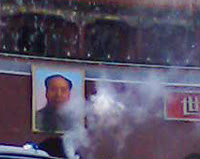
During riots
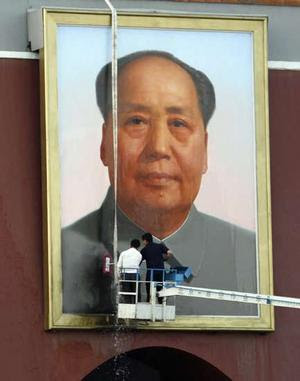
Tiananmen incident ... workers clean the picture of Chairman Mao at the entrance to the Forbidden City in Beijing.
On Saturday, May 12, an unemployed Xinjiang man lobbed an incendiary device at the iconic portrait of Mao Zedong that hangs over the entrance to the Forbidden City (or the Palace Museum as the Chinese call it). Here's a photograph, taken on a mobile phone camera, of Mao's portrait burning. The witness who took the photograph was driving by moments after the painting caught alight and said he saw flames coming from the bottom of the portrait, then some sort of foam shooting upwards, presumably from the fire brigade, to extinguish the fire, then just the smoke.
In the south-west, villagers have been rioting over oppressive enforcement of China's one-child policy. Coverage of both events was censored within China, but footage of the rioting in Guangxi has been widely posted on blogs accessible in Hong Kong, which although returned to Chinese rule in 1997, under the one country, two systems deal worked out with the British, enjoys a greater deal of press and other freedoms for the first 50 years of its post-colonial life.
International media such as CNN have also broadcast footage of the aftermath of the rioting, but predictably whenever the story was promoted as ''coming up next'', or the footage shown, the television screen went blank, although technical glitches meant mainland viewers still got the announced headline of the story. Such clumsy censorship is common on any stories considered sensitive by the Government, despite satellite or cable stations such as CNN and BBC (the BBC website is banned in China, although the broadcast station is not) being ostensibly only permitted in diplomatic compounds, residential areas where foreigners live, big hotels etc, far away from the eyes of most ordinary Chinese. But of course this is China, and anyone who wants satellite television can simply pay for a dish ... hence the need to censor sensitive topics in case such events - as rioting villagers fed up with corrupt or overzealous bureaucrats - gets too widely disseminated and creates flow-on social unrest, ie. gives people ideas.
The Government's justification for censorship is that its overriding interest is to maintain social order. In the case of the attack on Mao's portrait, many Chinese, who still respect and even revere the late paramount leader who, for all his subsequent mistakes, restored China's pride after a century of humiliation at the hands of Western powers, would be outraged. And many people understand and accept, even if they don't like, the Government's one-child policy because as people are wont to say ''it is for the good of the nation''. The issue in Guangxi appears to be not so much the policy as such but the corrupt and brutal way the authorities chose to enforce and collect fines. So why can't the Chinese public be allowed to know of and debate such issues?
The State Departments, Ministeries of nations able to facilitate a 'FREER press' in countries capable of providing it have to provide guidelines for the practice. The Safe Practice. Promoting unrest recklessly without good alternatives in government can lead to anarchy and with a population of one billion people that is a lot hardship. Responsible journalism that brings the issues of the populous to the attention of authority without risk of disrupting the society so much that it can't care of it's people is the only way a professional standard can be developed. This isn't pity. It is knowing the power of knowledge, the power of information, the power of motivation and applying it responsibly.
Countries with different structure than the USA, the EU, Australia and the like need to ALLOW a transcendence of the 'authority' of journalism that provides quality of life. In the USA the politics are the 'release' for the change people seek. In countries like China, respect of authority while bring people closer to that authority and will move mountains without victimizing the professionals that seek a better life for the towns, city, hamlets and villages. Countries like China and Russia get such a bad rap from the press in countries they trade with that it causes a deterioration of the quality of life within it's borders. These countries don't need diminishment of their poeple, they need a higher dignity placed on them.
Bridging the professional gap between journalism and government while promoting positive experiences of press corps internationally will make the journalistic experience more fulfilling for all people. I have yet to see 'on the ground' promotion of the 2008 Olympics from Chinese journalists that can provide insight and interviews from the 'workers' in China that took pride in their efforts to make it all possible. Why?

During riots

Tiananmen incident ... workers clean the picture of Chairman Mao at the entrance to the Forbidden City in Beijing.
On Saturday, May 12, an unemployed Xinjiang man lobbed an incendiary device at the iconic portrait of Mao Zedong that hangs over the entrance to the Forbidden City (or the Palace Museum as the Chinese call it). Here's a photograph, taken on a mobile phone camera, of Mao's portrait burning. The witness who took the photograph was driving by moments after the painting caught alight and said he saw flames coming from the bottom of the portrait, then some sort of foam shooting upwards, presumably from the fire brigade, to extinguish the fire, then just the smoke.
In the south-west, villagers have been rioting over oppressive enforcement of China's one-child policy. Coverage of both events was censored within China, but footage of the rioting in Guangxi has been widely posted on blogs accessible in Hong Kong, which although returned to Chinese rule in 1997, under the one country, two systems deal worked out with the British, enjoys a greater deal of press and other freedoms for the first 50 years of its post-colonial life.
International media such as CNN have also broadcast footage of the aftermath of the rioting, but predictably whenever the story was promoted as ''coming up next'', or the footage shown, the television screen went blank, although technical glitches meant mainland viewers still got the announced headline of the story. Such clumsy censorship is common on any stories considered sensitive by the Government, despite satellite or cable stations such as CNN and BBC (the BBC website is banned in China, although the broadcast station is not) being ostensibly only permitted in diplomatic compounds, residential areas where foreigners live, big hotels etc, far away from the eyes of most ordinary Chinese. But of course this is China, and anyone who wants satellite television can simply pay for a dish ... hence the need to censor sensitive topics in case such events - as rioting villagers fed up with corrupt or overzealous bureaucrats - gets too widely disseminated and creates flow-on social unrest, ie. gives people ideas.
The Government's justification for censorship is that its overriding interest is to maintain social order. In the case of the attack on Mao's portrait, many Chinese, who still respect and even revere the late paramount leader who, for all his subsequent mistakes, restored China's pride after a century of humiliation at the hands of Western powers, would be outraged. And many people understand and accept, even if they don't like, the Government's one-child policy because as people are wont to say ''it is for the good of the nation''. The issue in Guangxi appears to be not so much the policy as such but the corrupt and brutal way the authorities chose to enforce and collect fines. So why can't the Chinese public be allowed to know of and debate such issues?
Title: INTERNAL FRAGMENTATION OF THE NEWS.
Any profession has to have control over their standards and expertise in order to maintain them. How can the profession of journalism 'pass on' the necessary requirements in other venues of other countries if it hasn't maintained a standard 'thread' throughout the profession. There is a huge difference between daily news and tabloids, yet they are all lumped together under one umbrella of journalism. I don't consider "Lad Mags" a professional journal, BUT, there is nothing saying they cannot have profound articles and well paid professionals writing investigative journalism to 'bring up' the profession across the board. "Specializing" in entertainment has it's benefit, but, there has to be a way of translating that enjoyment into a serious tone that connects to a profession of excellance within the content of such publications and broadcasts. Professionalism has to be a part of Playgirl and a lead to an enthusiam that brings the readership to the front pages of The New York Times other than once a month. It's a form of outreach to benefit the profession as well as the circulation of magazines. Respect the reader and they will thrive under the professional standards that are enforced through ethics. Quality newsprint in every venue, audio rendition and visual media. A QUALITY that international authorities can recognize and strive to meet.
Ben-Porath, Eran N.
Source:
Journalism Studies; Aug2007, Vol. 8 Issue 3, p414-431, 18p
Unlike the edited news package, which dominates network and local news in America, the cable news channels recount the day's news predominantly through conversation, a format dubbed here dialogical news. At the center of this article is the concept of internal fragmentation, a consequence of the turn to conversation-based reporting, and its central implications: (1) the authority of the news reporter diminishes; (2) question-asking replaces fact-checking; (3) news organizations relinquish their accountability for news content; and (4) the news audience assumes the role of witness or participant rather than receiver. As dialogical news becomes prominent in the repertoire of viewers, short- and long-term prospects are suggested here. In the short-run, journalists are losing their battle to control their sources and maintain their gatekeeping function. In the long run, journalism might lose its significance as society's reflexive storyteller, reverting instead to its former role as a partisan instrument, a source of entertainment or a bit of both. [ABSTRACT FROM AUTHOR]
Ben-Porath, Eran N.
Source:
Journalism Studies; Aug2007, Vol. 8 Issue 3, p414-431, 18p
Unlike the edited news package, which dominates network and local news in America, the cable news channels recount the day's news predominantly through conversation, a format dubbed here dialogical news. At the center of this article is the concept of internal fragmentation, a consequence of the turn to conversation-based reporting, and its central implications: (1) the authority of the news reporter diminishes; (2) question-asking replaces fact-checking; (3) news organizations relinquish their accountability for news content; and (4) the news audience assumes the role of witness or participant rather than receiver. As dialogical news becomes prominent in the repertoire of viewers, short- and long-term prospects are suggested here. In the short-run, journalists are losing their battle to control their sources and maintain their gatekeeping function. In the long run, journalism might lose its significance as society's reflexive storyteller, reverting instead to its former role as a partisan instrument, a source of entertainment or a bit of both. [ABSTRACT FROM AUTHOR]
EMERGING MODELS OF JOURNALISTIC AUTHORITY IN MTV'S COVERAGE OF THE 2004 US PRESIDENTIAL ELECTION.


Somehow the Founding Father's of Journalism didn't imagine MTV as an authority. I realize in order to 'stimulate' voters to go to the polls it can be a 'trendy' issue. Rock the vote and all that, but, in all honesty whom is going to host this 'walk on the wild side' for journalism. It is a concern that 'trends' can 'take authority' in a profession so vital to connecting people to their own authority in expressing their vote. There needs to be a moderator capacity of the profession for new venues to maintain a 'standard.'
During the 2004 US presidential campaign, MTV produced an intriguing series of news reports, documentaries, and other programming designed to educate its youthful audience about the presidential election and democratic politics. The Choose or Lose series was an unlikely discursive blend, mixing MTV's usual fare of music, celebrity, and style, with serious information, issue coverage, and social advocacy. It also experimented with the parameters of journalistic authority, combining elements drawn from a traditional paradigm of professional journalism with a variety of alternative, emergent claims to credibility, in the hope of reaching a demographic that largely has "tuned out" from news and politics. To explore the changing nature of journalistic authority as articulated on MTV News, this study first develops a theory of discursive integration - the blending of once-distinct discursive domains, standards, and styles. It then identifies five potential models of journalistic authority constructed in the Choose or Lose series. It concludes by considering the implications of discursive integration and the ongoing re-conceptualization of journalistic authority for young people's engagement with broadcast journalism. [ABSTRACT FROM AUTHOR]
I looked through some professional journals to define the profession
It was diffuse. The profession has been very fluid and I am not sure it for the better or it's survival.
I believe practicing in multi-media is fine, it reaches readership. But, the fluidity of the profession in the year 2007 has brought a casualness to it that I believe falls outside the practice. Accepted. Sure, but, is it really journalism or the dumming down of the profession.
Are there ethical reviews of journalists as in the practice of law? There probably should be with an increase and not decrease in the specialty of 'investigative' journalism. It's disturbing to find the profession is moving away from the venue.
Journalism requires honesty and good faith (click on title)
By ROSEMARY MCLEODIt's no surprise that Kevin McNeil, son of murdered Tokoroa teacher Lois Dear, would get death threats. We like to crush people who speak out.
McNeil has had malicious calls since his mother's death, he revealed last week. Such bullying would have silenced many people, but he refused to tone down his victim impact statement at the killer's sentencing in spite of them.
Admittedly his initial outbursts were a bit rugged. He said he wanted the killer to "swing off the nearest tree". But by the time he made the statement that really mattered, time had passed, and he'd become more reasonable.
Who are the people who make furtive calls like this? I suspect they come from the same pool as people who write mean-spirited letters to newspapers, and to journalists. The late great Frank Haden used to insist that they all live in boarding houses, taking pen (red biro) to paper on wet Sundays when they have nothing to do but brood. The most virulent usually don't sign their offerings, and write in capital letters. Now that they have the internet to rant on, you rather miss that red ink. It gave fair warning.
The casual malice of such mail still gets to me sometimes; it can overpower kind and reasonable correspondence on a bad day. I always imagine its authors' families, postmen, neighbours, and the local body politicians they surely harass over easement disputes and stray cats. Why don't they take up something useful, like canasta, and give us all a break?
Last week I confessed in this column that I'd wept over an unpleasant magazine article targeting people I knew.
I believe practicing in multi-media is fine, it reaches readership. But, the fluidity of the profession in the year 2007 has brought a casualness to it that I believe falls outside the practice. Accepted. Sure, but, is it really journalism or the dumming down of the profession.
Are there ethical reviews of journalists as in the practice of law? There probably should be with an increase and not decrease in the specialty of 'investigative' journalism. It's disturbing to find the profession is moving away from the venue.
Journalism requires honesty and good faith (click on title)
By ROSEMARY MCLEODIt's no surprise that Kevin McNeil, son of murdered Tokoroa teacher Lois Dear, would get death threats. We like to crush people who speak out.
McNeil has had malicious calls since his mother's death, he revealed last week. Such bullying would have silenced many people, but he refused to tone down his victim impact statement at the killer's sentencing in spite of them.
Admittedly his initial outbursts were a bit rugged. He said he wanted the killer to "swing off the nearest tree". But by the time he made the statement that really mattered, time had passed, and he'd become more reasonable.
Who are the people who make furtive calls like this? I suspect they come from the same pool as people who write mean-spirited letters to newspapers, and to journalists. The late great Frank Haden used to insist that they all live in boarding houses, taking pen (red biro) to paper on wet Sundays when they have nothing to do but brood. The most virulent usually don't sign their offerings, and write in capital letters. Now that they have the internet to rant on, you rather miss that red ink. It gave fair warning.
The casual malice of such mail still gets to me sometimes; it can overpower kind and reasonable correspondence on a bad day. I always imagine its authors' families, postmen, neighbours, and the local body politicians they surely harass over easement disputes and stray cats. Why don't they take up something useful, like canasta, and give us all a break?
Last week I confessed in this column that I'd wept over an unpleasant magazine article targeting people I knew.
Journalism

I don't do this for sport everyday. I do it because I have long respected a profession vital to the democracy of the USA. It has been badly bruised and beaten since 2000 and there needs to be a reassessment of the practive domestically.
Since this administration has taken office the deaths and jailing of journalists globally has skyrocketed. This is the life blood of hope for people of all nations. For that reason I intend to attempt to begin a dialogue on what is best for the profession. The reason for the scrutiny of journalists internationally is not so much terrorist influence in societies but more the tightening of boarders and closing any chance that authority is challenged by unrest. The reason is simple. The Bush/Cheney administration is a threat, a known threat to global stability and the damage is directly related in the need of countries to define their sovereignty and reign in any discension. Hence. Journalism is the first rhelm of oppression.
To begin I see a broader responsibility for a profession in terms of setting up panels to develop guidelines for 'behavior' of journalists in the USA and a broad. Domestically the role of journalists need to be broadened and court decisions challenged. Internationally I propose a 'rating system' based in literacy or illiteracy, government and laws, population of the country and overall expertise of those that practice the profession within any country. A support if you will to develop an education process that can be measurable in diplomatic dealings to advance the profession in a responsible way along with the development of the country.
I don't see countries advancing without a press in place to connect people to their lifestyle choices, their government and social advances.
With a global rating system, the State Department can be held responsible in legislation to answer to the press organization of the USA as to the adverse arrests, detentions and deaths of collegues while demanding the 'art of journalism' be promoted along with and no different than child labor laws and environemental standards.

"Write it down" by George Strait
Write this down
Write this down
I never saw the end in sight
Fools are kind of blind
Thought everything was going alright
But I was running out of time
cause you had one foot out the door
I swear I didnt see
But if youre rally going away
Heres some final words from me
Stick it on your frigerator door
Hang it in a picture frame up above the mantel
Where you'll see it for sure
You can find a chisel, I can find a stone
Folks will be reading these words, long after were gone
Baby, write this down, take a little note
To remind you in case you didnt know
Tell yourself I love you and I dont want you to go
Write this down
You can find a chisel, I can find a stone
Folks will be reading these words, long after were gone
Take my words, readem everday
Keepem close by dont you letem fade away
So youll remember what I forgot to say
Write this down
Ill sign it at the bottom of this page
Ill swear under oath
cause every single word is true
And I think you need to know
So use it as a bookmark
Stick it on your frigerator door
Hang it in a picture frame up above the mantel
Where youll see it for sure
Stick it on your frigerator door
Hang it in a picture frame up above the mantel
Where you'll see it for sure
You can find a chisel, I can find a stone
Folks will be reading these words, long after we're gone
You can find a chisel, I can find a stone
Folks will be reading these words, long after we're gone
Oh I love you and I dont want you to go
Baby write this down
Write this down
I never saw the end in sight
Fools are kind of blind
Thought everything was going alright
But I was running out of time
cause you had one foot out the door
I swear I didnt see
But if youre rally going away
Heres some final words from me
Stick it on your frigerator door
Hang it in a picture frame up above the mantel
Where you'll see it for sure
You can find a chisel, I can find a stone
Folks will be reading these words, long after were gone
Baby, write this down, take a little note
To remind you in case you didnt know
Tell yourself I love you and I dont want you to go
Write this down
You can find a chisel, I can find a stone
Folks will be reading these words, long after were gone
Take my words, readem everday
Keepem close by dont you letem fade away
So youll remember what I forgot to say
Write this down
Ill sign it at the bottom of this page
Ill swear under oath
cause every single word is true
And I think you need to know
So use it as a bookmark
Stick it on your frigerator door
Hang it in a picture frame up above the mantel
Where youll see it for sure
Stick it on your frigerator door
Hang it in a picture frame up above the mantel
Where you'll see it for sure
You can find a chisel, I can find a stone
Folks will be reading these words, long after we're gone
You can find a chisel, I can find a stone
Folks will be reading these words, long after we're gone
Oh I love you and I dont want you to go
Baby write this down
Saturday, May 26, 2007
"It's Saturday Night" will assemble tomorrow night at 8:30 PM
Living with War (click here)


I believe in competent leaders, in all areas of the American experience. I have exhibited my disgust for the leadership of the Republican Party when it is based in extremist views, values and budgets that rob Americans of their lives, dignity while providing debt for generations that will never benefit from a safer world.
I have a presentation on journalism. I think it is unique and provides a 'new standard' or at least one forgotten. One that even China can find comfort. I look forward to presenting it to you. I have a surprise visitor for Memorial Day Weekend. It's lovely to realize people simply plan to come to enjoy the weekend unexpectedly. I love surprises when they are full of joy and excitement.
The link under the title of this blog by Michael Knight is entitled "Pat Tillman, Memorial Day and Veterans." Mr. Knight reflects strong sentiment I share. It's worth reading. It is in no way Anti-Americanism. It reflects people that realize their military is vital to a secure nation and a secure world, however, a breed of American that doesn't appreciate their patriotism and loyalty toyed with as occured under Richard Cheney and Don Rumsfeld twice in the USA's history. Shame on us, we should have known better. Oh. Wait. Some of us did.
We don't belong in Iraq.
We never did.
Bring the troops home now.
Oppose the draft.
Write your US House and Senate representative demanding impeachment.
Until tomorrow night ...


5 die in storm surge

May 25, 2007
Polvadera, New Mexico
Photographer states :: Green Storm - A different area of the sky showing the clouds from a fairly strong thunderstorm just passed through with 30mph winds, heavy rain, and a bit of hail. This is a single RAW image with minimal processing, just a little contrast adjustment.
Green clouds such as these are usually hail clouds. Dangerous stuff. Hail can accompany tornadoes.
"By Justin Cox
Killeen Daily Herald
Ravaging floodwaters claimed the lives of at least five people in the Killeen area in less than a 12-hour period during the overnight hours Thursday.
Three of the five victims met their fate in Killeen, and one man is still missing, while two others died in Copperas Cove.
Carroll Smith, public information coordienator for the Killeen Police Department, said authorities were called after a report of an overturned vehicle on Watercrest Drive between 8 and 9 p.m. Thursday. A woman and two of her children had been rescued from her white Ford Excursion.
But her two other children remained trapped in the vehicle and could not be rescued, Smith said, adding that the SUV was swept away in the swift current, eventually sinking below the surface.
Divers from the Morgan's Point Water Recovery Team were not able to locate the vehicle until 8:32 a.m. Friday, when the two boys, 5-year-old Jarvis Tarrance, and 6-year-old Javiante Tarrance, were recovered from the vehicle, stuck engine down in an estimated 18 feet of water that flowed across Watercrest Drive.
Justice of the Peace Garland Potvin pronounced the two brothers dead at just after 9 a.m.
Potvin said the mother and the two other children, a 3-year-old girl and a 7-year-old boy, owe their lives to a man who transported them from their flooding vehicle by canoe to the safety of the banks."
The mother drove the vehicle into the water, and it got picked up and carried it off the roadway," Potvin said. "He just heard the screaming, and he went and tried to help. He got in his canoe and paddled out there to help."
That guy saved three of them, because they wouldn't have gotten out of there by themselves, I don't believe."
Potvin said the height of the water at that location was unprecedented...."
This was a rough guestimate of the civilian toll as of November 4, 2006; three days before the majority shift.

It was Baghdad then and it still is. It would seem as though the USA military takes solice in applying "Lessons Learned" while civilians die. This is one of my favorite "Lessons Learned" by the USA military. It was post illegal invasion and the way Saddam's munitions, under UN Seal were never secured although they drove around them and through them, the bunkers were never considered significant to secure. Yep, one of my favorites.
Need ..... gov.
Following the invasion of Iraq in March 2003—known as ... on unsecured conventional munitions in Iraq, (2) report related risk mitigation ... conventional munitions storage sites in Iraq, combined with certain prewar planning ...
OVERVIEW:-->Following the invasion of Iraq in March 2003--known as Operation Iraqi Freedom (OIF)--concerns were raised about how the Department of Defense (DOD) secured Iraqi conventional munitions storage sites during and after major combat operations. Because of the broad interest in this issue, GAO conducted this work under the Comptroller General's authority to conduct evaluations.
This report examines
(1) the security provided by U.S. forces over Iraqi conventional munitions storage sites and
(2) DOD actions to mitigate risks associated with an adversary's conventional munitions storage sites for future operations on the basis of OIF lessons learned. To address these objectives, GAO reviewed ...
Background: Following the invasion of Iraq in March 2003--known as Operation Iraqi Freedom (OIF)--concerns were raised about how the Department of Defense (DOD) secured Iraqi conventional munitions storage sites during and after major combat operations. Because of the broad interest in this issue, GAO conducted this work under the Comptroller General's authority to conduct evaluations. This report examines (1) the security provided by U.S. forces over Iraqi conventional munitions storage sites and (2) DOD actions to mitigate risks associated with an adversary's conventional munitions storage sites for future operations on the basis of OIF lessons learned. To address these objectives, GAO reviewed ...
There was this report that I haven't found at the GAO yet. I would be nice if they would include a link to the report they refer to:
The number of attacks carried out by factions in Iraq’s overlapping conflicts has dipped slightly since the start of a new security plan but remains high, according to a US report released last week.The Government Accountability Office report recorded only the raw number of attacks, not the number of casualties, so it remains possible that a recent spate of large-scale car bombings had kept civilian deaths at record levels.
The GAO’s report into the problems facing US reconstruction efforts cites Pentagon figures showing the number of daily attacks peaked in October before dropping off in recent months, but remained twice as high as one year ago.“The US reconstruction effort was predicated on the assumption that a permissive security environment would exist. However, since June 2003, overall security conditions in Iraq have deteriorated”, the report said.“The average total number of attacks per day has risen from 71 per day in January 2006 to a record high of 176 per day in October 2006”, it added.“For the last three months, average attacks per day were 164 in February, 157 in March, and 149 in April 2007”.
The GAO used the Pentagon’s figures to compile its estimates, despite these being compiled using a methodology which has been much criticized in the past as likely to severely underestimate the true level of violence.
Last year’s report by a panel of senior American lawmakers and policy experts headed by former Secretary of State James Baker said the military’s method for recording attacks led to “significant underreporting of the violence”.
“For example”, it said, “on one day in July 2006 there were 93 attacks or significant acts of violence reported. Yet a careful review of the reports for that single day brought to light 1,100 acts of violence”.
Whether complete or not, the US government’s figures show a clear trend of escalating daily attacks since the invasion of March 2003, dipping slightly after the launch of a security operation in February this year.
"...Dipping slightly..." That justifies everything doesn't it. Slight dip. Bush has no conscience.
Just a reminder...
For quality of life, Baghdad ranks last in world, survey finds (click here). Who would have thought.


The Shape of a Shadowy Air War in Iraq
Turse, TomDispatch, 25 May 2007


Who's war is this anyway? I mean let's just give Bush all the money he wants and keep him smiling.
Leaving Iraq will not make the circumstances these people face worse, it will 'stabilize' them. The Iraqis have been taking care of themselves all this time, it won't change.
The role the holy men of Iraq play now is no different or dissimilar than that of someone like Nasrallah. It isn't preferable but for the Iraqis at least livable. I don't believe it can get worse from here. The 'scare' tactics/pleadings for continued war' simply don't hold water. The only issue at peril in Iraq is Baghdad. All the other provinces are reasonably stable. We leave Baghdad and it will find it's perscibed fate/gravity if you will. That IS what Bush is afraid of.
Sorry. Stability has it's virtue.
The USA is killing too, too many people. There are an average of 2 to 4 dead civilians for each of the 167,400 square miles of Iraq. Texas is 163696 square miles. Picture that for every square mile of Texas one would walk there would be two to four dead bodies. That is what the USA is doing in Iraq. If we were to leave it would not get worse, those statistics would improve.
BAGHDAD — The U.S. military Friday reported the deaths of seven more troops in Iraq, hours after President Bush warned that a bloody summer lay ahead.
Military officers in Baghdad predict that insurgents will seek to inflict maximum casualties before the top commander, U.S. Army Gen. David H. Petraeus, delivers a review of the troop buildup in September.
Three of the U.S. service members died Friday. One soldier was killed by small-arms fire in Baghdad province, another in a roadside bombing north of the capital, and a Marine died of noncombat causes in Al Anbar province, the military said.
On Thursday, a soldier was killed by small-arms fire and two died in bombings in Baghdad and north of the capital, the military said. One of the blasts also killed an Iraqi interpreter.
A U.S. soldier was killed Tuesday in an explosion near his vehicle in Baghdad province.
The deaths brought the number of U.S. personnel killed in Iraq since the start of the war in 2003 to 3,444, according to the website icasualties.org, which tracks military deaths and injuries.
At least 93 U.S. troops have died this month, putting May on course to be one of the deadliest months for the U.S. military in Iraq. Last month, 104 soldiers were killed, the sixth time since the war began that more than 100 troops died in a month.

Saturday, May 26, 2007
By Rupert Cornwell
President George Bush was able to sign the "no-strings" Iraq funding bill he demanded. But this is likely to be a short-lived victory, as domestic opposition to the war grows, and a bloody summer of fighting lies ahead.
Congress finally approved the $120bn (£60bn) measure by relatively comfortable margins yesterday. In the House the majority was 280 to 142 - even though more than half of the Democrats opposed a bill they considered a betrayal of the platform on which they won back control of Congress last November.
The Senate margin, of 80 votes for and 14 against, was even more conclusive. But Hillary Clinton and Barack Obama, the two leading contenders for the 2008 Democratic presidential nomination, both voted no - a sign of their fear of alienating the party's liberal anti-war constituency, so important in the upcoming primaries.
Unlike the initial funding measure which Mr Bush vetoed on 1 May, this one contains no timetable for an American troop withdrawal. It does lay down "benchmarks" for political progress by the Baghdad government, but even these can be waived by the President.
But for the White House the going is likely to get much tougher in the next few months, even before a new funding measure comes up for debate in September. The Senate and House will hold repeated votes on whether US troops should be pulled out, and whether Mr Bush even has the authority carry on the war.
By Rupert Cornwell
President George Bush was able to sign the "no-strings" Iraq funding bill he demanded. But this is likely to be a short-lived victory, as domestic opposition to the war grows, and a bloody summer of fighting lies ahead.
Congress finally approved the $120bn (£60bn) measure by relatively comfortable margins yesterday. In the House the majority was 280 to 142 - even though more than half of the Democrats opposed a bill they considered a betrayal of the platform on which they won back control of Congress last November.
The Senate margin, of 80 votes for and 14 against, was even more conclusive. But Hillary Clinton and Barack Obama, the two leading contenders for the 2008 Democratic presidential nomination, both voted no - a sign of their fear of alienating the party's liberal anti-war constituency, so important in the upcoming primaries.
Unlike the initial funding measure which Mr Bush vetoed on 1 May, this one contains no timetable for an American troop withdrawal. It does lay down "benchmarks" for political progress by the Baghdad government, but even these can be waived by the President.
But for the White House the going is likely to get much tougher in the next few months, even before a new funding measure comes up for debate in September. The Senate and House will hold repeated votes on whether US troops should be pulled out, and whether Mr Bush even has the authority carry on the war.

The Shape of a Shadowy Air War in Iraq
Turse, TomDispatch, 25 May 2007
Does the U.S. military keep the numbers of rockets and cannon rounds fired from its planes and helicopters secret because more Iraqi civilians have died due to their use than any other type of weaponry?
These are just two of the many unanswered questions related to the largely uncovered air war the U.S. military has been waging in Iraq.
What we do know is this: Since the major combat phase of the war ended in April 2003, the U.S. military has dropped at least 59,787 pounds of air-delivered cluster bombs in Iraq -- the very type of weapon that Marc Garlasco, the senior military analyst at Human Rights Watch (HRW) calls, "the single greatest risk civilians face with regard to a current weapon that is in use." We also know that, according to expert opinion, rockets and cannon fire from U.S. aircraft may account for most U.S. and coalition-attributed Iraqi civilian deaths and that the Pentagon has restocked hundreds of millions of dollars worth of these weapons in recent years.
Unfortunately, thanks to an utter lack of coverage by the mainstream media, what we don't know about the air war in Iraq so far outweighs what we do know that anything but the most minimal picture of the nature of destruction from the air in that country simply can't be painted. Instead, think of the story of U.S. air power in Iraq as a series of tiny splashes of lurid color on a largely blank canvas.
Cluster Bombs
Even among the least covered aspects of the air war in Iraq, the question of cluster-bomb (CBU) use remains especially shadowy. This is hardly surprising. After all, at a time when many nations are moving toward banning the use of cluster munitions -- at a February 2007 conference in Oslo, Norway, 46 of 48 governments represented supported a declaration for a new international treaty and ban on the weapons by 2008 -- the U.S. stands with China, Israel, Pakistan, and Russia in opposing new limits of any kind.
Little wonder. The U.S. military has a staggering arsenal of these weapons. According to a recent Human Rights Watch report, the Army holds 88% of the Pentagon's CBU inventory -- at least 638.3 million of the cluster bomblets that are stored inside each cluster munition; the Air Force and Navy, according to Department of Defense figures, have 22.2 million and 14.7 million of the bomblets, respectively. And even these numbers are considered undercounts by experts.
A cluster bomb bursts above the ground, releasing hundreds of smaller, deadly submunitions or "bomblets" that increase the weapon's kill radius causing, as Garlasco puts it, "indiscriminate effects." It's a weapon, he notes, that "cannot distinguish between a civilian and a soldier when employed because of its wide coverage area. If you're dropping the weapon and you blow your target up you're also hitting everything within a football field. So to use it in proximity to civilians is inviting a violation of the laws of armed conflict."

President Gerald R. Ford, center, with Chief of Staff Donald H. Rumsfeld, left, and Rumsfeld's assistant, Dick Cheney, on April 28, 1975. (By David Hume Kennerly -- Ford Library Via Associated Press)
For those that seem to think Bush is correct. Well, for about 24% of the country (click here) the fact of the matter is, the man that 'called off' Vietnam would do the say with Iraq. To 'stop the killing' in Iraq there has to be a USA exit of that country, especially now, there will be more and more aggression by the Bush/Cheney military and the slaughter of people will be astronomical again.
...According to the survey, which was conducted May 18-23, more than three out of four citizens (76 percent) now believe the Iraq war is going badly, up from 66 percent just a month ago. (May 25, 2007)...
Muqtada. Muqtada. Muqtada. The West is emboldened againt him. They need a scapegoat to justify occupation.

In his recent appearance he looks well. I congratulate him for marshalling the Shia forces under a Fatwa. Very interesting. His father's son.
The foolishness of the Western Press is that upon his return the USA has lead a successful attack on Sadr City. For one, he isn't in Sadr City, which is East Baghdad. He never has been there. So any titles in the media spoken or print or video tempting people of The West to believe the Cleric is under seige in Baghdad is a lie. It's not nice to lie and deceive when American troops lives are on the line while lining the pockets of billionaires. Shame on them all. As a matter of fact the so called attack by the USA into Sadr City was completely botched killing innocent people.
Sadr uses dramatic reappearance to deliver blast of anti-US rhetoric (click here)
Saturday, May 26, 2007
By Patrick Cockburn
The nationalist Shia cleric Muqtada al-Sadr has reappeared before thousands of supporters for the first time in months to call for American troops to end the occupation of Iraq.
In an impassioned sermon to 6,000 worshippers in a mosque in the holy city of Kufa al-Sadr, wearing a white martyr's cloak thrown over his dark robes, he cried: "No, no to Satan! No, no to America! No, no to the occupation! No, no to Israel!"
He had appeared earlier in the morning in the nearby shrine city of Najaf to travel in a long motorcade to Kufa to deliver the Friday sermon.
Mr Sadr, leader of a powerful Shia political movement and the much-feared Mehdi Army militia, disappeared some four months ago, evidently fearing that he would be targeted by the US. But he stood down his militiamen as the US Army introduced a security plan for Baghdad and avoided an all-out confrontation with the US.
In his sermon yesterday he forcefully demanded an end to the US-led occupation and offered reconciliation to Sunni Arabs. The Sadrist movement, founded by Muqtada's murdered father, Mohammed Sadiq al-Sadr, in the 1990s, has always been nationalist but the Mehdi Army is hated by many Sunnis for its death squads and sectarian cleansing.
Surrounded by guards and aides in Kufa al-Sadr, Mr Sadr declared: "I renew my demand for the occupiers to leave or draw up a timetable for withdrawal, and I ask the government not to let the occupiers extend the occupation even for one day." He has removed six Sadrist ministers from the government, citing its failure to set a timetable for American departure.
Mr Sadr's demand for an end to the occupation is likely to resonate in Iraq where the Sunni community has favoured this since the invasion of 2003 and the majority Shia community has increasingly wanted a timetable for a withdrawal, according to opinion polls. The Sadrists have been meeting with anti-al-Qa'ida Sunni tribal leaders from Anbar to discuss forming a common front. Sectarian suspicions between Shia and Sunni are so deep and bitter, however, that differences will be difficult to bridge.
There has been escalating intra-Shia fighting in southern Iraq over the past two months with skirmishes in all the main Shia cities. Often the police and security forces are simply militiamen in uniform.
Yesterday, Mr Sadr condemned fighting between the Mehdi Army and Iraqi security forces, saying that this served "the interests of the occupiers". He said that he preferred peaceful protests and sit-ins.
In an attempt to refurbish his reputation as a non-sectarian nationalist, Mr Sadr said he was ready to co-operate with Sunnis "on all issues". He added: "I am completely ready to defend them [Sunnis and Christians] and be their armour against their enemies."
Mr Sadr has been out of Iraq in Iran and Lebanon according to one of his aides, abandoning the Sadrist claim that he never left Iraq. He seems to have returned about a week ago, at which time Iraqis talking to Sadrist leaders noticed that they seemed to be able to reach him rapidly by phone on landlines, though there are no landlines to Iran.
His return now is probably explained by the damage his prolonged absence was doing to his movement. It is very dependent on the cult-like devotion felt towards the 33-year-old Mr Sadr by millions of poor and devout Shias.
Previously unheard of by the outside world, he emerged as a surprisingly powerful leader in 2003 at the time of the fall of Saddam Hussein. He inherited much of the authority of his father, who was assassinated with two of his sons by Saddam Hussein's agents in Najaf in 1999.
The Sadrist movement's blend of Islam, Iraqi nationalism and populism has proved highly attractive to Shia, particularly those who are very poor. The US tried and failed to eliminate Mr Sadr in two armed confrontations in April and August 2004. The Sadrist movement survived and went on to do well in the parliamentary elections of 2005, gaining 32 seats in the 275-member national assembly and six ministerial posts.
A further reason for Mr Sadr's return now is the growing competition between his supporters and those of the Supreme Islamic Iraqi Council (SIIC) led by the ailing Abdul Aziz al-Hakim, who has been diagnosed with lung cancer. SIIC, formed under Iranian auspices in Tehran in 1982, has been trying with some success to rid itself of the imputation that it is subservient to Iran. The Sadrists, by contrast, were traditionally hostile to Iran but under US pressure have increasingly come to depend on Tehran's support.
The Sadrists and SIIC are the main components of the United Iraqi Alliance, the Shia front supported by Grand Ayatollah Ali al-Sistani and the religious hierarchy or Marjai'iyyah. Much though they dislike each other, they will be under pressure from the grand ayatollah not to divide the Shia community.
Iraq is a pilgram's haven. The Shia have their holiest lands in Iraq. There are going to be Iranians in Iraq all the time because of personal pilgramages to their holy land. These Iranians will be armed and I would not be surprised to find they are in possession of substantially armed escorts. Did the USA know there is a war torn nation still in chaos of leadership, food, water and medical care? Maybe they didn't know that to 'get around' Iraq one travels well armed and in multiples to add maximum protection to 'that movement.' Makes sense, huh? So no matter whom in Iraq the USA decides to 'target' is guilty because they carry arms. One would think the NRA is in it's glory in Iraq. Arm the nation. Isn't that the rant of the NRA? Right? Sure, why not?
US military says five Iraqi militants killed in Sadr City raid
US-led forces seized a suspected militant with ties to Iran and killed five others in an early morning raid in the east Baghdad Shiite stronghold of Sadr City on Saturday, the US military said.
However, an Iraqi defence ministry official said an air strike launched in support of the ground raid hit cars lined up to purchase gas at a nearby petrol station, and that those killed were innocent civilians.
The US military statement said the man detained in the raid had been "acting as a proxy for an Iranian Revolutionary Guard Corps officer," and smuggling explosively formed penetrators (EFPs) to local militias.
It added that five people were killed when troops called in an air strike after nine vehicles moved into the area following the arrest in an apparent attempt to resist the operation.
The Iraqi official disputed this version and said the cars hit in the air strike had been waiting to fill up with gas, a common pre-dawn scene in a city where shortages are common and lines often stretch for several blocks.
The military official added that several houses were destroyed and six vehicles incinerated, in the raid.
A local hospital official reported receiving three bodies and eight wounded people following the battle.
The United States has long accused Iran of supplying EFPs, sophisticated explosive devices that discharge a ball of molten metal capable of tearing through an armoured vehicle, to Shiite militias.
The United States and Iran frequently accuse each other of fomenting violence in Iraq, but on Monday their respective ambassadors will hold landmark meetings in Baghdad aimed at slowing Iraq's spiralling mayhem.
Saturday's raids came one day after radical Shiite cleric Moqtada al-Sadr reappeared from a four-month absence to deliver a Friday sermon calling for national reconciliation and the departure of US and British forces.
Sadr called on his forces to refrain from fighting the Iraqi Army and Iraqi police, but a few hours later Iraqi special forces with British support killed one of his senior commanders while trying to detain him at Basra checkpoint.
Sadr's well-armed but increasingly fractured Mahdi Army militia has largely cooperated with a three-month-old US-led security crackdown in the capital, but rogue elements continue to battle coalition and Iraqi forces.
Doesn't anyone beside me recognize propaganda? The article below from The Washington Post outlines what USA intelligence 'estimates' to be expected in Iraq. Where have you heard it before now? Here? Most of it. The al Qaeda mess is irrelevant. The so called "Al Qaeda in Iraq" has proven to be a violent entity against primarily The Shia of Iraq. They are known to be Sunnis. Look. There just aren't that many 'bad guys' in Iraq. They aren't international terrorists. Not even close. There will never be a perfect Middle East until the Shia, Sunnis and Israelis settle their disputes with international intervention promoting good behavior with good economics. Can we please get on with this. It would be good if the USA left Iraq. I don't care how many 'sympathy stories' The Western Media puts out of the hardship in Iraq of the people there. I really don't. Those stories on tell me loud and clear what a mess the USA is making of that country. Sooner or later the USA has to come to terms with it's defeat in Iraq and return to 'the real war' currently floundering badly in Afghanistan. PLEASE GET OVER THIS. Innocent Iraqis are dying in large numbers. The CHAOS in Iraq will end when it isn't confused with an illegal war by Bush and Cheney. Jeeze. The Iraq War, also known as 'Exponential Corruption.'
Analysts' Warnings of Iraq Chaos Detailed (click here)
Senate Panel Releases Assessments From 2003
By Walter Pincus and Karen DeYoungWashington Post Staff WritersSaturday, May 26, 2007; Page A01
Months before the invasion of Iraq, U.S. intelligence agencies predicted that it would be likely to spark violent sectarian divides and provide al-Qaeda with new opportunities in Iraq and Afghanistan, according to a report released yesterday by the Senate Select Committee on Intelligence. Analysts warned that war in Iraq also could provoke Iran to assert its regional influence and "probably would result in a surge of political Islam and increased funding for terrorist groups" in the Muslim world.
The intelligence assessments, made in January 2003 and widely circulated within the Bush administration before the war, said that establishing democracy in Iraq would be "a long, difficult and probably turbulent challenge." The assessments noted that Iraqi political culture was "largely bereft of the social underpinnings" to support democratic development.
A Fatwa called and honored will eliminate any meaningful reason for the USA to occupy Iraq any further. The USA is now an enemy to a martyred war. The Shia in the Iraqi military and police will be 'moved' to honor the Fatwa. The Shia in the Iraqi Unity Government will be feeling their obligations in the face of the USA military and their generals. This is not the USA's war. Iraq will divide into there autonomous provinces, the Iraq 'oil obligation' to the USA due to the illegal invasion of Bush/Cheney will desolve along with Iraq's sovereignty. There will be a Shiastan, Sunnistan and Kurdistan. The alliances are clear, Sunni-Saudi, Shia-Iran, and alas the Kurds. Ah, the Kurds. Well, they already have their eyes set on an expansive country encompassing all of Kurdistan including 'Turkish occupied' lands. It's reality. It will happen and there isn't a darn thing The West can do about it except realize 'it's place' and learn to thrive 'within that reality' through abundant and peaceful trade initiatives. I am not going to discuss the Iranian enrichment facility; I have already done that; it cannot be tolerated. Russia has the best option for Iran and any illegitimate nuclear country.
Subscribe to:
Posts (Atom)