Global Warming/Climate Change
Global warming the biggest worry, Clinton tells forum
24 February 2006
By JANNA HAMILTON
Former American president Bill Clinton told 600 of New Zealand's top business people their greatest worry in the world was global warming.
Mr Clinton held his audience in Auckland captive for one hour as he talked about global conflicts, global warming and how the richer nations could help.
He was introduced by Prime Minister Helen Clark who welcomed him back for his third visit.
After his speech he answered four submitted questions read by Miss Clark. Organisers would not allow questions from the floor.
Mr Clinton was speaking at a high-powered business forum in Auckland which also featured Michael Eisner, the former chief executive of Walt Disney, Carly Fiorina, the chief executive of Hewlett Packard for six years until last year, and Jack Perkowski, the chairman and chief executive of ASIMCO Technologies, the most successful western business in China.
It was one of the most costly business functions the country has seen.
A single ticket cost $2400 but that reduced to $1895 if it was bought before January 31.
Advertisement
Advertisement
Private meetings with Mr Clinton cost a lot more.
Small group hourly bookings cost $5000 a head (excluding GST). For that paying guests got a handshake, a photograph and a chance to mingle with the only Democratic president in the last 60 years to win two terms.
Larger group bookings of about 50 people cost up to $150,000.
http://www.stuff.co.nz/stuff/0,2106,3583391a11,00.html
Global Warming Shifts from Theory to Reality
BY CHRISTINE NIELSEN
Anyone who has lived in the Northeast of the United States for at least a couple of years can testify that this winter has been abnormally warm. Though winter has cracked back occasionally and with a vengeance—such as the largest snowstorm in New York on record, which hit the city the week before last—in general the words most often used to describe the weather recently are “unseasonable” and downright “weird.” Another phrase that has been frequently thrown around is “global warming.” Though there has always been some disagreement in the scientific community about the real and significant results of the greenhouse effect, the evidence to support the theory of human-induced, worldwide, and significant climate change is accumulating. Though the anecdotal evidence felt by the Bard community does not have scientific weight, many studies published recently do.
To start with, climatologists at NASA’s Goddard Institute for Space Studies published a report last month stating that 2005 was the warmest year in a century, adding that the Earth has warmed a total of 1.44 degrees Fahrenheit in the past 100 years, but 1.08 degrees in the past 30 years. Though 1.44 degrees may sound like a pittance, its effects are proving otherwise. The results of global climate change, once a far-off seeming prediction, are now being seen and felt all over the world, from Greenland, to Tanzania, to the Gulf Coast of the United States.
A little less than the size of Mexico, the Greenland Ice Sheet would raise the ocean levels by 23 feet if it melted altogether. And according to research conducted at NASA’s Jet Propulsion Laboratory at the California Institute of Technology in Pasadena, California, the rate at which the Ice Sheet is melting has more than doubled in the past ten years. In 1996 the Ice Sheet was losing 90 cubic kilometers of ice per year—last year it lost 224 cubic kilometers of ice. This research, the first of its kind to be done regarding Greenland, was published in last month’s edition of the journal Science. Of course, given the magnitude of the Earth’s oceans, even a loss of 224 cubic kilometers of ice per year only contributes .5 millimeters to the over 3 millimeters of global water level increase per year. More disturbing than the increase of water level, however, is the effect that overall colder ocean waters could have on climate change. Europe, for one, and also much of North America, rely heavily on hot currents within the ocean to warm their peripheries. With the oceans becoming colder due to the melting of polar ice, those hot currents could cool and possibly cease altogether, leaving Europe in a mini Ice Age.
In 2002, Lonnie Thompson, professor of geological sciences at Ohio State University, and his fellow researches made the prediction that the ice fields of Mt. Kilimanjaro would recede and eventually disappear between 2015 and 2020 due to global warming. Though Thompson had some skeptics at the time, it is now evident that his prediction is coming true, maybe even faster than was anticipated. According to data collected by Thompson and colleagues, 56 feet of ice has melted off of the top of the fields since 1962, meaning that the fields are melting at an average rate of more than half a meter per year, and that rate is only accelerating—no new ice has formed on the peak for six years now.
While the melting of polar ice happens at such a rate that it may be hard to foresee the effects in the next decade, Mt. Kilimanjaro is another story. If the ice fields melt entirely by 2020 as is expected, both the income brought in by tourism and the water supplied to local people by ice melts will be in jepoardy.
Though it is true that the Earth has experienced other periods of global warming in its history, a new study by researchers at the University of California, Santa Cruz, states that the rate of warming today is 30 times what it would have been at any other time. James Zachos, a professor of earth sciences at Santa Cruz and a leading expert on the episode of global warming known as the palaeocene-eocene thermal maximum, was quoted by the Independent as saying, “The emissions that caused this past episode of global warming probably lasted 10,000 years. By burning fossil fuels, we are likely to emit the same amount over the next three centuries.” Though the oceans are always working to remove carbon from the air, Zachos says the magnitude of past and continuing greenhouse gas emissions have overwhelmed the oceans’ natural capacity for cleansing. “It will take tens of thousands of years before atmospheric carbon dioxide comes down to pre-industrial levels,” says Zachos. “Even after humans stop burning fossil fuels, the effects will be long-lasting.”
More than a year has passed since Dr. Rajendra Pachauri, the chairman of the official Intergovernmental Panel on Climate Change, shocked the Bush administration--which lobbied strongly for his appointment--and many others by issuing the dire statement, “Climate change is for real. We have just a small window of opportunity and it is closing rather rapidly. There is not a moment to lose,” adding, “We are risking the ability of the human race to survive.” Though the Bush administration has admitted that global warming poses a significant threat to the welfare of the country, it has yet to take serious action to severely curb the United States’ greenhouse gas emissions, even at this critical juncture.
http://observer.bard.edu/articles/news/186
Frisco addresses global warming
Get News Feeds
HARRIET HAMILTON
summit daily news
February 23, 2006
The town of Frisco took its first steps last week toward addressing the issue of global warming when the town council approved a resolution to adopt an official environmental stewardship policy.
The resolution calls for all town employees to consider environmentally sustainable practices in all operating and budgetary decisions.
"It will have an impact on every single department in the town," Frisco community development director Mark Gage said.
Buying recycled paper products, putting timers on building lights, increasing thermal efficiency when building new buildings and using biodiesel energy are all possible ways for the town to implement the policy, Gage added.
The resolution addresses environmental sustainability in general, but is specific about the issue of global warming.
"The international scientific community has reached consensus that human activities are warming the planet, and with its mountain setting and proximity to some of Colorado's major ski resorts, Frisco is on the front lines of climate change ...," the resolution reads.
Buildings account for about half of U.S. energy consumption, Gage said, and energy consumption leads to global warming.
"Where change really needs to start is with buildings," he said.
Gage emphasized the importance of action at the local level.
Global warming is becoming an important issue for mountain communities that depend on ski resorts for economic viability. Snowpack is already decreasing over much of the American West, according to "Less Snow, Less Water: Climate Disruption in the West" - a report released by the Rocky Mountain Climate Organization (RMCO), a Louisville-based advocacy group that monitors climate change in the region.
What snowpack there is, the report goes on to say, melts earlier. A small increase in nighttime temperatures could have a devastating effect on the ski industry.
The town of Frisco joined forces with a handful of other Colorado municipal governments, including Aspen, Boulder and Fort Collins, when it became a member of RMCO last fall. Councilmember Tom Looby credited Frisco's town character with the impetus for the resolution.
"We (the town council) reflect the strong environmental emphasis of our citizens," he said.
The city of Aspen is taking a particularly aggressive approach to reducing its climate-warming emissions. Last spring, the city launched its "Canary Initiative," named after the traditional practice of keeping a caged canary in underground mines to detect deadly gases. As part of the initiative, the city, in partnership with the Aspen Skiing Company and area environmental groups, formed the Aspen Global Warming Alliance to study the area's climate change and facilitate implementation of environmentally sustainable policies.
Frisco is keeping its eye on Aspen, Gage said.
"We're waiting to see where the Canary Initiative goes," he said. "It may be that we can partner with them down the road. It's a possibility that we can use a lot of information they're generating."
http://www.summitdaily.com/article/20060223/NEWS/102230037
Global warming the real terror
By Judy Cannon - posted Friday, 24 February 2006
Can we ease up for a moment? Desist from the drum-beating and the alarums? Hush the television interviews, the pronouncements and the what-ifs? Put the terror button on pause for a spell and maybe stop and think? What is the extent of current dangers to us and in what form do they lurk?
What do the facts and figures tell us? For within them maybe we can discern some context, some sense of balance, some reality.
In October 2002, Muslim terrorists detonated two powerful bombs that destroyed Paddy's Club Café and Sari Club Café in Bali’s tourist district when 88 of the 202 people killed were Australian.
We had earlier grieved and been horrified at New York’s loss of life after al-Qaeda supporters flew aircraft, and passengers, into the Twin Towers. We were saddened at the loss of life at Madrid, London and other targets of terrorist activity. We sincerely feel for those families who have had to endure the bad news.
It is sensible to guard against terrorism but it also necessary to see it in perspective and in context with other dangers. Britain was attacked for years by IRA terrorists but sought to deal with it within democratic limits and controlled alarm.
Fear of terrorism and new technology have provided governments with the open sesame to introduce severe (and maybe anti-democratic) anti-terrorism legislation. People in power can always be tempted to go too far, clamping down on the freedom of people and freedom of speech. Once politicians get the bit between their teeth, they don’t seem able to stop themselves. It is the public that has to reign them in.
Fear breeds fear. Look at the US, now with a presidential licence to spy on its own citizens; look at the past bad ways of the old Communist Soviet Union and consider Putin’s Russia; and wonder too about China.
In Australia recent severe anti-terror legislation, including the reintroduction of sedition laws, caused deep consternation, but nevertheless it was passed by parliament with the help of the Opposition. Now the Federal Attorney-General Philip Ruddock has decided it is necessary to have legislation to allow police to tap the phones of people not suspected of crime (ABC, February 16, 2006).
He has introduced a Bill into parliament designed to formalise the powers of police and intelligence agencies to access phone calls, text messages and emails of suspects. The law would also allow police to tap the phones of friends and family of a person under investigation for major crimes or terrorism offences. That could be your emails, phone calls and text messages, as well as mine. This is all under the terrorism-fear umbrella.
Therefore it is useful to consider current facts and figures to put terror concerns in context and perspective. Regretfully, we lost 88 Australians in the Bali terror bombing, but, concurrently we lose nearly 1,500 Australians each year in road fatalities. In 2005 the number of road deaths was 1,635, the previous year the figure was 1,598. Since record-keeping commenced in 1925, there have been over 169,000 road fatalities in Australia. This dreadful and unnecessary loss of life receives scant publicity given the huge number of people who die on the roads annually.
Other unexpected deaths include the victims of murder which in 2004 numbered 254 for the whole of Australia, (attempted murder 304), and manslaughter, 35. The 2005 totals are not yet available.
Australian service people killed on operations to date (February 21, 2006) since March 2003 total eleven. Nine were on a humanitarian helicopter mission at Nias Island, Indonesia; one serviceperson died in the Solomon Islands and one in the Middle East.
These figures prompt the question: is the terrorism drum being banged too loudly? Especially, when other hazards are mammoth in comparison?
Take for example, the dangers of climate change, the watered down name for “global warning”. Scientists around the world have been telling us that the danger is real enough. And that although hopefully something still in the future, action to minimise its effects needs to be undertaken immediately. To do that of course, we first have to debate and discuss.
However, recently a senate committee was informed that the former minister for science, Peter McGauran, had tried to influence the CSIRO to sever ties with the Wentworth Group of Respected Scientists who are concerned about the environment (Sydney Morning Herald, February 17, 2006).
The CSIRO's chief executive, Geoff Garrett, has denied that his organisation "gagged" scientists after a Labor senator, Peggy Wong, questioned him on allegations that scientists, including CSIRO’s Professor Mike Young, a member of the Wentworth Group, and former CSIRO scientist Dr Graeme Pearman, who advocated government involvement in reducing greenhouse gases, had been prevented from speaking about climate change. Dr Pearman told ABC Four Corners (February 13, 2006) that CSIRO scientists were muzzled and he had at times been censored. He said, “Just before I was made redundant I was actually head of CSIRO’s climate program. This is a multi divisional program that tries to bring together the researchers in 14 of CSIRO’s 20 divisions that have relationships to the climate change issue.” In other words, he knows what he is talking about.
To look again at some facts and figures: recent natural disasters have included the earthquake and resulting Boxing Day 2004 tsunami when about 275,000 people died in Sumatra, Indonesia, Sri Lanka, South India, Thailand, and other countries including the east coast of Africa. The furthest recorded death occurred at Port Elizabeth, South Africa, 8,000kms away from the epicentre.
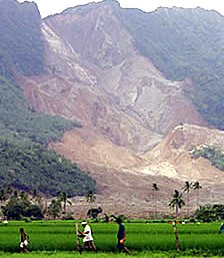
There was the earlier Papua New Guinea earthquake in 1998 which killed at least 3,000; Hurricane Katrina, which hit US New Orleans, killed about 1,300 in January 2006 and the current Philippines mud slide is believed to have claimed about 1,800.
Global warming has been mooted as the likely cause of Hurricane Katrina. To claim global warning as the cause for all natural disasters mentioned would be to initiate a scientific bun fight, but people died just the same. So perhaps we (and the government) should start to listen to the scientists more carefully. The first warnings about global warming could be heard in the 1980s but most of us did not grasp the significance.
Is Nature in revolt? Or are we really doing it to ourselves? And what should we and governments do about it? This is the really urgent matter.
We need to pull the heads of the government out of our communication garbage bins and instead, persuade them to face up to the most important threat of the century. We need to get them to really listen to the scientists, both here and overseas, for they are warning about a much greater terror.
http://www.onlineopinion.com.au/view.asp?article=4194
Ctrip Cites Global Warming As Growth Catalyst
CTRP, Ctrip, Internet
Posted by: elias on Feb 24 09:02
Apparently, small rises in the global temperature are helping Chinese online travel services provider Ctrip sell more air tickets and hotel reservations.
During Ctrip's fourth quarter conference call, in response to a question from Jason Breuschke of Citigroup about Ctrip's suprisingly strong fourth quarter, Ctrip chairman James Liang said "the weather is getting warmer every year; the fourth quarter [this year] was not as cold as in earlier years, so leisure travel picks up a little bit and that contributes to hotel [bookings] and the air [ticketing business] and [travel] packages. So that also helps us a little bit."
When I am sitting in my uninsulated Shanghai aparment in February, I sometimes begin to think that maybe global warming could help me out a little bit too.
Have any analysts factored the annual global temperature change into their projections for Ctrip's future earnings?
http://www.pacificepoch.com/blog/54223_0_27_0_C/
The Copenhagen Post
24.02.2006
Friday
Partly to mostly sunny.
Highs between 1 and 4° C.
Friday night: Clear.
Lows down to -8° C.
Saturday
Clouds on the increase as a front moves down from the north.
Flurries possible.
Temperatures between 0 and 3° C.
Saturday night: Clearing.
Lows between -5 and -1° C.
Sunday
Partly cloudy.
Highs around 0° C.
Sunday night: Chance of snow or flurries.
Temperatures falling to between -5 and -1° C.
Monday
Partly sunny.
Temperatures between -3 and 0° C.
Monday night:
Clouding up.
Flurries possible.
Temperatures between -8 and -3° C.
DMI
http://www.cphpost.dk/get/94180.html
City councillors tired of illegally parked caravans want to build a five-star campground on Amager
Copenhagen city councillors are considering whether to build a new five-star campground in the Amager district, daily newspaper Berlingske Tidende reported on Friday.
The council will take up the proposal at its next meeting, but Claus Bondam, the deputy mayor for infrastructure and environmental issues, said the proposal was likely to pass.
'Copenhagen lacks a camping site close to the city,' he said, adding that the best choice for a site would be Amager Fælled, a large common on the outskirts of Copenhagen.
'It's close to the city, green spaces, the beach, and it's very, very easy to find,' he said.
The site is 15 minutes from the centre of the city, close to an underground station, and an existing hostel.
The city said a possible campground would have room for as many as 300 guests, and would aim for a rating of four or five stars.
Construction and operation would be contracted out to a private firm, but preparing the area would cost the city as much as DKK 400,000.
The Danish Camping Union was positive about the idea, as long as it lived up to modern campers' expectations.
'There's enough room and demand for another campground in Copenhagen, but it needs to be something where the surroundings, the facilities, and the sanitary facilities are top-shelf,' said Bjarne Jensen, president of the camping union.
Copenhagen already has a campground at the other end of the city, in the Bellahøj neighbourhood. But Bondam said age and increased interest in city camping meant the city needed a second one.
Bondam pointed out that the proposal to create a second campsite in the city comes as police report an increasing number of illegally parked caravans.
http://www.cphpost.dk/get/94184.html
Housing price increases will level off during the coming year, predict major banks
Major Danish banks expect a soft landing for a red-hot real estate market in 2006 after years of double-digit increases.
Economists expected a mere 5 percent increase in housing prices compared to a nationwide average of 21.6 percent last year.
The booming real estate market, especially in Copenhagen and other major cities, had led some analysts to fear that the market was inflated. They were also concerned that speculation had contributed to the price rises.
Now, they predict that rising interest rates would slow the galloping market, after surprisingly strong German business figures led to a rate hike for the seventh day in a row.
The development will directly affect homeowners with variable interest rate loans that are closely linked to the European Central Bank.
Senior analyst Jes Asmussen of Nordea bank welcomed the development.
'It's actually quite reasonable since interest rate increases take the top off the drastic housing price increases,' said Asmussen to financial daily Børsen. 'We expect continued interest rate hikes, but not to a degree that will be a problem and lead to a collapse of the real estate market.'
Dansk Bank's senior Steen Bocian also predicted a gradual levelling off.
'A quarter percentage increase in interest rates reduces price increases on the housing market by 2.5 percent in the long run,' he said. 'In other words, it's nothing dramatic, and we expect continued housing price increases despite the higher rate.'
http://www.cphpost.dk/get/94183.html
Warnings of the imminent arrival of bird flu has not meant that consumers are passing up the chicken for other meat
Concern that bird flu may be making its way towards Denmark is not causing consumers to stop buying poultry, several of the nation's supermarket chains say.
In other EU countries, the sale of poultry has fallen by as much as 70 percent. Danish consumers, however, continue to dish up fowl.
'We haven't really noticed many consumers asking about it,' said Jens Juul Nielsen, a spokesman for supermarket chain Coop Denmark, to daily newspaper Politiken.
As news began to spread last week that birds in Germany had died of the H5N1 influenza virus, grocers began fearing the worst.
A knee-jerk reaction by consumers resulted in a 50 percent drop in the sale of chicken, according to the Association of Danish Grocers.
Though neither Coop nor other major grocery chains have noticed a sustained fall in sales, they have created working groups to prepare for a possible outbreak in Denmark.
One of the primary tasks of the groups is to keep an open line to food and health authorities and poultry suppliers.
'There's not much else we can do. There's no reason to panic about something that isn't even here,' said Morten Petersen of Dansk Supermarked.
The government has repeatedly told consumers that bird flu is primarily an economic worry for poultry farmers.
Health officials continue to test dead birds found in the wild to determine the cause of death. None of the tests have been positive, but experts say the virus will arrive at some point.
Members of parliament supported the government's measures to prevent fear of bird flu from running amok.
'It's important that we let people know what the risks are involved with bird flu, and tell consumers that there's no reason not to eat poultry,' said opposition MP Bjarne Laustsen.
http://www.cphpost.dk/get/94067.html
BBC Europe
Hosepipe bans call in South East
Drought-hit region needs water
Water companies in south-east England are being urged to bring in hosepipe bans to avoid the introduction of more extreme water-saving measures.
A report from the Environment Agency made the recommendation, saying the region was in a "serious situation".
The period from October 2004 to January 2006 was the driest in some parts of the South East since 1921.
Rainfall has been low across most of England and Wales, but the south of England has been the driest area.
http://news.bbc.co.uk/2/hi/uk_news/england/4744862.stm
Winter drought fears for wildlife
By Mark Kinver
BBC News science and nature reporter
Low rainfall has raised concerns of a drought this summer
Concern is growing for flora and fauna in some parts of the UK because rainfall levels are well below the average for winter months.
Scientists say trees and fish could suffer in the summer because of the lack of rain to replenish water stocks.
A second successive dry winter has left some areas with groundwater and river levels well down on what they should be for this time of the year.
South-east England is the area worst affected by the lack of rainfall.
http://news.bbc.co.uk/1/hi/sci/tech/4739922.stm
Worse than 1976?
By Alexis Akwagyiram
BBC News
Bewl Water Reservoir on the Kent/ Sussex border is only 37% full
Extreme water-saving measures may be necessary in parts of England if a shortage is not addressed. BBC News considers how the situation compares to the drought of 1976 and how water can be conserved.
Parts of south-east England face a "serious situation" regarding water shortages, according to the Environment Agency.
By way of explanation, it points out that the period from October 2004 to January 2006 was the driest in some parts of the South East since 1921.
http://news.bbc.co.uk/1/hi/uk/4746368.stm
Not feeling the heat over fuel price rises
By Stephen Robb
BBC News
Energy price rises have prompted fresh warnings about more Britons shivering into "fuel poverty", with campaigners complaining some people are forced to choose "between heating and eating".
The government aims to eradicate fuel poverty in vulnerable homes
Sixty-five-year-old Pam Greenhalgh, who lives alone in Northwich, Cheshire, admits she "will skip a meal here or there, or have hot drinks sometimes instead of a meal" to make savings.
"As long as I have got my cup of tea, I don't care," she adds stoically.
Fuel poverty is defined as spending more than 10% of income on heating and power.
http://news.bbc.co.uk/2/hi/uk_news/4744866.stm
Milosevic medical plea rejected
Mr Milosevic's health problems have delayed his trial
The UN war crimes tribunal in The Hague has rejected a request by Slobodan Milosevic to be allowed to go to Russia for medical treatment.
The former Yugoslav president, on trial for alleged war crimes, has high blood pressure and a heart condition.
The court said his lawyers had not satisfactorily proved that Mr Milosevic's medical needs could not be met in the Netherlands.
It also said it feared Mr Milosevic might not return to continue the trial.
Mr Milosevic, 64, is facing charges of genocide and other war crimes.
http://news.bbc.co.uk/2/hi/europe/4746232.stm
Suspected bird flu on French farm
The German military has been deployed to collect dead birds
France has found a suspected case of the deadly bird flu virus H5N1 on a poultry farm, the farm ministry says.
If confirmed, it would be the first time a farm bird has been infected in France, where two wild ducks have tested positive in the south-east.
Officials in Germany say further tests carried out on a domestic duck thought to be infected with the H5N1 strain have shown it does not have the virus.
Meanwhile, Slovakia has found its first H5N1 cases in a wild falcon and grebe.
http://news.bbc.co.uk/2/hi/europe/4742536.stm
Chirac leads Jewish youth service
Mr Chirac (C) led religious and political leaders at the service
French President Jacques Chirac has attended a memorial for a young French Jew whose killing shocked the nation.
Ilan Halimi was held for three weeks then found naked with horrific injuries, dying on the way to hospital.
The suspected head of the kidnap gang, Youssouf Fofana, has been held in Ivory Coast and his extradition is expected to be completed shortly.
French ministers have suggested the crime may be anti-Semitic but Ivorian police say Mr Fofana has denied this.
http://news.bbc.co.uk/2/hi/europe/4744676.stm
Design probe after Moscow deaths
The designer of a collapsed Moscow market has been questioned as construction flaws are suspected of having contributed to 57 deaths there.
Heavy lifting gear is being used to clear the rubble, as the authorities believe no more survivors can be found.
The market's designer Nodar Kancheli had also planned Moscow's Transvaal water park, which collapsed in 2004, killing 28 people, Russian media said.
A huge build-up of snow on the market's roof was also blamed for the disaster.
http://news.bbc.co.uk/2/hi/europe/4746500.stm
Bird disaster hits Estonia coast
By Laura Sheeter
BBC News, Estonia
The authorities still do not know who caused the oil spill
International volunteers and Estonian conservationists are trying to save the last surviving birds caught in an oil spill in the frozen Baltic Sea.
The slick appeared off Estonia's north-west coast in late January.
"I'm wearing four layers of clothes, a down suit and a dry suit, and you can still feel the cold through all that," says one rescuer standing on the ice.
"But what else can we do? We can't just leave the birds to die."
The spill, the source of which is still unknown, is estimated to have killed 35,000 birds, making it by far the worst Estonia has experienced.
http://news.bbc.co.uk/2/hi/europe/4733418.stm
Russia's abandoned HIV children
By Emma Simpson
BBC News, Moscow
Russia has one of the fastest growing Aids epidemics in the world, with 100 new infections every day. Increasingly, women and their infants are being affected.
Latest figures show 22,000 babies have been born to HIV-positive women. And many are being abandoned by their mothers into the care of the state.
Many HIV-positive mothers give up their babies to the Russian state
The four babies in the maternity ward in the city of Tver were just a few days old and blissfully content.
But two of them had been abandoned by their HIV-positive mothers, who were either too ashamed or unable to cope.
They ought soon to have been heading to one of Russia's regular baby orphanages, but the two newborns are likely to be stuck here in this state-run infectious diseases hospital instead.
If they are lucky it will be only for 18 months - the time it takes doctors in Russia officially to diagnose whether children are HIV-positive.
http://news.bbc.co.uk/2/hi/europe/4735006.stm
Living with race hate in Russia
By Patrick Jackson
BBC News website, Moscow
Juldas Okie Etoumbi, a postgraduate international relations student at Moscow's RUDN university, remembers well his first encounter with a Russian.
Gabriel Kotchofa says the number of prosecutions is minute
Standing in a Moscow Metro carriage for the first time, the young Gabonese man was thrown forward when the train started with a jolt and he grabbed a pole to keep his balance, brushing the Russian man's hand.
Without a word, the Russian withdrew his hand, produced a handkerchief and proceeded to wipe it demonstratively in front of the other passengers.
Christian, a former electrical engineering student from Cameroon now working in Moscow, was recently assaulted by a group of about 10 teenagers on a Metro train in the city centre.
http://news.bbc.co.uk/2/hi/europe/4737468.stm
Mayor is suspended over Nazi jibe
Mr Livingstone said he was expressing his honestly-held view
London's mayor has been suspended from office for four weeks for comparing a Jewish journalist to a concentration camp guard.
The Adjudication Panel for England ruled Ken Livingstone had brought his office into disrepute when he acted in an "unnecessarily insensitive" manner.
The ban is due to begin on 1 March, but Mr Livingstone's representative said he may appeal to the High Court.
The hearing followed a complaint from the Jewish Board of Deputies.
http://news.bbc.co.uk/2/hi/uk_news/england/london/4746016.st
Family escape harm in gun attack
Two shots were fired in the attack in Londonderry
A couple and their two-year-old daughter have escaped injury in a gun attack at their home in Londonderry.
The 22-year-old woman said she believed paramilitaries had "mistaken her partner for someone else".
A masked gunman fired two shots shattering a window in the house at Bradley Park in the Shantallow area at about 2330 GMT on Thursday.
Two accomplices then kicked the front and back doors of the house, but failed to gain entry.
http://news.bbc.co.uk/2/hi/uk_news/northern_ireland/4746268.stm
Third person held over £50m raid
Raid reconstruction
A third person has been arrested by detectives investigating the raid on a Securitas depot in Kent in which armed robbers got away with up to £50m.
Police said the woman, 41, was detained in Bromley, south-east London, at the Portman Building Society on Thursday.
It followed the arrest of a man, 29, and a woman, 31, in south London on conspiracy-related charges.
Three vehicles involved in the robbery have been found, but not the lorry used to transport the money, police said.
Officers said the depot manager's car, the Nissan Almera, had been found, together with the Volvo used to pull over Colin Dixon.
http://news.bbc.co.uk/2/hi/uk_news/england/kent/4745856.stm
Go-ahead for Europe ice mission
By Helen Briggs
BBC News science reporter
Cryosat: Mission guide
The Cryosat mission lost in the Arctic Ocean last year minutes after launch from northern Russia will fly again.
The European Space Agency (Esa) has agreed to build a copy of the original £90m (135m-euro) craft.
Early estimates suggest Cryosat-2 could be ready to launch in three years.
The mission will study how the Earth's ice sheets are responding to climate change amid mounting evidence that some areas are thinning.
http://news.bbc.co.uk/2/hi/science/nature/4745168.stm
Friday, February 24, 2006

Morning Papers Southern Pacific
Global Warming/Climate Change
Rival militias drive fear
February 24, 2006
BAGHDAD: Menacing militiamen in trucks intimidated the few motorists moving along darkening Baghdad streets yesterday after the bombing of a Shia shrine left Iraqis fearing they were on the brink of sectarian civil war.
Political and religious leaders called for calm - but the tense streets, jumpy police and lines of people stockpiling food in case violence spins out of control suggested otherwise.
"We don't know what could happen in the next few days," said Mohammed Tariq, standing in a long line queuing outside a bread shop. "I will buy as much as I can because of the security situation."
http://www.theaustralian.news.com.au/common/story_page/0,5744,18255005%255E601,00.html
Shrine a most sacred site
February 24, 2006
THE Askariya shrine is among Iraq's most sacred sites for Shia Muslims, containing the tombs of the 10th and 11th imams, Ali al-Hadi, who died in 868AD, and his son, Hassan al-Askari, who died six years later.
The landmark golden dome was completed in 1905 under Muzaffar al-Din Shah.
The shrine is near the place where the last of the 12 Shia imams, Mohammed al-Mahdi, disappeared. Mahdi, known as the "hidden imam", was the son and grandson of the two imams buried in the shrine.
The shrine is in Samarra, 95km north of Baghdad, one of the four Shia holy cities in Iraq. It was built by Caliph al-Mutasim in 836 to replace Baghdad as the capital of the Abbasid Caliphate, and was abandoned in 892.
http://www.theaustralian.news.com.au/common/story_page/0,5744,18255007%255E601,00.html
West's plea: step back from precipice
Correspondents in Washington and Tehran
February 24, 2006
WESTERN and Muslim leaders are urging Iraqis to stand back from the precipice of civil war after the bombing of a revered Shia shrine sparked deadly reprisals against Sunni mosques and worshippers.
US President George W. Bush denounced the blast and pleaded for calm as crowds attacked 50 Sunni mosques, in a rage over the destruction of the golden dome on Samarra's 1000-year-old Imam Ali al-Hadi mausoleum.
"I ask all Iraqis to exercise restraint in the wake of this tragedy and to pursue justice in accordance with the laws and constitution of Iraq," Mr Bush said in a statement yesterday.
http://www.theaustralian.news.com.au/common/story_page/0,5744,18255011%255E601,00.html
Baghdad bid may leave AWB in cold
Steve Lewis and Cath Hart
February 24, 2006
MARK Vaile will press Iraq to buy Australian wheat even if the nation's monopoly wheat exporter AWB is excluded from the deal.
The Deputy Prime Minister, who will lead a mission to Iraq to save hundreds of millions of dollars in lost wheat sales, said yesterday he wanted a "clear indication" Iraq would "consider Australian wheat through another exporter if necessary to go into that tendering process".
Mr Vaile confirmed yesterday that AWB chairman Brendan Stewart had been dropped from the rescue mission to Iraq amid concerns that his presence would jeopardise Australia's hopes of snaring the lucrative deals.
Despite being excluded from the trip, AWB sought to pacify angry grain growers yesterday by pledging to fight to keep its monopoly hold on wheat exports. At a rowdy annual shareholders' meeting in Melbourne, Mr Stewart said he would battle "tooth and nail" to retain the single desk for wheat exports.
http://www.theaustralian.news.com.au/common/story_page/0,5744,18255386%255E601,00.html
Michael Costello: Realism over idealism
But democracy has to be our ultimate goal
February 24, 2006
IN 1989, an unknown middle-ranking officer in the US State Department, Francis Fukuyama, leapt to prominence with an article, The End of History, in Washington journal The National Interest.
His basic theme was not that the human narrative had stopped. Rather, his thesis was that the course of history showed that the principle of liberal democracy was the final resting point for human ideological evolution. There was in his work a sense of historical determinism, that liberal democracy must prevail. As he said in an interview in 1990, if all the remarkable gains for democracy in the Soviet Union and eastern Europe in the previous year were reversed, he "would still believe my theory is true". Fukuyama's subsequent book argued for free market capitalism as the ultimate economic model, although he noted industrialisation and economic modernisation did not always equate to liberal democracy.
http://www.theaustralian.news.com.au/common/story_page/0,5744,18251387%255E601,00.html
The Sydney Morning Herald
Firefighters battle Sydney bushfire
Firefighters are battling to contain a bushland blaze in Sydney's north west before it jumps a creek and ignites heavy loads of dry scrub and leaf litter.
The fire started about 2.20pm (AEDT) today at Excelsior Reserve in Baulkham Hills and has destroyed more than three hectares of bush, a fire spokesman said.
More than six crews are working to extinguish the fire before it reaches Darling Mills Creek.
"It's in quite an inaccessible area at the moment and they're trying to extinguish it before it crosses a creek and hits some heavy fuel loads," the spokesman said.
http://www.smh.com.au/news/national/firefighters-battle-sydney-bushfire/2006/02/24/1140670254949.html
Bronzed Aussie
February 24, 2006 - 7:56AM
Australia's Alisa Camplin shows off her bronze medal at this morning's ceremony for the women's aerials freestyle skiing Olympic event.
Picture: Reuters
AdvertisementAdvertisement
Alisa Camplin celebrated has been presented with her medal for finishing third in the freestyle aerials event at the Winter Olympics.
The 31-year-old was all smiles as she accepted the bronze at a ceremony in Turin early this morning AEST.
Camplin finished behind winner Swiss Evelyne Leu and China's Li Nina in the event.
It had been a remarkable accomplishment by the 2002 Games champion who struggled to even make these Winter Olympics after knee surgery in October.
http://www.smh.com.au/news/sport/bronzed-aussie/2006/02/24/1140670231470.html
Bones harvested from 1000 corpses
Four men were charged in New York today with illegally harvesting bones and organs from more than 1,000 corpses, including the bones of the late veteran BBC broadcaster Alistair Cooke.
In a scheme described by a US District Attorney Charles Hynes as "something out of a cheap horror movie", the four men allegedly made millions of dollars selling body tissue to transplant companies.
In many cases, the bones were replaced by PVC pipes so their theft would not be noticed at a funeral.
http://www.smh.com.au/news/world/bones-harvested-from-1000-corpses/2006/02/24/1140670230277.html
Shrine bombing: Sunnis give a lesson in how to start a civil war
ANALYSIS
THE dawn attack on the gilded dome of Samarra's Askariya shrine is rightly a cause for great anxiety. In the eyes of their enemies, the worst any of Iraq's waring parties might do is to desecrate a mosque.
But this is not any old mosque. As an act of religious vandalism the bombing of the Golden Mosque, as it also is known, is on a par with firing a rocket-propelled grenade into St Peter's Basilica or laying improvised explosive devices in the aisles of Canterbury Cathedral.
As they confront furious outpourings of Shiite anger, world and Iraqi leaders are clutching at the calculated sacrilegiousness of the bombing as the only argument that might hold Iraqis back from a crazed descent into civil war.
http://www.smh.com.au/news/world/sunnis-give-a-lesson-in-how-to-start-a-civil-war/2006/02/23/1140670212254.html
Christians burn Muslim corpses in Nigeria
Christian youths have burned the corpses of Muslims on the streets of Onitsha in south-eastern Nigeria.
The city is the worst hit by religious riots that have killed at least 138 people across the country in five days.
Christian mobs, seeking revenge for the killings of Christians in the north, have attacked Muslims with cutlasses, destroyed their houses and torched mosques in two days of violence in Onitsha, where at least 85 people have died.
http://www.smh.com.au/news/world/christians-burn-muslim-corpses-in-nigeria/2006/02/24/1140670234953.html
Trapped rescuers pulled from landslide mud
GUINSAUGON, Philippines: Taiwanese rescuers at the site of a massive Philippine landslide had to be rescued themselves yesterday after getting stuck in treacherous mud.
A US Marine Chinook helicopter plucked the Taiwanese from the middle of the wasteland after they became marooned in a vast, shifting field of mud. Search operations were later suspended at the devastated village of Guinsaugon.
Seven members of the Taiwan rescue team were pulled out in the morning after heavy overnight rain at the site.
http://www.smh.com.au/news/world/trapped-rescuers-pulled-from-landslide-mud/2006/02/23/1140670212266.html
Philippine coup bid sparks emergency law
Philippine President Gloria Arroyo invoked emergency rule today after security forces said they had foiled a coup attempt.
The declarations triggered street clashes.
Police used water cannons to disperse about 5,000 protesters defying a ban on rallying at a shrine to the "people power" uprising that toppled dictator Ferdinand Marcos.
Tomorrow is the 20th anniversary of his ouster.
The military barricaded its camps to keep troops from joining the demonstrations and detained an army general allegedly involved in the takeover plot.
http://www.smh.com.au/news/world/philippine-coup-bid-sparks-emergency-law/2006/02/24/1140670256157.html
Lawyers swept up files, inquiry told
TWO months after the fall of Saddam Hussein, the wheat exporter AWB hired an outside law firm that gathered up hundreds of documents and emails on the company's dealings with Iraq and took them off the premises, the Cole inquiry heard yesterday.
The senior in-house lawyer for AWB, Jim Cooper, told the inquiry that Project Rose, launched in June 2003, was one of the largest legal investigations undertaken by the company, ultimately involving three large law firms and two barristers.
It was designed to discover whether AWB, its managers and staff were legally exposed for breaching UN sanctions on Iraq and bribing Iraqi officials to win wheat sales under the UN's oil-for-food program.
http://www.smh.com.au/news/national/lawyers-swept-up-files-inquiry-told/2006/02/23/1140670205128.html
Drag-dressing director to clean up Hollywood
James Bond filmmaker Lee Tamahori has been sentenced to three years' probation and ordered to help clean up Hollywood after being arrested in drag during a prostitution swoop.
New Zealander Tamahori, 55, who also directed the 1994 award-winning film Once Were Warriors, was arrested in Hollywood on January 8.
He allegedly entered an undercover policeman's car while clad in women's clothes and offered to perform a sex act for money, according to Los Angeles police.
http://www.smh.com.au/news/world/drag-director-gets-probation/2006/02/24/1140670248412.html
Scientists doubt virus has arrived
ONCE the avian flu virus has reached Papua New Guinea it will quickly spread to Australia, carried by migratory birds, a World Health Organisation expert has warned.
Dr Luo Dapeng, who is in PNG helping authorities prepare for the virus, said: "If something happens here, I think Australia cannot escape."
However, doubts have been cast on claims by two leading Australian scientists that the H5N1 strain is probably already here. Professor Aileen Plant, of the Australian Biosecurity Co-operative Research Centre, said it was very unlikely the virus had reached Australia's shores.
http://www.smh.com.au/news/national/scientists-doubt-virus-has-arrived/2006/02/23/1140670205172.html
Costello to violent Muslims: get out
THE Treasurer, Peter Costello, has criticised "confused, mushy, misguided multiculturalism" and told Muslim immigrants to leave violent cultural baggage at the door.
His criticism of Muslims who do not respect Australian values appears designed to present a conservative social image to repair his damaged leadership campaign.
"Before entering a mosque visitors are asked to take off their shoes," he told the Sydney Institute last night. "This is a sign of respect. If you have a strong objection to walking in your socks, don't enter the mosque.
http://www.smh.com.au/articles/2006/02/23/1140670205134.html
Weaker sex's sins exposed
February 18, 2006
Page 1 of 4 Single page
Men have failings as investors, writes Simon Hoyle.
GETTING a man to stop the car and ask for directions is like, well, getting a man to stop and ask for directions. New research suggests men are also less likely than women to ask for directions - or follow them - when investing in managed funds.
The landmark research, released last week by BT Financial Group, gives a compelling insight into the behaviour of managed fund investors.
Conducted by a team from the University of Western Australia headed by associate professor Ray da Silva Rosa, the study looked at the behaviour of 850,000 BT investors in 210 retail managed funds over a period of some 30 years.
http://www.smh.com.au/news/money/weaker-sexs-sins-exposed/2006/02/17/1140151812613.html
Qantas workers prepare to strike
QANTAS heavy maintenance workers are mobilising for strike action after the national carrier unexpectedly called off enterprise bargaining talks with unions yesterday.
Adding confusion to the situation, Qantas chief executive Geoff Dixon called off a briefing slated for this morning where he was expected to announce whether the airline would outsource its widebody heavy maintenance overseas.
Qantas's head of people, Kevin Brown, said Qantas called off the "engineering transformation" update because of last-minute delays but said a decision was imminent.
http://www.smh.com.au/news/business/qantas-workers-prepare-to-strike/2006/02/23/1140670207955.html
Feeling peaky (Blog)
Glad tidings of great joy: there could be a straightforward medical explanation for at least three of the world's major religions.
Moses, Mohammed, and Jesus all experienced revelations on mountains, but they were probably just suffering a form of altitude sickness, say a group of Swiss and Israeli neurologists, casting doubt in the process on the very existence of God.
All three felt, heard or saw a presence, experienced lights and felt afraid, say the brain scientists from Lausanne, Geneva and Jerusalem. But so have contemporary mountaineers who are more interested in ice picks and thermal undies than anything mystical - suggesting the dizzy heights may have the effect of turning ordinary mortals into prophets.
"Different functions relying on brain areas such as the temporo-parietal junction and the prefrontal cortex have been suggested to be altered in altitude," they write in the marvellous journal Medical Hypotheses, which is positively boastful about giving a run to bright new ideas that haven't been through the usual discouraging process of scientific peer review.
"Moreover, acute and chronic hypoxia significantly affect the temporo-parietal junction and the prefrontal cortex and both areas have also been linked to altered own body perceptions and mystical experiences."
http://blogs.smh.com.au/dissection/archives/2006/02/feeling_peaky.html
The New Zealand Herald
Clinton cruises into City of Sails
24.02.06
By Anne Beston and Stuart Dye
Apparently fully recovered from a bout of "Delhi belly", Bill Clinton arrived in Auckland early today on the final leg of a speaking tour expected to earn him more than $1 million.
The globe-trotting former United States President flew in from Australia on a private jet after speaking engagements in Sydney and Melbourne.
He touched down at Auckland Airport at 12.30am for his third visit to New Zealand. He and his entourage were met amid tight security by a motorcade including limousines, four-wheel-drive vehicles and a van.
Forty minutes later he checked into SkyCity's Grand Hotel, where a luxury suite can cost $3200 a night.
Mr Clinton's speech, to be delivered to the Global Business Forum at SkyCity's convention centre, is expected to be broadly similar to that delivered in Australia, touching on war, terrorism and HIV/Aids.
He told Australian audiences it was important all nations had a chance to participate in and benefit from a global economy but currently half the world's population was being left out.
In a world becoming increasingly interdependent, the next 40 to 50 years would see greater emphasis on nations developing not just economically but "politically and socially", he said.
Co-operation between countries was the best way to fight terrorism and while the UN and the World Trade Organisation were "not perfect", they were the best way to deal with global threats and meet global challenges.
Mr Clinton also warned of the threat posed by global warming and the melting of the Greenland icecap.
http://www.nzherald.co.nz/section/story.cfm?c_id=72&objectid=10369838
Roof of Russian market caves killing 56
24.02.06 10.15am
By Guy Faulconbridge
MOSCOW - A Moscow market roof collapsed, possibly under the weight of snow, killing at least 56 people and trapping many in the rubble, emergency services said.
Rescue workers with sniffer dogs were searching for survivors trapped under twisted metal and concrete as smoke billowed from the market's ruins.
An Emergency Ministry spokesman put the death toll from the early morning accident at 56 with 32 injured. But emergency workers at the scene said the toll could rise further.
http://www.nzherald.co.nz/section/story.cfm?c_id=2&ObjectID=10369859
Celebrities club together for Charlotte fundraiser
24.02.06
By Stuart Dye
Charlotte Cleverley-Bisman's fight for life against meningitis was only the beginning. Now two years old, she and her parents face a new battle - giving her the best chance in life possible.
At just six months, Charlotte became the face of the meningococcal vaccine campaign after the disease ravaged her body, leaving her with stumps instead of arms and legs.
Yesterday, she found herself centre of attention once again, as 23 celebrity teams played golf and held a charity auction.
http://www.nzherald.co.nz/section/story.cfm?c_id=72&objectid=10369798
Diana crash photos cost paparazzi €1
24.02.06
PARIS - A French court has ordered three photographers to pay €1 damages for taking pictures of Dodi al-Fayed and Diana, Princess of Wales, on the night of their fatal accident in 1997.
The ruling by the Paris Appeal Court is - depending on interpretation - a vindication, or a slap in the face, for Dodi's father, Mohammed al-Fayed, who forced the case to be re-opened last year.
The three press photographers - Jacques Langevin, Fabrice Chassery and Christian Martinez - will have to pay the multi-millionaire Fayed €1 between them for taking pictures of the couple inside their car before and after the accident in Paris on August 31, 1997.
They must also pay up to €6000 to cover the cost of publishing the court ruling in three French newspapers.
The ruling is a vindication of Fayed's refusal to accept two earlier French court rulings - in 2003 and 2004 - that the photographers were merely doing their job (mostly at the commission of British popular newspapers). Following an appeal by Fayed, the Supreme Court overturned these rulings last year and ordered the case to be reheard. The Court of Appeal found the photographers guilty of infringing French privacy laws.
http://www.nzherald.co.nz/section/story.cfm?c_id=72&objectid=10369762
Sharon has abdominal procedure, says hospital
23.02.06 10.20am
JERUSALEM - Israeli Prime Minister Ariel Sharon, incapacitated by a January 4 stroke, underwent a procedure to remove fluids in his abdominal cavity today and remained in critical but stable condition, his hospital said.
http://www.nzherald.co.nz/section/story.cfm?c_id=72&objectid=10369681
Moss named most stylish British woman of all time
21.02.06 5.00pm
By Genevieve Roberts
From mukluk Eskimo boots to vintage waistcoats, Kate Moss can start a fashion trend just by walking down the street.
As if confirmation were needed that the model's iconic status has not been destroyed by last year's public cocaine scandal, and the following loss of lucrative modelling contracts with Chanel and Burberry last year, she has now been voted the most stylish British woman of all time.
The 32-year-old model from Croydon, who recently ended a relationship with Babyshambles singer Pete Doherty after she spent a month in a rehabilitation clinic in Arizona, came top of a poll of more than 5,000 readers of Grazia magazine, followed by actresses Sienna Miller and Keira Knightley.
http://www.nzherald.co.nz/section/story.cfm?c_id=72&objectid=10369414
Top US general praises NZ role in Afghanistan
24.02.06
By Ruth Berry
The top-ranking commander of United States forces in the Middle East has praised New Zealand's contribution in Afghanistan, saying it has been "very helpful to the coalition".
General John Abizaid met Prime Minister Helen Clark in Wellington yesterday during a short visit to New Zealand.
His stopover came two days after Foreign Affairs Minister Winston Peters raised eyebrows when he said the US did not give New Zealand the credit it deserved for its role in the Pacific.
Asked about the issue, General Abizaid said: "I can't say what role I think that New Zealand would play in the Pacific but I can tell you that New Zealand's role in Afghanistan has been very helpful to the coalition.
http://www.nzherald.co.nz/section/story.cfm?c_id=1&ObjectID=10369794
Banks to pay $10b for Enron 'misdeeds'
24.02.06
An American judge has given preliminary approval to a US$6.7 billion ($10.1 billion) civil settlement by three banks accused by Enron shareholders of helping the company to hide financial misdeeds that led to its ruin.
Lead shareholder lawyer William Lerach said the settlement approved by United States District Court Judge Melinda Harmon was the largest of its kind and that more would follow.
"It is the largest recovery for fraud in history and, believe me, we are not done. There's more to come," he said.
The agreement, which still must receive final approval from Harmon, included settlements of US$2.4 billion from Canadian Imperial Bank of Commerce, US$2.2 billion from JP Morgan Chase and US$2 billion from Citigroup.
The US$6.7 billion amount includes interest accrued since those proposed settlements were announced last year.
http://www.nzherald.co.nz/section/story.cfm?c_id=3&ObjectID=10369777
Global growth to buffer economy
24.02.06
By Adam Bennett
Continued strong growth in overseas economies, particularly in Europe, Japan and China, should provide a buffer preventing the slowing New Zealand economy from tipping into recession, the country's largest fund manager says.
AMP Capital Investors, which manages more than $10 billion, said international growth assets, including equities and property, had been the standouts in its investment portfolio during the three months to December.
Senior portfolio manager Grant Hassell yesterday expected global economies to continue growing reasonably strongly. "We think that the powerhouses will be Europe, Japan and China," he said.
Hassell said AMP believed growth in global economies was going to be synchronised this time around. The outlook wasn't as positive for New Zealand, where high interest and exchange rates and low consumer and business confidence would see the economy "stepping out of phase with the rest of the world".
http://www.nzherald.co.nz/section/story.cfm?c_id=3&objectid=10369774
Inside the mind of Prince Charles
24.02.06
LONDON - An astonishing insight into the Prince of Wales' view of the world, including both criticism and praise for Tony Blair, politically charged complaints as well as his attachment to the days of Empire, was released to a court yesterday.
Embarrassingly for both sides, in the document disclosed in the High Court, the Prince describes the British Prime Minister as a politician who takes decisions based on "market research", but also said he found him "enjoyable" company.
The 3000-word document titled The Handover of Hong Kong or The Great Chinese Takeaway, was written following his attendance at the handover of Hong Kong to the Chinese in 1997.
http://www.nzherald.co.nz/section/story.cfm?c_id=2&ObjectID=10369775
Expansion for Panama canal
24.02.06 5.40am
Panama is about to announce plans to expand its canal to make way for increasingly large ships.
The 80km canal, which carries almost 4.5 per cent of world trade, was completed by US engineers in 1914.
It is operating at more than 90 per cent capacity and up to 40 ships transit the continental divide daily.
http://www.nzherald.co.nz/section/story.cfm?c_id=3&ObjectID=10369781
India bird flu tests clear 11, fears rise in EU
24.02.06 1.00pm
By Krittivas Mukherjee
MUMBAI - Indian authorities today cleared 11 out of 12 people quarantined following an H5N1 outbreak in chickens, while EU states tested farm birds as the virus threatened to hit their domestic fowl for the first time.
France found a suspected outbreak of the deadly H5N1 bird flu virus at a turkey farm in the east of the country and was awaiting test results due tomorrow. German authorities were still waiting for conclusive results on a farm duck that has been tested twice already.
Cases in domestic birds are likely to shake the poultry industry, which has already been hit by falling sales.
"For the moment it's just a suspicion but we have to kill off the flock this afternoon, even before we have the final results, so that we are in line with international rules," Farms Minister Dominique Bussereau said of the French turkeys.
http://www.nzherald.co.nz/section/story.cfm?c_id=2&ObjectID=10369873
Iraq slides towards civil war
24.02.06
BAGHDAD - Iraq is edging closer to outright civil war as furious mobs attack Sunni mosques in retaliation for the bombing of one of the country's most revered Shiite shrines.
Forty-seven people were killed in Baghdad alone in the 24 hours after the blasts which destroyed the golden-domed mosque at Samarra.
Gunmen sprayed a Sunni mosque in the city of Baquba, killing one person, in the latest of dozens of incidents that have left religious and political leaders scrambling to halt a descent into all-out civil war. In the same city, a bomb targeting an Iraqi army foot patrol killed 12 people and wounded 21.
Last night, an Interior Ministry source said all leave for police and army personnel had been cancelled and extended curfew hours imposed in Baghdad.
http://www.nzherald.co.nz/section/story.cfm?c_id=2&ObjectID=10369826
Iraq government closes Baghdad to stem violence
24.02.06 1.00pm
BAGHDAD - The Iraqi government will impose a daytime curfew on Baghdad and three surrounding provinces tomorrow in an effort to avert sectarian clashes on the Muslim day of prayer, government sources said today.
A overnight curfew will be extended until 4pm (2am NZT) and police will arrest those who take to the streets, even to go to mosques, sources in the prime minister's office and the Interior Ministry told Reuters after two days of sectarian violence between Shi'ites and minority Sunni Muslims.
Officials had been forecasting protest marches from both camps and US, UN and Iraqi leaders have been speaking out on the need for calm to prevent a descent into civil war.
The curfew will also affect the religiously mixed provinces of Salahaddin, Diyala and Babil to the north, east and south of the capital and the city's airport will be closed. An official announcement would be made later, the sources said.
http://www.nzherald.co.nz/section/story.cfm?c_id=2&ObjectID=10369863
Armed robbers abduct family to steal $106m
24.02.06
By Genevieve Roberts
LONDON - An armed gang posed as policemen to abduct a security manager and his family before stealing up to £40 million ($106 million) in one of Britain's biggest robberies.
A gang of at least six people tied up 15 members of staff at the Securitas depot in Tonbridge, Kent, in southern England before fleeing with the cash.
Police said yesterday that the raid began when the manager of Securitas' main southern cash depot was pulled over in his car on Tuesday by what he believed was an unmarked police car.
A man in a high-visibility jacket and "police-style" hat got out of the vehicle, which had blue lights in the front grille, and spoke to him. Trusting the men to be officers, the manager got into their car and was handcuffed.
http://www.nzherald.co.nz/section/story.cfm?c_id=2&ObjectID=10369776
Nigerian gangs campage in religious riots
24.02.06
ONITSHA - Nigerian military clash with militant youth in Onitshain southeastern Nigeria where revenge attacks against Muslims killed at least 27 people yesterday.
Groups of armed youths rampaged through the city littering the streets with bodies, reports said.
The violence followed anti-Christian attacks which killed dozens and left thousands homeless in the mainly Muslim north.
The slaughter raised the death toll from five days of religious riots fuelled by political tensions to at least 73.
http://www.nzherald.co.nz/section/story.cfm?c_id=2&objectid=10369761
Paper under fire for printing cartoon
24.02.06
Malaysia has reprimanded the New Straits Times for printing a cartoon lampooning the global controversy over caricatures of the Prophet Muhammad. It featured a street artist offering "caricatures of Muhammad while you wait".
The paper said the Government's Internal Security Ministry had given it three days to explain itself, saying: "The ministry said the cartoon had breached the conditions of the newspaper's publishing permit."
http://www.nzherald.co.nz/section/story.cfm?c_id=2&ObjectID=10369836
Two additional moons of Pluto found
23.02.06 1.00pm
LONDON - The tiny, distant and frozen planet Pluto, for 30 years believed to have just one moon, has suddenly been found to have two more satellites.
Only discovered in 1930 because of its vast distance from Earth, Pluto has remained a largely enigmatic object ever since.
Some three billion miles from the Sun, Pluto, the ninth planet, is the only one not yet to have been visited by a spacecraft.
Its first known satellite Charon was not discovered until 1978. With a diameter of 1,200 km, it is half that of Pluto -- abnormally large for a moon in relation to its primary.
http://www.nzherald.co.nz/section/story.cfm?c_id=5&ObjectID=10369691
New kind of space blast seen not far from Earth
24.02.06 1.00pm
A new kind of cosmic explosion has been spotted in Earth's celestial neighbourhood, and amateur astronomers in the Northern Hemisphere might be able to see it next week, scientists reported today.
The blast seemed a lot like a gamma-ray burst, the most distant and powerful type of explosion known to astronomers.
But when scientists first detected it with Nasa's Swift satellite on February 18, the explosion was about 25 times closer and lasted 100 times longer than a typical gamma-ray burst.
http://www.nzherald.co.nz/section/story.cfm?c_id=5&ObjectID=10369869
Small and young countries are counting on their International Piers to do their part !
Climate change may also hit Kazakhstan, Vice Premier
ASTANA. February 24, 2006. KAZINFORM. /Muratbek Makulbekov/ The Vice Premier of Kazakhstan Karim Massimov has made a report at today’s parliamentary hearings in Astana.
In accordance with the present-day climate evolution model Kazakhstan may face further air temperature variation leading to natural zones shifting followed by unpredictable effects, deputy PM said. The issue concerning the ratification of the Kyoto Protocol is of great political meaning for Kazakhstan’s relationship with its strategic partners depends on the country’s position.
The task aimed at reduction of greenhouse gases atmospheric emissions is impossible under the current technical basis of the industry. The Kyoto Protocol ratifying will consequently claim the industry’s technical retooling which meets the key goals of Kazakhstan’s strategic development.
Upon all-round discussion of the Kyoto Protocol ratification will be taken deliberate and proper decision, the Vice Premier expressed hope.
http://www.inform.kz/txt/showarticle.php?lang=eng&id=140053
KIRIBATI: Church Faces The Brunt Of Climate Change, Says WCC
Friday: February 24, 2006
As the Pacific Delegation to the World Council of Churches 9th Assembly in Porto Alegre, Brazil works to raise awareness and call to action on the issue of the effects of climate change, for one Pacific delegate, the subject is a matter of life and death.
Rev.Teeruro Ieuti of the Kiribati Protestant church says that the WCC needs to recognise that rising sea levels pose a direct threat to the way of life and possibly the very existence of many Pacific Island peoples.
“We can see a time when the islands will sink. If WCC could voice the concerns to all member churches of the WCC, I think it will improve a lot as the Kiribati peoples voice will be heard by other nations. I believe the WCC should put this as a priority in its Agenda.”
According to Rev. Ieuti, the Kiribati church is dealing with the issue of rising sea levels pastorally, in terms of counselling and dealing with the fears of the people, raising awareness so that people will understand that this is a reality now.
http://www.pacificislands.cc/pina/pinadefault2.php?urlpinaid=20502
Four Mayors agree to work together to combat climate change
The Mayors of Berlin, London, Moscow and Paris have agreed a joint declaration to tackle climate change during their regular four Mayors’ meeting, held in Berlin.
Tabled by the Mayor of London, the four Mayors agree in the declaration to work together to reduce greenhouse gas emissions and adapt to the changing weather patterns that come with global warming. They agreed to approach other Mayors across the world to seek similar collaboration in particular with the US and China.
The meetings, dubbed the M4, bring together the Mayors of these four leading capital cities to discuss issues of common concern, including transport, economic development, and environmental protection.
Mayor of London, Ken Livingstone, said: ‘Large cities are among the most significant energy users in the world and cities in 2005 were responsible for three quarters of all the world's carbon emissions. But it is also cities that are most likely to innovate and act to tackle climate change. This declaration shows that our four capitals recognise we must adapt to the changing weather patterns that come with global warming and do whatever we can to help future generations by reducing harmful emissions now.’
Their declaration states: ‘We, the mayors of the ‘M4’ cities, meeting in Berlin, agree that climate change is one of the most serious challenges facing our planet, requiring urgent and concerted action and collaboration by all levels of government, and commit to work together to reduce greenhouse gas emissions and adapt to climate change.’
‘As set out in our individual climate change plans, we will strive to meet or exceed Kyoto Protocol targets for reducing global warming.
‘We further commit to working with each other, and with the ‘C20’ group of large world cities to:
· set ambitious collective, individual but differentiated targets for reducing greenhouse gas emissions post Kyoto’s 2012 timeframe,
· commit to ensure that we have highly effective agencies or programmes dedicated to accelerating investments in municipal and community greenhouse gas emission reductions and adaptations
· commit to develop, exchange and implement best practice and strategies on emission reduction and adaptation
· commit to develop and share communications strategies that sensitize citizens and stakeholders to climate change issues
· commit to create sustainable procurement alliances and policies that accelerate the take up of climate friendly technologies
· participate in the next C20 World Cities Summit in New York, to measure progress and also to monitor progress regularly at future M4 meetings.
‘We will also approach Mayors from other continents, including the signatories to the US Mayors Climate Protection Agreement, and those from major Asian, African, Latin American and Oceanic cities, to engage in similar collaboration.’
The Mayors also agreed to promote tourism between their cities, and enhance the conditions for inward investment.
Ken Livingstone announced that London would host the next M4 meeting, in 2007, and that in recognition of the growing importance of China as a global power, and Beijing’s role as the next Olympic Host City, he will invite his counterpart the Mayor of Beijing Wang Qishan to this next meeting.
http://www.blackukonline.com/black/2731/online.html
What you can do about climate change
John VasconCELLOS and CALLUM GRIEVE
The debate about global warming is over. The recent study published in the journal Nature linking species extinction in Central America and South America to global warming is still yet more evidence that Western civilization is on an accelerating collision course with the Earth's environment.
Record numbers of hurricanes are battering our shores. There is extinction of more than 130 species each day due to rainforest destruction alone. World water demand has more than tripled over the last half-century.
The average global temperature for 2004 of 58.28 degrees Fahrenheit makes it the fourth-warmest year on record.
Rising global temperatures are lengthening melting seasons, thawing frozen ground, and thinning ice caps and glaciers that in some cases have existed for millennia. These changes are raising the sea level faster than had been projected earlier by scientists, threatening human and wildlife populations.
A major new report commissioned by the British government suggests that a rise of just 3.6 degrees Fahrenheit will be enough to cause decreasing crop yields in the developing world and developed world; three times the likelihood of "poor" harvests in Europe and Russia; large-scale displacement of people in much of Africa from desertification; up to 2.8 billion people at risk of water shortage; 97 percent loss of coral reefs; total loss of summer Arctic sea ice, causing extinction of polar bears and walruses; and a spread of malaria in Africa and North America.
http://www.southcoasttoday.com/daily/02-06/02-24-06/04opinion.htm
The Australian
What a catch
Peter Alford and Matthew Denholm reveal why the Howard Government isn't trying to stop the Japanese from killing whales in Australian waters
February 24, 2006
AFTER all the tough talk about the evils of whaling, Australia went to water when Japanese harpooners began staining the Southern Ocean with blood this summer. Why? Because the real issue is much less about saving Conservation Minister Ian Campbell's "beautiful creatures" than avoiding a punishing row with Australia's biggest trade partner and close Asian ally. Even if that means letting Japanese whalers break Australian law in waters claimed by Australia.
Campbell is a passionate advocate for whale conservation but the Government's authentic line on this matter comes in the dry-as-dust tones of Attorney-General Philip Ruddock. Last May, Ruddock "advised" the Federal Court that Japan would view an attempt to enforce Australian law against its vessels in Australian Antarctic waters as a breach of international law. It would probably cause a diplomatic dispute and trouble with the other 55 Antarctic Treaty signatories.
Justice James Allsop later denied Humane Society International leave to seek orders restraining Japanese whaling company Kyodo Senpaku from hunting in Australia's Antarctic exclusive economic zone, which the Howard Government christened the Australian Whale Sanctuary in 2000.
Not only had the Government declined to enforce its own Environment Protection and Biodiversity Conservation Act of 1999 in an area where it claims jurisdiction, it successfully argued it was in the national interest that no one else should intervene to stop Australian law being broken by Japanese whalers.
HSI has appealed the Allsop decision and is awaiting judgment. "Japan is the provocative country here and it is time Australia had a diplomatic showdown over it," says the society's chief anti-whaling campaigner, Nicola Beynon. "Though, of course, we would prefer that the Australian Government enforced Australian legislation in the Australian Whaling Sanctuary, not us."
Campbell insists Australia's hands are tied because Japan won't recognise its Antarctic claim. "Action to apprehend Japanese vessels engaged in whaling in what we regard as Australian Antarctic waters would be legally difficult and could be perceived as provocative to many other nations," he says.
Beynon says it's ludicrous to suggest Australia must choose between doing nothing and causing an international incident by boarding a Japanese whaler. How about confronting Tokyo with an Australian court order restraining its whaling company from breaking Australian law?
In June, Beynon was a de facto member of Campbell's team in Ulsan, South Korea, as he rallied enough countries to stop Japan winning a majority in the International Whaling Commission. Had he failed, Japan and its allies would have started unwinding the IWC's 20-year-old embargo on commercial whaling.
In four months, Campbell has to do it all over again, this time in St Kitts, the picturesque capital of the tiny pro-whaling Caribbean nation of St Kitts and Nevis. The outlook for the minister's team is grim. The whalers are quietly confident of nailing the numbers this year, and Campbell admits: "There's a serious chance that Iceland, Norway and Japan will have the numbers to defeat our pro-conservation majority."
In Ulsan he proclaimed whales "have a right to swim free and live free and not to have to suffer the consequences of a grenade being shot into them and blown up". But that's happening right now in Australian waters.
This Antarctic summer, Japanese whalers are killing twice as many whales as before. In April, the fleet will return to Shimonoseki with about 3000 tonnes more whale meat than last season. Officials from the Institute of Cetacean Research, which operates the program for the Japan Fisheries Agency, describe all that meat as a by-product of research.
Under the new JARPA II plan, Japan awarded itself an annual quota of 935 minke whales. This summer, for the first time since 1986, there will also be 10 fin whales. Over coming seasons, another 50 fins and 50 humpbacks will be added. This is allowed by Article 8 of the International Convention for the Regulation of Whaling under the rubric of "whaling for scientific purposes". Only Japan and Iceland exploit Article 8. Come June, a majority of IWC members will again condemn it. But they can't stop it.
The Japanese alternate between two main whaling zones in the Southern Ocean. The eastern zone has only a small overlap with Australia's territorial claim. More than 50 per cent of the western zone, where this summer's hunt is happening, falls within the Antarctic EEZ, which extends 200 nautical miles from the Australian Antarctic Territory shore.
Japan regards the EEZ and sanctuary as fictions. "This is based not in international law but Australian domestic law," says Joji Morishita of JFA's international department.
But Japan's refusal to recognise a territorial claim doesn't make it legally invalid or unenforceable. Australia has passed laws that apply to its Antarctic EEZ, including the EPBC Act, which contains the nation's whale-protection regulations. The Australian Government believes its laws are enforceable in the Antarctic because in mid-2004 Sharman Stone, then parliamentary environment secretary, had Steve Irwin investigated for possible EPBC breaches while filming there.
The croc-hunter was suspected of illegally wriggling on his belly beside seals, unlicensed tobogganing with penguins and wrongfully swimming with humpbacks, but was cleared.
Yet Australia did nothing when Japanese whalers let the humpies have it with their explosive-tipped harpoons. At the height of last month's Southern Ocean confrontation between Japanese and conservationist vessels, Campbell and Foreign Minister Alexander Downer declined to send a surveillance vessel to monitor the mayhem, or to call Japan's ambassador in for a frank discussion.
Instead, Campbell criticised the eco-warriors for getting between the harpooners and their quarry: "I don't think people are going to have respect for tactics that are going to put human life at risk. We don't want to bring the whole cause of whale conservation into disrepute." He complained about the Sea Shepherd Conservation Society's "warlike" confrontations and hinted at legal action. Greenpeace and Sea Shepherd felt betrayed.
"It was disappointing to see so much energy being directed against the protesters instead of the whalers," says Shane Rattenbury, the head of Greenpeace's oceans campaign and leader of its Antarctic mission.
While other conservation groups acknowledge criticism of Sea Shepherd's gung-ho expedition leader Paul Watson, they share Rattenbury's disappointment. They also contrast Australia's inaction with its lengthy pursuits of illegal Patagonian toothfish trawlers across international waters and through the courts.
"John Howard has silently abrogated Australia's claim to Antarctic territories this summer," claims Greens Senator Bob Brown.
Campbell insists Australia must "win the hearts and minds of the Japanese people" to stop the slaughter. But outside the Ministry of Agriculture, Forests and Fisheries, Japanese folk barely register the whaling issue. The Antarctic confrontation attracted little attention in Tokyo.
It's a myth Japan is ravenous for whale meat. The stockpile fluctuates seasonally but the unsold inventory steadily grows. The stockpile stood at 4500 tonnes in August (about a full year's catch before JARPA II), though officials claim it's now down to 2500 tonnes. It will soar when the fleet returns.
The Japanese insist it's their right to eat whales. The Australian mood is completely opposite, so why does Canberra go softly-softly? Brown claims it's because of a free-trade agreement.
"The Prime Minister is working very hard to get an FTA with both Japan and China in this term of government. He has a very close relationship with Prime Minister Koizumi and he doesn't want to risk that for a few whales."
Trade insiders doubt this makes much difference. They say it's far from certain Japan will agree even to start FTA negotiations, let alone finish in three years. Junichiro Koizumi retires in September. Also, MAFF bureaucrats have huge sway over trade policy and they don't want any FTA that further exposes Japanese farmers to Australian competition. Says one analyst: "MAFF is implacably opposed to opening agriculture and closing whaling."
Campbell denies the FTA is a consideration. "Australia has been taking, and will continue to take, strong diplomatic action to bring an end to lethal scientific whaling. The Australian Government has not ruled out any future legal or diplomatic action to bring pressure to bear on Japan."
Australia and other anti-whaling countries on the Hobart-based commission now refuse to even discuss whaling, despite its objective of managing all Antarctic "living resources". The issue is considered too political.
Labor's environment spokesman Anthony Albanese points out that Australia appealed to the International Law of the Sea Tribunal to stop Japanese fishing for southern bluefin tuna in 1999, but refuses to do the same over whales.
"[Large-scale] whaling was introduced to Japan after World War II because of huge meat shortages," Brown says. "Coming into our waters to kill whales to take back to the tables of Tokyo is not a cultural operation: it's a commercial operation."
http://www.theaustralian.news.com.au/common/story_page/0,5744,18250895%255E28737,00.html
Iraq on brink of religious war
Martin Chulov, Middle East correspondent
February 24, 2006
IRAQ is on the brink of civil war with up to 50 Sunni mosques destroyed and three imams slain in a wave of violence to avenge the bombing of one of the holiest Shia shrines.
At least 80 people were killed in Baghdad in the 24 hours after the bombing of the Golden Mosque in Samarra, north of the capital, sparked the worst sectarian violence the country has seen since the fall of Saddam Hussein.
The bloodletting exploded on to the streets of the Shia south and the simmering Sunni heartland in the wake of the destruction of the shrine.
http://www.theaustralian.news.com.au/common/story_page/0,5744,18255392%255E601,00.html
Rival militias drive fear
February 24, 2006
BAGHDAD: Menacing militiamen in trucks intimidated the few motorists moving along darkening Baghdad streets yesterday after the bombing of a Shia shrine left Iraqis fearing they were on the brink of sectarian civil war.
Political and religious leaders called for calm - but the tense streets, jumpy police and lines of people stockpiling food in case violence spins out of control suggested otherwise.
"We don't know what could happen in the next few days," said Mohammed Tariq, standing in a long line queuing outside a bread shop. "I will buy as much as I can because of the security situation."
http://www.theaustralian.news.com.au/common/story_page/0,5744,18255005%255E601,00.html
Shrine a most sacred site
February 24, 2006
THE Askariya shrine is among Iraq's most sacred sites for Shia Muslims, containing the tombs of the 10th and 11th imams, Ali al-Hadi, who died in 868AD, and his son, Hassan al-Askari, who died six years later.
The landmark golden dome was completed in 1905 under Muzaffar al-Din Shah.
The shrine is near the place where the last of the 12 Shia imams, Mohammed al-Mahdi, disappeared. Mahdi, known as the "hidden imam", was the son and grandson of the two imams buried in the shrine.
The shrine is in Samarra, 95km north of Baghdad, one of the four Shia holy cities in Iraq. It was built by Caliph al-Mutasim in 836 to replace Baghdad as the capital of the Abbasid Caliphate, and was abandoned in 892.
http://www.theaustralian.news.com.au/common/story_page/0,5744,18255007%255E601,00.html
West's plea: step back from precipice
Correspondents in Washington and Tehran
February 24, 2006
WESTERN and Muslim leaders are urging Iraqis to stand back from the precipice of civil war after the bombing of a revered Shia shrine sparked deadly reprisals against Sunni mosques and worshippers.
US President George W. Bush denounced the blast and pleaded for calm as crowds attacked 50 Sunni mosques, in a rage over the destruction of the golden dome on Samarra's 1000-year-old Imam Ali al-Hadi mausoleum.
"I ask all Iraqis to exercise restraint in the wake of this tragedy and to pursue justice in accordance with the laws and constitution of Iraq," Mr Bush said in a statement yesterday.
http://www.theaustralian.news.com.au/common/story_page/0,5744,18255011%255E601,00.html
Baghdad bid may leave AWB in cold
Steve Lewis and Cath Hart
February 24, 2006
MARK Vaile will press Iraq to buy Australian wheat even if the nation's monopoly wheat exporter AWB is excluded from the deal.
The Deputy Prime Minister, who will lead a mission to Iraq to save hundreds of millions of dollars in lost wheat sales, said yesterday he wanted a "clear indication" Iraq would "consider Australian wheat through another exporter if necessary to go into that tendering process".
Mr Vaile confirmed yesterday that AWB chairman Brendan Stewart had been dropped from the rescue mission to Iraq amid concerns that his presence would jeopardise Australia's hopes of snaring the lucrative deals.
Despite being excluded from the trip, AWB sought to pacify angry grain growers yesterday by pledging to fight to keep its monopoly hold on wheat exports. At a rowdy annual shareholders' meeting in Melbourne, Mr Stewart said he would battle "tooth and nail" to retain the single desk for wheat exports.
http://www.theaustralian.news.com.au/common/story_page/0,5744,18255386%255E601,00.html
Michael Costello: Realism over idealism
But democracy has to be our ultimate goal
February 24, 2006
IN 1989, an unknown middle-ranking officer in the US State Department, Francis Fukuyama, leapt to prominence with an article, The End of History, in Washington journal The National Interest.
His basic theme was not that the human narrative had stopped. Rather, his thesis was that the course of history showed that the principle of liberal democracy was the final resting point for human ideological evolution. There was in his work a sense of historical determinism, that liberal democracy must prevail. As he said in an interview in 1990, if all the remarkable gains for democracy in the Soviet Union and eastern Europe in the previous year were reversed, he "would still believe my theory is true". Fukuyama's subsequent book argued for free market capitalism as the ultimate economic model, although he noted industrialisation and economic modernisation did not always equate to liberal democracy.
http://www.theaustralian.news.com.au/common/story_page/0,5744,18251387%255E601,00.html
The Sydney Morning Herald
Firefighters battle Sydney bushfire
Firefighters are battling to contain a bushland blaze in Sydney's north west before it jumps a creek and ignites heavy loads of dry scrub and leaf litter.
The fire started about 2.20pm (AEDT) today at Excelsior Reserve in Baulkham Hills and has destroyed more than three hectares of bush, a fire spokesman said.
More than six crews are working to extinguish the fire before it reaches Darling Mills Creek.
"It's in quite an inaccessible area at the moment and they're trying to extinguish it before it crosses a creek and hits some heavy fuel loads," the spokesman said.
http://www.smh.com.au/news/national/firefighters-battle-sydney-bushfire/2006/02/24/1140670254949.html
Bronzed Aussie
February 24, 2006 - 7:56AM
Australia's Alisa Camplin shows off her bronze medal at this morning's ceremony for the women's aerials freestyle skiing Olympic event.
Picture: Reuters
AdvertisementAdvertisement
Alisa Camplin celebrated has been presented with her medal for finishing third in the freestyle aerials event at the Winter Olympics.
The 31-year-old was all smiles as she accepted the bronze at a ceremony in Turin early this morning AEST.
Camplin finished behind winner Swiss Evelyne Leu and China's Li Nina in the event.
It had been a remarkable accomplishment by the 2002 Games champion who struggled to even make these Winter Olympics after knee surgery in October.
http://www.smh.com.au/news/sport/bronzed-aussie/2006/02/24/1140670231470.html
Bones harvested from 1000 corpses
Four men were charged in New York today with illegally harvesting bones and organs from more than 1,000 corpses, including the bones of the late veteran BBC broadcaster Alistair Cooke.
In a scheme described by a US District Attorney Charles Hynes as "something out of a cheap horror movie", the four men allegedly made millions of dollars selling body tissue to transplant companies.
In many cases, the bones were replaced by PVC pipes so their theft would not be noticed at a funeral.
http://www.smh.com.au/news/world/bones-harvested-from-1000-corpses/2006/02/24/1140670230277.html
Shrine bombing: Sunnis give a lesson in how to start a civil war
ANALYSIS
THE dawn attack on the gilded dome of Samarra's Askariya shrine is rightly a cause for great anxiety. In the eyes of their enemies, the worst any of Iraq's waring parties might do is to desecrate a mosque.
But this is not any old mosque. As an act of religious vandalism the bombing of the Golden Mosque, as it also is known, is on a par with firing a rocket-propelled grenade into St Peter's Basilica or laying improvised explosive devices in the aisles of Canterbury Cathedral.
As they confront furious outpourings of Shiite anger, world and Iraqi leaders are clutching at the calculated sacrilegiousness of the bombing as the only argument that might hold Iraqis back from a crazed descent into civil war.
http://www.smh.com.au/news/world/sunnis-give-a-lesson-in-how-to-start-a-civil-war/2006/02/23/1140670212254.html
Christians burn Muslim corpses in Nigeria
Christian youths have burned the corpses of Muslims on the streets of Onitsha in south-eastern Nigeria.
The city is the worst hit by religious riots that have killed at least 138 people across the country in five days.
Christian mobs, seeking revenge for the killings of Christians in the north, have attacked Muslims with cutlasses, destroyed their houses and torched mosques in two days of violence in Onitsha, where at least 85 people have died.
http://www.smh.com.au/news/world/christians-burn-muslim-corpses-in-nigeria/2006/02/24/1140670234953.html
Trapped rescuers pulled from landslide mud
GUINSAUGON, Philippines: Taiwanese rescuers at the site of a massive Philippine landslide had to be rescued themselves yesterday after getting stuck in treacherous mud.
A US Marine Chinook helicopter plucked the Taiwanese from the middle of the wasteland after they became marooned in a vast, shifting field of mud. Search operations were later suspended at the devastated village of Guinsaugon.
Seven members of the Taiwan rescue team were pulled out in the morning after heavy overnight rain at the site.
http://www.smh.com.au/news/world/trapped-rescuers-pulled-from-landslide-mud/2006/02/23/1140670212266.html
Philippine coup bid sparks emergency law
Philippine President Gloria Arroyo invoked emergency rule today after security forces said they had foiled a coup attempt.
The declarations triggered street clashes.
Police used water cannons to disperse about 5,000 protesters defying a ban on rallying at a shrine to the "people power" uprising that toppled dictator Ferdinand Marcos.
Tomorrow is the 20th anniversary of his ouster.
The military barricaded its camps to keep troops from joining the demonstrations and detained an army general allegedly involved in the takeover plot.
http://www.smh.com.au/news/world/philippine-coup-bid-sparks-emergency-law/2006/02/24/1140670256157.html
Lawyers swept up files, inquiry told
TWO months after the fall of Saddam Hussein, the wheat exporter AWB hired an outside law firm that gathered up hundreds of documents and emails on the company's dealings with Iraq and took them off the premises, the Cole inquiry heard yesterday.
The senior in-house lawyer for AWB, Jim Cooper, told the inquiry that Project Rose, launched in June 2003, was one of the largest legal investigations undertaken by the company, ultimately involving three large law firms and two barristers.
It was designed to discover whether AWB, its managers and staff were legally exposed for breaching UN sanctions on Iraq and bribing Iraqi officials to win wheat sales under the UN's oil-for-food program.
http://www.smh.com.au/news/national/lawyers-swept-up-files-inquiry-told/2006/02/23/1140670205128.html
Drag-dressing director to clean up Hollywood
James Bond filmmaker Lee Tamahori has been sentenced to three years' probation and ordered to help clean up Hollywood after being arrested in drag during a prostitution swoop.
New Zealander Tamahori, 55, who also directed the 1994 award-winning film Once Were Warriors, was arrested in Hollywood on January 8.
He allegedly entered an undercover policeman's car while clad in women's clothes and offered to perform a sex act for money, according to Los Angeles police.
http://www.smh.com.au/news/world/drag-director-gets-probation/2006/02/24/1140670248412.html
Scientists doubt virus has arrived
ONCE the avian flu virus has reached Papua New Guinea it will quickly spread to Australia, carried by migratory birds, a World Health Organisation expert has warned.
Dr Luo Dapeng, who is in PNG helping authorities prepare for the virus, said: "If something happens here, I think Australia cannot escape."
However, doubts have been cast on claims by two leading Australian scientists that the H5N1 strain is probably already here. Professor Aileen Plant, of the Australian Biosecurity Co-operative Research Centre, said it was very unlikely the virus had reached Australia's shores.
http://www.smh.com.au/news/national/scientists-doubt-virus-has-arrived/2006/02/23/1140670205172.html
Costello to violent Muslims: get out
THE Treasurer, Peter Costello, has criticised "confused, mushy, misguided multiculturalism" and told Muslim immigrants to leave violent cultural baggage at the door.
His criticism of Muslims who do not respect Australian values appears designed to present a conservative social image to repair his damaged leadership campaign.
"Before entering a mosque visitors are asked to take off their shoes," he told the Sydney Institute last night. "This is a sign of respect. If you have a strong objection to walking in your socks, don't enter the mosque.
http://www.smh.com.au/articles/2006/02/23/1140670205134.html
Weaker sex's sins exposed
February 18, 2006
Page 1 of 4 Single page
Men have failings as investors, writes Simon Hoyle.
GETTING a man to stop the car and ask for directions is like, well, getting a man to stop and ask for directions. New research suggests men are also less likely than women to ask for directions - or follow them - when investing in managed funds.
The landmark research, released last week by BT Financial Group, gives a compelling insight into the behaviour of managed fund investors.
Conducted by a team from the University of Western Australia headed by associate professor Ray da Silva Rosa, the study looked at the behaviour of 850,000 BT investors in 210 retail managed funds over a period of some 30 years.
http://www.smh.com.au/news/money/weaker-sexs-sins-exposed/2006/02/17/1140151812613.html
Qantas workers prepare to strike
QANTAS heavy maintenance workers are mobilising for strike action after the national carrier unexpectedly called off enterprise bargaining talks with unions yesterday.
Adding confusion to the situation, Qantas chief executive Geoff Dixon called off a briefing slated for this morning where he was expected to announce whether the airline would outsource its widebody heavy maintenance overseas.
Qantas's head of people, Kevin Brown, said Qantas called off the "engineering transformation" update because of last-minute delays but said a decision was imminent.
http://www.smh.com.au/news/business/qantas-workers-prepare-to-strike/2006/02/23/1140670207955.html
Feeling peaky (Blog)
Glad tidings of great joy: there could be a straightforward medical explanation for at least three of the world's major religions.
Moses, Mohammed, and Jesus all experienced revelations on mountains, but they were probably just suffering a form of altitude sickness, say a group of Swiss and Israeli neurologists, casting doubt in the process on the very existence of God.
All three felt, heard or saw a presence, experienced lights and felt afraid, say the brain scientists from Lausanne, Geneva and Jerusalem. But so have contemporary mountaineers who are more interested in ice picks and thermal undies than anything mystical - suggesting the dizzy heights may have the effect of turning ordinary mortals into prophets.
"Different functions relying on brain areas such as the temporo-parietal junction and the prefrontal cortex have been suggested to be altered in altitude," they write in the marvellous journal Medical Hypotheses, which is positively boastful about giving a run to bright new ideas that haven't been through the usual discouraging process of scientific peer review.
"Moreover, acute and chronic hypoxia significantly affect the temporo-parietal junction and the prefrontal cortex and both areas have also been linked to altered own body perceptions and mystical experiences."
http://blogs.smh.com.au/dissection/archives/2006/02/feeling_peaky.html
The New Zealand Herald
Clinton cruises into City of Sails
24.02.06
By Anne Beston and Stuart Dye
Apparently fully recovered from a bout of "Delhi belly", Bill Clinton arrived in Auckland early today on the final leg of a speaking tour expected to earn him more than $1 million.
The globe-trotting former United States President flew in from Australia on a private jet after speaking engagements in Sydney and Melbourne.
He touched down at Auckland Airport at 12.30am for his third visit to New Zealand. He and his entourage were met amid tight security by a motorcade including limousines, four-wheel-drive vehicles and a van.
Forty minutes later he checked into SkyCity's Grand Hotel, where a luxury suite can cost $3200 a night.
Mr Clinton's speech, to be delivered to the Global Business Forum at SkyCity's convention centre, is expected to be broadly similar to that delivered in Australia, touching on war, terrorism and HIV/Aids.
He told Australian audiences it was important all nations had a chance to participate in and benefit from a global economy but currently half the world's population was being left out.
In a world becoming increasingly interdependent, the next 40 to 50 years would see greater emphasis on nations developing not just economically but "politically and socially", he said.
Co-operation between countries was the best way to fight terrorism and while the UN and the World Trade Organisation were "not perfect", they were the best way to deal with global threats and meet global challenges.
Mr Clinton also warned of the threat posed by global warming and the melting of the Greenland icecap.
http://www.nzherald.co.nz/section/story.cfm?c_id=72&objectid=10369838
Roof of Russian market caves killing 56
24.02.06 10.15am
By Guy Faulconbridge
MOSCOW - A Moscow market roof collapsed, possibly under the weight of snow, killing at least 56 people and trapping many in the rubble, emergency services said.
Rescue workers with sniffer dogs were searching for survivors trapped under twisted metal and concrete as smoke billowed from the market's ruins.
An Emergency Ministry spokesman put the death toll from the early morning accident at 56 with 32 injured. But emergency workers at the scene said the toll could rise further.
http://www.nzherald.co.nz/section/story.cfm?c_id=2&ObjectID=10369859
Celebrities club together for Charlotte fundraiser
24.02.06
By Stuart Dye
Charlotte Cleverley-Bisman's fight for life against meningitis was only the beginning. Now two years old, she and her parents face a new battle - giving her the best chance in life possible.
At just six months, Charlotte became the face of the meningococcal vaccine campaign after the disease ravaged her body, leaving her with stumps instead of arms and legs.
Yesterday, she found herself centre of attention once again, as 23 celebrity teams played golf and held a charity auction.
http://www.nzherald.co.nz/section/story.cfm?c_id=72&objectid=10369798
Diana crash photos cost paparazzi €1
24.02.06
PARIS - A French court has ordered three photographers to pay €1 damages for taking pictures of Dodi al-Fayed and Diana, Princess of Wales, on the night of their fatal accident in 1997.
The ruling by the Paris Appeal Court is - depending on interpretation - a vindication, or a slap in the face, for Dodi's father, Mohammed al-Fayed, who forced the case to be re-opened last year.
The three press photographers - Jacques Langevin, Fabrice Chassery and Christian Martinez - will have to pay the multi-millionaire Fayed €1 between them for taking pictures of the couple inside their car before and after the accident in Paris on August 31, 1997.
They must also pay up to €6000 to cover the cost of publishing the court ruling in three French newspapers.
The ruling is a vindication of Fayed's refusal to accept two earlier French court rulings - in 2003 and 2004 - that the photographers were merely doing their job (mostly at the commission of British popular newspapers). Following an appeal by Fayed, the Supreme Court overturned these rulings last year and ordered the case to be reheard. The Court of Appeal found the photographers guilty of infringing French privacy laws.
http://www.nzherald.co.nz/section/story.cfm?c_id=72&objectid=10369762
Sharon has abdominal procedure, says hospital
23.02.06 10.20am
JERUSALEM - Israeli Prime Minister Ariel Sharon, incapacitated by a January 4 stroke, underwent a procedure to remove fluids in his abdominal cavity today and remained in critical but stable condition, his hospital said.
http://www.nzherald.co.nz/section/story.cfm?c_id=72&objectid=10369681
Moss named most stylish British woman of all time
21.02.06 5.00pm
By Genevieve Roberts
From mukluk Eskimo boots to vintage waistcoats, Kate Moss can start a fashion trend just by walking down the street.
As if confirmation were needed that the model's iconic status has not been destroyed by last year's public cocaine scandal, and the following loss of lucrative modelling contracts with Chanel and Burberry last year, she has now been voted the most stylish British woman of all time.
The 32-year-old model from Croydon, who recently ended a relationship with Babyshambles singer Pete Doherty after she spent a month in a rehabilitation clinic in Arizona, came top of a poll of more than 5,000 readers of Grazia magazine, followed by actresses Sienna Miller and Keira Knightley.
http://www.nzherald.co.nz/section/story.cfm?c_id=72&objectid=10369414
Top US general praises NZ role in Afghanistan
24.02.06
By Ruth Berry
The top-ranking commander of United States forces in the Middle East has praised New Zealand's contribution in Afghanistan, saying it has been "very helpful to the coalition".
General John Abizaid met Prime Minister Helen Clark in Wellington yesterday during a short visit to New Zealand.
His stopover came two days after Foreign Affairs Minister Winston Peters raised eyebrows when he said the US did not give New Zealand the credit it deserved for its role in the Pacific.
Asked about the issue, General Abizaid said: "I can't say what role I think that New Zealand would play in the Pacific but I can tell you that New Zealand's role in Afghanistan has been very helpful to the coalition.
http://www.nzherald.co.nz/section/story.cfm?c_id=1&ObjectID=10369794
Banks to pay $10b for Enron 'misdeeds'
24.02.06
An American judge has given preliminary approval to a US$6.7 billion ($10.1 billion) civil settlement by three banks accused by Enron shareholders of helping the company to hide financial misdeeds that led to its ruin.
Lead shareholder lawyer William Lerach said the settlement approved by United States District Court Judge Melinda Harmon was the largest of its kind and that more would follow.
"It is the largest recovery for fraud in history and, believe me, we are not done. There's more to come," he said.
The agreement, which still must receive final approval from Harmon, included settlements of US$2.4 billion from Canadian Imperial Bank of Commerce, US$2.2 billion from JP Morgan Chase and US$2 billion from Citigroup.
The US$6.7 billion amount includes interest accrued since those proposed settlements were announced last year.
http://www.nzherald.co.nz/section/story.cfm?c_id=3&ObjectID=10369777
Global growth to buffer economy
24.02.06
By Adam Bennett
Continued strong growth in overseas economies, particularly in Europe, Japan and China, should provide a buffer preventing the slowing New Zealand economy from tipping into recession, the country's largest fund manager says.
AMP Capital Investors, which manages more than $10 billion, said international growth assets, including equities and property, had been the standouts in its investment portfolio during the three months to December.
Senior portfolio manager Grant Hassell yesterday expected global economies to continue growing reasonably strongly. "We think that the powerhouses will be Europe, Japan and China," he said.
Hassell said AMP believed growth in global economies was going to be synchronised this time around. The outlook wasn't as positive for New Zealand, where high interest and exchange rates and low consumer and business confidence would see the economy "stepping out of phase with the rest of the world".
http://www.nzherald.co.nz/section/story.cfm?c_id=3&objectid=10369774
Inside the mind of Prince Charles
24.02.06
LONDON - An astonishing insight into the Prince of Wales' view of the world, including both criticism and praise for Tony Blair, politically charged complaints as well as his attachment to the days of Empire, was released to a court yesterday.
Embarrassingly for both sides, in the document disclosed in the High Court, the Prince describes the British Prime Minister as a politician who takes decisions based on "market research", but also said he found him "enjoyable" company.
The 3000-word document titled The Handover of Hong Kong or The Great Chinese Takeaway, was written following his attendance at the handover of Hong Kong to the Chinese in 1997.
http://www.nzherald.co.nz/section/story.cfm?c_id=2&ObjectID=10369775
Expansion for Panama canal
24.02.06 5.40am
Panama is about to announce plans to expand its canal to make way for increasingly large ships.
The 80km canal, which carries almost 4.5 per cent of world trade, was completed by US engineers in 1914.
It is operating at more than 90 per cent capacity and up to 40 ships transit the continental divide daily.
http://www.nzherald.co.nz/section/story.cfm?c_id=3&ObjectID=10369781
India bird flu tests clear 11, fears rise in EU
24.02.06 1.00pm
By Krittivas Mukherjee
MUMBAI - Indian authorities today cleared 11 out of 12 people quarantined following an H5N1 outbreak in chickens, while EU states tested farm birds as the virus threatened to hit their domestic fowl for the first time.
France found a suspected outbreak of the deadly H5N1 bird flu virus at a turkey farm in the east of the country and was awaiting test results due tomorrow. German authorities were still waiting for conclusive results on a farm duck that has been tested twice already.
Cases in domestic birds are likely to shake the poultry industry, which has already been hit by falling sales.
"For the moment it's just a suspicion but we have to kill off the flock this afternoon, even before we have the final results, so that we are in line with international rules," Farms Minister Dominique Bussereau said of the French turkeys.
http://www.nzherald.co.nz/section/story.cfm?c_id=2&ObjectID=10369873
Iraq slides towards civil war
24.02.06
BAGHDAD - Iraq is edging closer to outright civil war as furious mobs attack Sunni mosques in retaliation for the bombing of one of the country's most revered Shiite shrines.
Forty-seven people were killed in Baghdad alone in the 24 hours after the blasts which destroyed the golden-domed mosque at Samarra.
Gunmen sprayed a Sunni mosque in the city of Baquba, killing one person, in the latest of dozens of incidents that have left religious and political leaders scrambling to halt a descent into all-out civil war. In the same city, a bomb targeting an Iraqi army foot patrol killed 12 people and wounded 21.
Last night, an Interior Ministry source said all leave for police and army personnel had been cancelled and extended curfew hours imposed in Baghdad.
http://www.nzherald.co.nz/section/story.cfm?c_id=2&ObjectID=10369826
Iraq government closes Baghdad to stem violence
24.02.06 1.00pm
BAGHDAD - The Iraqi government will impose a daytime curfew on Baghdad and three surrounding provinces tomorrow in an effort to avert sectarian clashes on the Muslim day of prayer, government sources said today.
A overnight curfew will be extended until 4pm (2am NZT) and police will arrest those who take to the streets, even to go to mosques, sources in the prime minister's office and the Interior Ministry told Reuters after two days of sectarian violence between Shi'ites and minority Sunni Muslims.
Officials had been forecasting protest marches from both camps and US, UN and Iraqi leaders have been speaking out on the need for calm to prevent a descent into civil war.
The curfew will also affect the religiously mixed provinces of Salahaddin, Diyala and Babil to the north, east and south of the capital and the city's airport will be closed. An official announcement would be made later, the sources said.
http://www.nzherald.co.nz/section/story.cfm?c_id=2&ObjectID=10369863
Armed robbers abduct family to steal $106m
24.02.06
By Genevieve Roberts
LONDON - An armed gang posed as policemen to abduct a security manager and his family before stealing up to £40 million ($106 million) in one of Britain's biggest robberies.
A gang of at least six people tied up 15 members of staff at the Securitas depot in Tonbridge, Kent, in southern England before fleeing with the cash.
Police said yesterday that the raid began when the manager of Securitas' main southern cash depot was pulled over in his car on Tuesday by what he believed was an unmarked police car.
A man in a high-visibility jacket and "police-style" hat got out of the vehicle, which had blue lights in the front grille, and spoke to him. Trusting the men to be officers, the manager got into their car and was handcuffed.
http://www.nzherald.co.nz/section/story.cfm?c_id=2&ObjectID=10369776
Nigerian gangs campage in religious riots
24.02.06
ONITSHA - Nigerian military clash with militant youth in Onitshain southeastern Nigeria where revenge attacks against Muslims killed at least 27 people yesterday.
Groups of armed youths rampaged through the city littering the streets with bodies, reports said.
The violence followed anti-Christian attacks which killed dozens and left thousands homeless in the mainly Muslim north.
The slaughter raised the death toll from five days of religious riots fuelled by political tensions to at least 73.
http://www.nzherald.co.nz/section/story.cfm?c_id=2&objectid=10369761
Paper under fire for printing cartoon
24.02.06
Malaysia has reprimanded the New Straits Times for printing a cartoon lampooning the global controversy over caricatures of the Prophet Muhammad. It featured a street artist offering "caricatures of Muhammad while you wait".
The paper said the Government's Internal Security Ministry had given it three days to explain itself, saying: "The ministry said the cartoon had breached the conditions of the newspaper's publishing permit."
http://www.nzherald.co.nz/section/story.cfm?c_id=2&ObjectID=10369836
Two additional moons of Pluto found
23.02.06 1.00pm
LONDON - The tiny, distant and frozen planet Pluto, for 30 years believed to have just one moon, has suddenly been found to have two more satellites.
Only discovered in 1930 because of its vast distance from Earth, Pluto has remained a largely enigmatic object ever since.
Some three billion miles from the Sun, Pluto, the ninth planet, is the only one not yet to have been visited by a spacecraft.
Its first known satellite Charon was not discovered until 1978. With a diameter of 1,200 km, it is half that of Pluto -- abnormally large for a moon in relation to its primary.
http://www.nzherald.co.nz/section/story.cfm?c_id=5&ObjectID=10369691
New kind of space blast seen not far from Earth
24.02.06 1.00pm
A new kind of cosmic explosion has been spotted in Earth's celestial neighbourhood, and amateur astronomers in the Northern Hemisphere might be able to see it next week, scientists reported today.
The blast seemed a lot like a gamma-ray burst, the most distant and powerful type of explosion known to astronomers.
But when scientists first detected it with Nasa's Swift satellite on February 18, the explosion was about 25 times closer and lasted 100 times longer than a typical gamma-ray burst.
http://www.nzherald.co.nz/section/story.cfm?c_id=5&ObjectID=10369869


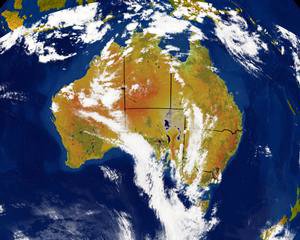
February 24, 2006. Australia
Showers and Isolated Thunderstorms for SE AustraliaA low pressure trough, together with a passing cold front, is expected to trigger scattered showers and thunderstorms across much of Victoria on Saturday, and this activity is then predicted to affect southern NSW, including Sydney, on Sunday. A southerly change will follow in the wake of the front, and this system will pass across Victoria on Saturday, before reaching southern and central NSW on Sunday.

The South Pacific (click on)
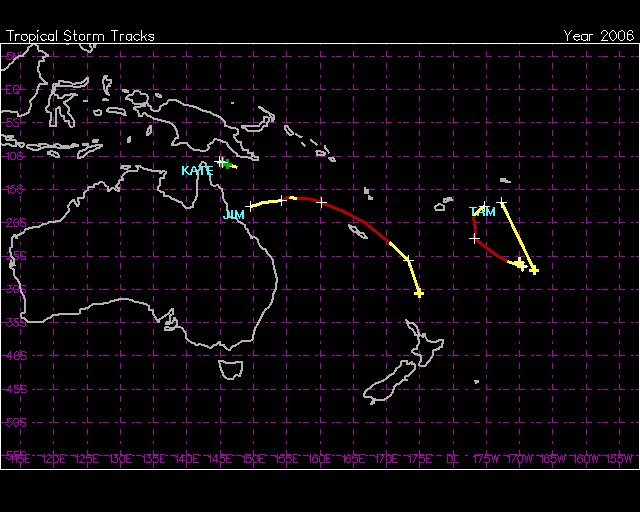
The Australian Hurricane Season
"Kate" weakens to Ex-Tropical Cyclone"Kate" continued to weaken Friday morning and has been downgraded further to be an Ex-Tropical Cyclone. Her central pressure has climbed to 995 hPa and while the satellite picture still shows a mass of cloud in the northern Coral Sea, about 400 km east-northeast of Lockhart River, the system lacks the structure required to be a Tropical Cyclone. The system will continue to be monitored and if it redevelops warnings will be reissued. Ex-TC "Kate" is still likely to produce some wet weather along the North Tropical Coast and eastern Tablelands districts of Qld and possibly to coastal areas further south.
This is Global Warming. Antarctica should never be this hot ! This is insane. (click on for animation)

February 24, 2006.
Antarctica.
Global Warming.
Subscribe to:
Posts (Atom)