asahi.com
Coast guard subs for MSDF on inspections
10/25/2006
THE ASAHI SHIMBUN
Tokyo plans to call on the Japan Coast Guard, not the Maritime Self-Defense Force, to inspect vessels entering or leaving North Korea under a United Nations Security Council resolution, sources said.
The measure, for the time being, was planned after government officials concluded that Washington needs more time to decide how its military will inspect cargo on ships going to and coming from North Korea.
There is also the unresolved legal problems concerning the dispatch of MSDF vessels to support U.S. ships inspecting cargo in international waters.
In fact, the government has put off plans to compile a special measures law that would enable the MSDF to provide logistics support for U.S. military vessels inspecting ships for cargo that could be used to enhance or fund North Korea's weapons programs, the sources said.
But the MSDF will not sit by idly while the international community imposes sanctions against Pyongyang for its Oct. 9 nuclear test.
The MSDF is stepping up its information-gathering activities to monitor suspicious vessels heading for and leaving North Korea, the sources said.
Tokyo will decide on further action against the reclusive state depending on Washington's countermeasures and how Pyongyang responds, the sources added.
During her recent swing through Japan, South Korea, China and Russia, U.S. Secretary of State Condoleezza Rice emphasized that the United States has no intention of escalating the crisis concerning North Korea's nuclear program.
She also informed leaders of each country that Washington will inspect vessels only when it has solid information that the vessels pose a risk.
"The United States will stress a diplomatic approach for the time being," a senior Foreign Ministry official said. "I assume it will take some time (for Washington) to discuss how to deploy the U.S. military for cargo inspections and other purposes."
The Japanese government plans to instruct the coast guard to bolster its measures to inspect ships entering or leaving North Korea, mainly in Japanese territorial waters, the sources said.
The coast guard can also board a vessel in contiguous waters--the maritime zone stretching 12 nautical miles adjacent to Japan's territorial waters--if the vessel is suspected of breaking Japanese laws, such as violating customs clearance procedures and immigration control.
On the other hand, the MSDF can inspect a vessel only when the situation is acknowledged as an emergency in areas surrounding Japan.
Debate is continuing over whether North Korea's nuclear test can be considered such an emergency.
The Defense Agency, meanwhile, has deployed MSDF P3C patrol aircraft for monitoring activities over the Sea of Japan and the East China Sea. The agency will also use escort vessels and Air SDF AWACS surveillance planes for that purpose.
If a suspicious vessel is detected, an MSDF destroyer will track it down and pass on information to the coast guard, U.S. Navy vessels deployed off the coast of North Korea and other related authorities, the sources said.
The government is also considering ways to provide fuel, water and other supplies to U.S. Navy vessels calling at the SDF's Maizuru base in Kyoto Prefecture and elsewhere, the sources said.
On the basis of the UNSC resolution condemning North Korea's nuclear test, Japan is also scrambling to determine the luxury goods that will be banned from entering North Korea.
Customs houses will crack down on such items as soon as they are identified, the sources said.(IHT/Asahi: October 25,2006)
http://www.asahi.com/english/Herald-asahi/TKY200610250142.html
U.S. missile defense under way in Okinawa
10/27/2006
THE ASAHI SHIMBUN
Launchers for the PAC3 missile defense system are seen at the U.S. Air Force's Kadena Air Base in Okinawa Prefecture on Wednesday. (Jun Kaneko/ The Asahi Shimbun)
OKINAWA, Okinawa Prefecture--The deployment of a state-of-the-art, ground-to-air Patriot Advanced Capability 3 (PAC3) missile defense system is proceeding apace at U.S. Kadena Air Base.
The system's launchers were observed on the base Wednesday. The U.S. military plans to have the system partially up and running by the end of the year, according to sources.
Fifteen launchers, both for PAC3 and PAC2 missiles designed to intercept short-range ballistic missiles, are lined up at the base barely 200 meters from Kadena town hall.
The deployment follows a recent series of military actions on the part of North Korea, including missile test launches on July 5 and a nuclear test on Oct. 9.
Tokyo and Washington agreed to deploy the PAC3 system at U.S. bases around Japan as part of a May agreement on the realignment of U.S. forces in Japan.
That plan includes relocating about 8,000 U.S. Marine Corps personnel and 9,000 of their family members from Okinawa Prefecture to Guam. It also transfers the functions of the Marine Corps Air Station Futenma from populated Ginowan to Nago's Camp Schwab, both in Okinawa Prefecture, and returns some land in the prefecture now used by the U.S. military.
Pasted from <http://www.asahi.com/english/Herald-asahi/TKY200610270150.html>
Bills to upgrade Defense Agency will likely be passed in Diet session
10/27/2006
The Asahi Shimbun
With opposition Minshuto (Democratic Party of Japan) now on board, bills to give the Defense Agency more power and independence will likely be passed during the current Diet session, sources said.
Minshuto decided Thursday to comply with the ruling parties' plan to upgrade the agency to a ministry to maintain support from conservative voters amid the nuclear crisis involving North Korea.
One of the bills will revise the law on the establishment of the Defense Agency to give the agency the higher status. Currently, the Defense Agency must go through the prime minister to submit bills to the Diet or ask for Cabinet meetings. If it is upgraded to a Defense Ministry, it can take such action on its own.
Pasted from <http://www.asahi.com/english/Herald-asahi/TKY200610270242.html>
SBI Holdings hid 3 billion yen through shady stock transactions with subsidiaries
10/27/2006
The Asahi Shimbun
SBI Holdings Inc. failed to report about 3 billion yen ($25.3 million) in income over a three-year period until March 2005, sources close to tax authorities said.
The venture capital firm sold stock to several subsidiaries and later bought back the same shares at inflated prices in an attempt to improve the financial standing of those subsidiaries. That action was considered a "donation" from SBI Holdings to its subsidiaries.
Sources said SBI Holdings has paid about 1 billion yen in back taxes and penalties.
http://www.asahi.com/english/Herald-asahi/TKY200610270240.html
254 high schools skipping compulsory classes
10/27/2006
The Asahi Shimbun
In a further embarrassment for the education system, The Asahi Shimbun found that more than 250 senior high schools are not teaching compulsory subjects for graduation, and some have covered-up the practice.
Earlier, The Asahi Shimbun learned that 87 public senior high schools were not teaching world history, a compulsory subject, to their students.
A further investigation shows that the practice is more widespread and that other compulsory subjects, such as health education and information, are being skipped.
The reason is that schools were so focused on getting students into the best universities that they emphasized subjects, such as math, needed for university entrance exams. The other courses, although compulsory for graduation, were often left out of the students' schedules.
http://www.asahi.com/english/Herald-asahi/TKY200610270288.html
More breast cancer patients fully recovering
10/25/2006
The Asahi Shimbun
The number of breast cancer surgeries with a nearly 100 percent rate for a complete recovery has more than doubled since 2002, thanks largely to the growing use of mammography tests, a survey showed.
Such surgeries are for ductal carcinoma in situ (DCIS), which has been dubbed "breast cancer at the super-early stage."
Patients can expect a complete recovery if they are treated during that stage, which underscores the importance of health checks and mammographies, according to medical experts.
The survey has been conducted annually since 2002 by a breast cancer conference comprising about 20 advanced medical facilities, including St. Luke's International Hospital in Tokyo's Chuo Ward.
http://www.asahi.com/english/Herald-asahi/TKY200610250230.html
LDP victories signal promising start for Abe
10/24/2006
THE ASAHI SHIMBUN
Prime Minister Shinzo Abe got a boost Sunday when two ruling Liberal Democratic Party candidates won by-elections for the Lower House. Passing this test a month after being sworn in gives Abe's administration a much needed sense of stability. Abe is now expected to push through the Diet such key bills as a revision of the Fundamental Law of Education. "The voters have given power to the ruling coalition. I will do my best to steadily fulfill my policy pledges," Abe told LDP Secretary-General Hidenao Nakagawa by phone.
http://www.asahi.com/english/Herald-asahi/TKY200610240115.html
LDP to retract proposal that allows "illegal" interest rate
10/25/2006
The Asahi Shimbun
The Liberal Democratic Party plans to scrap a provisional measure for the revised moneylending system that would enable consumer loan companies to continue charging interest rates beyond the legal limits. In the face of heavy criticism, executives of the LDP's Research Commission on the Finance and Banking Systems decided Tuesday to remove the measure from the package of bills to revise moneylending laws. The LDP plans to make other modifications to better protect consumers. The bills are intended to close loopholes and eliminate confusion concerning the interest rates charged by consumer finance companies and to prevent desperate borrowers from falling victim to shady lending and debt-collecting practices. Critics of the bills, however, say the some of the initial revisions, including the provisional measure, favor the lenders instead.
http://www.asahi.com/english/Herald-asahi/TKY200610250233.html
Asia/ In China, booming scrap metal industry poses hidden dangers
10/25/2006
BY KAZUTO TSUKAMOTO,THE ASAHI SHIMBUN
ALASHANKOU, China--It used to be that China couldn't get enough scrap metal. Pots, pans, old military tanks, guns, anything that could be sold off to be resold to dealers, who then sell it on to smelters and other factories throughout the country. But here in western China's only railway port, which links the Xinjiang Uyghur Autonomous Region with Kazakhstan, border officials are being forced to turn away scrap by the ton. In a rush to feed China's thirst for scrap metal, dealers from throughout Central Asia are apparently including radioactive waste in their scrap exports. According to Xinjiang Uyghur custom houses and waste importers, iron scrap and other metals that contained radiation levels higher than the permitted standard have been discovered at two locations--Alashankou, which is about 450 kilometers from Urumqi, the capital of the autonomous region; and the Torugart Pass, a rugged mountain road that provides access into Kyrgyzstan. It sits high in the mountains about 130 km from Kashgar, a major city in Xinjiang Uyghur. While radiation has been detected in imported scrap since the 1990s, the situation has been getting steadily worse since the volume of imports began to increase in 2000. During the five-year period from 2001 to 2005, a total of 9.58 million tons of scrap metal entered the autonomous region through the two points. Of that, roughly 2.27 million tons were imported in 2005 alone, creating a record annual high. Although levels dropped significantly to only 550,000 tons in the first six months of this year, mainly due to the fall in domestic iron prices in China, officials say contaminated imports still pose a grave danger. From January through June this year, radioactivity was detected in 9,995 tons coming through Alashankou. All of it was sent back. According to one customs officer in the border town, most of the scrap is sent to Kazakhstan from Russia, Uzbekistan, Kyrgyzstan and Turkmenistan, where it is collected and then sent by train to the autonomous region. The situation is getting so bad that both China and Kazakhstan have now appointed permanent customs and quarantine officers at the checkpoint specifically to implement radiation tests of scrap imports. Those tests, according to Chinese newspaper Guojixianqudaobao (International Herald Leader), are turning up imports that contain radiation levels 2,000 to 4,000 times higher than what is found in the natural environment. At Torugart Pass, the problem is similar, only the waste is brought in by truck rather than railway. In January last year, above normal radiation levels were detected in 91 tons of metallic waste. Authorities point to the many nuclear-related facilities throughout Central Asia, most of which are left over from the Soviet era. Of particular concern is Kazakhstan's uranium mine as well as the Semipalatinsk Test Site, which was once one of the world's largest nuclear test sites. It was closed in 2000. Zhang Yao, a vice director of the Department of Russian and Central Asia Studies at the Shanghai Institute for International Studies, is one of many deeply concerned about scrap trading at the western border. "It is suspected that the scraps (that were found to be contaminated with radioactivity) were those that had been produced in uranium mining sites, nuclear facilities and radioactive waste processing centers (in the Central Asian countries)," he said.(IHT/Asahi: October 25,2006)
http://www.asahi.com/english/Herald-asahi/TKY200610250120.html
Asia/ Off the Beaten Track: Afghan women learn to bring home the honey
10/25/2006
BY MANABU KITAGAWA,THE ASAHI SHIMBUN
JALALABAD, Afghanistan--Life hasn't always been sweet for women in Afghanistan, but the United Nations hopes that the beekeeping program run by the U.N. High Commissioner for Refugees will give female refugees the chance to earn a living by making honey. About 50 women are taking part in the program that first started in a Jalalabad suburb in late June of this year. The women are learning everything they might need to know about bees, including their behavior and how to make beehives. The average beehive produces 40 kilograms of honey a year, earning a beekeeper about $200 (about 23,000 yen). Since the Taliban regime collapsed in 2001, an estimated 3.5 million Afghan refugees have returned to the country. However, for many, returning home has not been without its own problems. A shortage of work opportunities has meant that returnees often struggle to support themselves.(IHT/Asahi: October 25,2006)
http://www.asahi.com/english/Herald-asahi/TKY200610250117.html
EDITORIAL/Nobel Peace Prize
10/25/2006
The Norwegian Nobel Committee has awarded the 2006 Nobel Peace Prize to Muhammad Yunus of Bangladesh and the Grameen Bank (bank of villages) that he established in Dhaka in 1976. Borrowing money from financial institutions was never an option for the poor in developing nations. Lenders avoided these people because they lacked guarantors and carried the risk of being unable to pay back their delinquent loans. Yunus came up with the concept of microcredit when he set up Grameen Bank. It is a system for small-sum lending without collateral extended to any group of five borrowers who assume joint liability. Poor people also have an entrepreneurial spirit. What these people need most is capital that encourages self-reliance, not economic aid or charity. Over the years, Yunus's concept of microcredit spread from South Asia to Latin America, the Middle East and Africa. And by limiting the borrowers mainly to women, his bank helped to raise the status of women who have always been prone to discrimination.
http://www.asahi.com/english/Herald-asahi/TKY200610250114.html
POINT OF VIEW/ Masazumi Yoshii:Ministry to blame for the Minamata fiasco
10/25/2006
THE ASAHI SHIMBUN
In spring last year, I agreed to the Environment Ministry's request to serve as a member of the ad-hoc panel set up by then Environment Minister Yuriko Koike to review the government's policy response to the outbreak of Minamata disease. With the nation set to mark the 50th anniversary of the official recognition of the cases of neurological syndrome due to mercury poisoning on May 1 this year, the panel was asked to scrutinize how the government responded to the outbreak and draw lessons from the experience to prevent similar mistakes. But the panel's submission of proposals was delayed to September this year. Since the ministry requested a fresh look into the mistakes made in the past, I thought we were supposed to offer candidly critical opinions about the government's handling of this public health disaster. So I offered candid criticism. Instead of getting serious attention from the officials in charge, however, my criticism actually displeased them and drew negative reactions from them. The focus of debate at the panel soon shifted from the responses made by the organizations involved, which failed to contain the outbreak quickly, to the ways compensation and relief have been provided to victims. Since many victims are not officially recognized as Minamata disease patients under the Environment Ministry's criteria, four different types of approaches to victim relief have been devised, including "political" relief and "judicial" relief. There are clear inequities among these approaches. And a 2004 Supreme Court ruling on the issue has triggered fresh applications for relief from more than 4,000 people. Nobody could deny that the ministry's strict criteria for recognition as Minamata patients are at the root of this confusion. But the ministry has been insisting that the criteria are based on scientific opinions of experts, adding that the Supreme Court ruling didn't reject the criteria. Indeed, the top court didn't strike down the criteria, but it didn't support them either. The court used its own, far less rigid criteria to recognize many additional sufferers as Minamata disease patients eligible for compensation. That should be interpreted as calling the appropriateness of the ministry's criteria into question. I urged the government to establish an independent council of experts from a wide range of fields, including medical, legal, social and administrative areas, and seek its proposals on the compensation and relief regime as a whole. This idea was included in the draft report of the Minamata panel for the ministry. My proposal was by no means a radical one. When the government embarks on an important new reform it usually sets up such an independent advisory panel to tap a wide range of opinions. But the Environment Ministry fiercely objected to the idea, saying it had not asked the panel to debate the issue of the criteria. The ministry said it would refuse to accept any proposal that is not related to the areas designated for the panel's work. It was quite clear that such an independent council would address problems with the criteria, and the ministry apparently thought it was the best strategy to forestall any serious debate on the subject by blocking the creation of such a panel. This attitude indicates the ministry is regressing from openness and transparency in policymaking to exclusivity and secrecy. The ministry appears to be more interested in saving its own skin than in rescuing Minamata disease patients. It is intent on defending its current policy to prevent any embarrassment for the minister and avoid shouldering any additional burden. I even began to wonder if the ministry was the major obstacle to solving the problem. There were no signs that Minister Koike asserted political leadership to pressure bureaucrats into taking action. A contentious issue on which public opinions are deeply divided can never be sorted out if the people responsible for the matter are trying to deflect criticisms. Such people should rather be willing to put their reputation at risk. As it turned out, the proposal to create an independent advisory council on the question of compensation and relief was not adopted as the Minamata panel's recommendation. But the panel's recommendations instead include the development of a permanent framework for providing compensation and relief for all victims of the disease. The panel also pointed out that bureaucrats tend to pay less than enough attention to the protection of human lives and rights during emergencies and that the government lacks an effective crisis management system to cope with such situations. As a step to tackle these problems, the panel proposed the creation of a new public safety committee with the power to conduct investigations into cases of public health disasters related to pollution, drugs and foods in order to find out how they occurred and recommend preventive measures. Realizing this idea requires high-level political decisions transcending the jurisdictions of the ministries and agencies. I really hope former Environment Minister Koike, now a special adviser to the prime minister, will tackle this challenge. In order to make good use of the panel's recommendations, though, it is more important than anything else for the Environment Ministry to demonstrate willingness to risk its reputation and accept its share of the blame for the historic policy failure. * * * The author is a former mayor of Minamata, Kumamoto Prefecture.(IHT/Asahi: October 25,2006)
http://www.asahi.com/english/Herald-asahi/TKY200610250113.html
North Korean nukes and the wash basin maker
10/25/2006
Recent events reminded me of the old adage about the wash basin maker, often used to explain how serendipity can lead to unexpected results. The story goes that a wooden wash basin maker mused one day, "I wish a strong wind would blow. "If a strong gale were to blow, it would lift sand and grit into the air. If sand got into people's eyes, some of them would go blind. If people go blind, they will learn to play samisen to earn a living. Since that musical instrument is made with the skin of cats, those animals would soon become scarce," he said. "If there were fewer cats around, the mice would have a field day and start chewing holes in wash basins." And that is why the wash basin maker hoped a gale would blow. Thus, the familiar maxim "When the wind blows strong, basin makers strike it rich." The passage is from the Edo Period (1603-1867) story collection called "Usokanwa," included in "Nihon Zuihitsu Taisei" (Japanese essays) published by Yoshikawa Kobunkan. The Liberal Democratic Party's wins of two seats in Lower House by-elections in Kanagawa and Osaka prefectures on Sunday remind me of this old adage. It seems the wind blown by the North Korean nuclear issue influenced the outcome in these two polls.
http://www.asahi.com/english/Herald-asahi/TKY200610250110.html
Assad: Syria not seeking to be nuclear state
10/27/2006
BY DAIJI SADAMORI ,AND JUNJI TACHINO
THE ASAHI SHIMBUN
DAMASCUS--Far from seeking nuclear weapons of its own, Syria's ultimate aim is to make the entire Middle East nuclear-free, according to President Bashar Assad.
Assad recently granted an exclusive interview to The Asahi Shimbun, his first with a Japanese media organization since he assumed the presidency in 2000 following the death of his father, Hafez Assad.
In response to North Korea's first underground nuclear test on Oct. 9, Assad reiterated that Syria was not seeking to become a nuclear power.
He said the international community should also apply pressure on Israel to abandon its nuclear arsenal.
http://www.asahi.com/english/Herald-asahi/TKY200610270143.html
Government backs atomic plant sales
10/27/2006
THE ASAHI SHIMBUN
The government and industry are joining in a double-team promotion of nuclear power plants in Asian export targets.
The Ministry of Economy, Trade and Industry is leading the drive to better compete with overseas rivals, such as France, which is conducting aggressive public-private campaigns.
The Japan External Trade Organization (JETRO) organized a meeting this summer with the Vietnamese government to study nuclear power plant projects.
"We are prepared to send nuclear experts from Japan to help Vietnam train government regulators, researchers and plant operators," a JETRO official said at the meeting.
Vietnam plans to build two nuclear power reactors between 2017 and 2020.
http://www.asahi.com/english/Herald-asahi/TKY200610270138.html
POINT OF VIEW/ Yasushi Akashi: What a new Asian U.N. chief means for Japan
10/27/2006
THE ASAHI SHIMBUN
The United Nations General Assembly has named South Korea's foreign minister, Ban Ki Moon, as its next secretary-general.
As someone who personally knows him, I welcome this decision from the bottom of my heart. Ban is known as an even-tempered man who excels in his ability for coordination based on careful consideration. I believe he is well qualified to be the chief administrative officer of the United Nations and its 192 members.
Some people question whether the fact that he comes from a divided country means he can deal fairly with the North Korean problem. But I think such worries are groundless. I am confident that Ban will act fairly and selflessly in his capacity as the top U.N. public servant, not as a South Korean government official. We should be confident in the ability of a U.N. secretary-general who is well informed about East Asian affairs, and who earnestly hopes to bring peace to the Korean Peninsula.
http://www.asahi.com/english/Herald-asahi/TKY200610270128.html
North Korean nukes and the wash basin maker
10/25/2006
Recent events reminded me of the old adage about the wash basin maker, often used to explain how serendipity can lead to unexpected results.
The story goes that a wooden wash basin maker mused one day, "I wish a strong wind would blow.
"If a strong gale were to blow, it would lift sand and grit into the air. If sand got into people's eyes, some of them would go blind. If people go blind, they will learn to play samisen to earn a living. Since that musical instrument is made with the skin of cats, those animals would soon become scarce," he said.
"If there were fewer cats around, the mice would have a field day and start chewing holes in wash basins."
And that is why the wash basin maker hoped a gale would blow.
Thus, the familiar maxim "When the wind blows strong, basin makers strike it rich." The passage is from the Edo Period (1603-1867) story collection called "Usokanwa," included in "Nihon Zuihitsu Taisei" (Japanese essays) published by Yoshikawa Kobunkan.
The Liberal Democratic Party's wins of two seats in Lower House by-elections in Kanagawa and Osaka prefectures on Sunday remind me of this old adage.
It seems the wind blown by the North Korean nuclear issue influenced the outcome in these two polls.
Beforehand, voters likely had this train of thought: "Nuclear tests cannot be tolerated. The North Korean test is a real threat; it is not bluffing. We need a government that is strong against such threats. Prime Minister Shinzo Abe has taken a hard stance against the North in the past. I'm going to vote for the LDP, this time."
Abe's visits to China and South Korea after his inauguration started another wind blowing. But the former Koizumi administration also left a legacy of ill will in the region.
While Abe's diplomacy turned that minus into a plus, had it not been for Koizumi's missteps, the summit meetings with Chinese and South Korean leaders could have happened sooner.
As the "nuclear wind" blew stronger, many voters must have sensed the disarray within the Minshuto (Democratic Party of Japan) ranks. The opposition party seems to lack the ability to perceive subtle public sentiment.
The phrase "When the wind blows" also connotes pinning one's hopes on unpredictable events. But there's no way an opposition that simply waits for the wind to bring down the ruling party can attain power.
--The Asahi Shimbun, Oct. 24(IHT/Asahi: October 25,2006)
http://www.asahi.com/english/Herald-asahi/TKY200610250110.html
Thoroughbred's drug test leaves deep impact
10/26/2006
Shuji Terayama (1935-1983) was not only an avant-garde dramatist, writer and director, he was also a horse-racing critic of some note.
In his "Yoroppa Keiba Nikki" (European horse-racing diary), he describes the 1972 Prix de l'Arc de Triomphe race in Paris, in which Japan's Mejiro Musashi ran.
"Paris ... It's the Prix de l'Arc de Triomphe, and darn, I overslept." He continues: "Mejiro Musashi was not the favorite, and he also lacked fighting spirit."
The essay is in "Keiba Mushuku" (Horse racing wanderings) published by Shinshokan Co. Mejiro Musashi finished a dismal 18th that day.
On Oct. 1 this year, Japan's Deep Impact placed third in the same prestigious race at Longchamp. But the horse had tested positive for a drug banned in Europe.
Traces of ipratropium, a tracheal relaxant used to aid breathing, were detected in the horse's urine sample. Ipratropium is not banned in Japan.
How could this have happened? Was it intentional, or was it a careless slip? The shock was felt everywhere. There have been calls for a thorough investigation and a full explanation.
The intentional use of performance-enhancing drugs, known as doping, goes back a long time. According to "Kusuri" (Medications), published by University of Tokyo Press, the English word is said to derive from the word dop, an alcoholic beverage that was imbibed by a tribe in South Africa during ceremonies.
In ancient Rome, horses competing in chariot races were given honey mixed with alcohol as a byproduct of fermentation.
That, apparently, is when doping began in the sporting world. The practice is said to have spread widely into cycling and soccer in the 19th century.
Contrary to human doping practices, at least Deep Impact cannot be blamed, and bears no responsibility for breaking the rules. That is some consolation.
But at the same time, I feel sorry for the horse. Couldn't his human handlers have looked out for him better?
The horse traveled a great distance to stand proud in Paris, and he competed bravely in what turned out to be a close race against powerful rivals all striving to come in first.
In my mind's eye, I can still see the beautiful image of Deep Impact's strong body pounding down the turf.
--The Asahi Shimbun, Oct. 21(IHT/Asahi: October 26,2006)
http://www.asahi.com/english/Herald-asahi/TKY200610260108.html
The Phildelphia Inquirer
N.J. court stops short of legalizing gay marriage but affirms rights of same-sex couples
By Kristen A. Graham and Terry Bitman
INQUIRER STAFF WRITERS
The New Jersey Supreme Court ruled today that gay and lesbian couples were entitled to the same benefits and rights as heterosexual couples. But the justices left it to the State Legislature to decide whether that equality will come in the form of full marriage or civil unions.
The Legislature has 180 days to either "amend the marriage statutes or enact an appropriate statutory structure," Justice Barry Albin wrote in his decision for a divided 4-3 court.
New Jersey has always been considered a prime battleground for a gay marriage case. It is one of five states without a law or constitutional amendment banning same-sex marriage, and its court is considered quite independent.
Nationwide, two states - Vermont and Connecticut - permit same-sex couples to form civil unions.
Only Massachusetts, by virtue of a 2003 high court ruling, allows gay and lesbian couples to marry.
http://www.philly.com/mld/philly/15846616.htm
Geno’s: Where’s the beef (from)?
By Michael Klein
Geno's, the South Philly cheesesteak stand that recently made worldwide news over its order-in-English signs, has a foreign accent after all.
In a cheeky Internet posting on DailyKos.com, a Philadelphia blogger known as DebtorsPrison on Tuesday put up photos taken outside Monday night. The photos show boxes of beef bearing labels from Frigorifico Elbio Perez Rodriguez - a meat packer not in South Philly but in South America.
Uruguay.
"Those cheesesteaks are made from 'immigrant' beef!" DebtorsPrison wrote in what appeared to be mock indignation.
The box markings were in English, by the way.
Owner Joey Vento drew a complaint in June from the city Human Relations Commission after it decided that Vento's signs - declaring, "This is America," and asking customers to please order in English - violated the city's Fair Practices Act.
"We buy wherever we can find the best steer rib eye," said Geno's day manager Jimmy Reds, when asked about this latest tempest-in-a-Cheez-pot. "Some of it comes from South America, some from Australia. But we buy locally, from American companies."
Vento was not available for comment.
According to an informal survey, many steak shops - including Geno's archrival Pat's King of Steaks - say they buy foreign beef. It is, on average, about 15 percent cheaper than domestic.
http://www.philly.com/mld/philly/15846428.htm
N.J. rejects federal sex ed money over abstinence rules
Associated Press
TRENTON, N.J. - The Corzine administration has rejected federal abstinence education money because new rules won't let teachers discuss contraception and require them to describe sex outside marriage as potentially mentally and physically damaging.
State health and education officials sent a letter Tuesday to the federal government, saying such requirements contradict the state's sex education and AIDS education programs.
The state had accepted the $800,000 each year since 1997, but said new rules give them little flexibility.
"Some of the elements required are inconsistent and violate our own educational standards," State Health Commissioner Fred M. Jacobs told the Star-Ledger of Newark for Wednesday's papers.
New Jersey is the fourth state to reject the abstinence education money, after California, Pennsylvania and Maine.
"Monogamy is not a bad idea, but having the government of New Jersey dictate these things for families is not something we wish to do," Jacobs said.
The state's AIDS Prevention Act also permits schools to discuss contraception.
Conservatives questioned the decision.
"We should take a step back and try a new approach," said Marie Tasy, executive director of New Jersey Right to Life. "What we have now is not working, as reflected by the rates of abortions and high incidence of sexually transmitted diseases."
Reputed mobster Filipelli arrested on federal charges
Associated Press
CAMDEN, N.J. - Authorities have arrested a reputed organized crime family member on charges stemming from an investigation into illegal sports gambling, state police said Wednesday.
State police, working with the FBI's Philadelphia office, arrested Vincent Filipelli, 53, at his Cherry Hill home on Tuesday. They seized anabolic steroids and drug paraphernalia valued at $10,000, two stun guns, gambling records and cash, according to state police.
Filipelli faces state and federal charges related to a sports betting operation and the distribution of illegal drugs, specifically anabolic steroids, said state police Sgt. Stephen Jones.
He was being held without bail Wednesday at the Camden County jail, pending a federal hearing.
According to state police, Filipelli was a former bodyguard for John Stanfa, boss of the Philadelphia La Cosa Nostra organized crime family.
During an undercover investigation that included two state police detectives, Filipelli threatened one of the undercover detectives, whom he believed owed him a debt, telling him he would put him in the hospital for a year, according to state police.
Santorum seeks moderate votes in Phila. suburbs
MARYCLAIRE DALE
Associated Press
PHILADELPHIA - In a hunt for votes in the Philadelphia suburbs, Sen. Rick Santorum's campaign brought four Senate colleagues to town Wednesday to portray Santorum as a moderate in conservative clothing.
"The caricature that is so often drawn of him as being an extremist is not the senator that I see," Sen. Susan Collins, of Maine, said at a morning news conference.
"None of us agree with Rick Santorum on every issue. I am pro-choice," Collins said. "(But) Rick is someone who works well with senators of all ideologies."
Santorum is facing an uphill battle against his challenger, state Treasurer Bob Casey. Independent polls have shown Santorum's approval rating this year hovering below 40 percent and Casey with a lead over the senator.
Fellow Pennsylvania Sen. Arlen Specter, Sen. Norm Coleman, of Minnesota, Sen. Lisa Murkowski, of Alaska, and Collins all set aside the day to campaign for Santorum in the vote-rich Philadelphia suburbs. Santorum hopes to woo enough moderates there to win the Nov. 7 election over Casey, a socially conservative Democrat.
Santorum clenched his fists and looked tense as his colleagues talked of what they called his unheralded work on social issues, from AIDS research to Amtrak funding. They spent less time discussing the war in Iraq.
"It's very easy to stereotype ... to play off the old themes and ignore what goes on," said Santorum, the third-ranking Republican in the Senate.
He said he knows some people may wonder if he is trying to run away from his record or his conservative stance. "Absolutely not. But there's more to the story," Santorum said.
Santorum offered an "alternative story line" about his 12 years in the Senate, describing his work on Amtrak, energy assistance programs and puppy mills.
"Those are the kinds of things that are real meat and potatoes for people in southeastern Pennsylvania," Santorum said.
Santorum has drawn headlines for his remarks comparing homosexuality to polygamy and bestiality and for suggesting more parents could afford to quit their jobs and stay home with their children.
Specter acknowledged that Santorum's candor draws attention.
"He has very strongly held views and he insists on saying them," Specter said. "My father taught me to know what you say, don't say what you know."
NRA backs Santorum, but it likes Casey, too
In a hunter-heavy state, gun policy is one area where the U.S. Senate candidates mostly agree.
By Carrie Budoff
Inquirer Staff Writer
No matter who wins Pennsylvania's U.S. Senate race, the National Rifle Association probably won't be complaining.
On gun issues, Republican Sen. Rick Santorum and Democrat Bob Casey Jr. could be twins.
Santorum earned an A-plus and an endorsement from the NRA - whose leaders campaigned with him yesterday. Casey got an A, the highest mark for a nonincumbent.
Both oppose renewing the federal ban on the sale of semiautomatic weapons. They support child-safety locks on guns, but back immunity for gun manufacturers from lawsuits and reject calls to limit handgun purchases to one a month.
Such overlapping on a fractious issue defies party labels, but it highlights an abiding rule of Pennsylvania politics: To win statewide, side with sportsmen, hunters and gun owners. The NRA says Pennsylvania has more members per capita than any other state.
Santorum and Casey may appear out of sync with Philadelphia-area voters, particularly in the city - which is having one of its deadliest years in more than a decade. Suburban and urban residents generally favor tighter gun laws, analysts say, but their intensity rarely matches those of gun-rights advocates.
http://www.philly.com/mld/philly/15840571.htm
Easing the stress children feel at the sight of a needle
By Lauran Neergaard
Associated Press
WASHINGTON - Vaccinations and other needle sticks are more than pinpricks to little children, and often to older ones, too. They cause fear that can turn a simple checkup into a stress-filled battle.
It sounds too easy, but distracting your tot can reduce the distress, concludes a new review that examined psychological techniques for easing the pain.
Nothing will stop all the crying. But pick a distraction suitable for the child's age and stage of development, and anything from a low-tech trick such as blowing bubbles to bringing a video game can take a child's mind off the impending pain long enough to make a difference.
"Needle procedures are really common, and among the most fear- and anxiety-provoking for children," notes Lindsay Uman of Dalhousie University in Nova Scotia, who led the review by the Cochrane Collaboration, an international network that assesses the evidence behind health-care practices. "A parent can very easily help."
Children can get 20 shots by age 2 from vaccinations alone, not counting blood tests or other needle-stick procedures for various illnesses.
http://www.philly.com/mld/philly/15832607.htm
Marriage as social contract
Stephanie Coontz
teaches history and family studies at The Evergreen State College in Olympia, Wash., and is author of "Marriage: A History: How Love Conquered Marriage"
For the first time in 150 years, households headed by single adults and unmarried couples now outnumber married-couple families. In 1960, married-couple households represented more than 78 percent of American households. As late as 2000, married couples were 52 percent of all households. But in 2005, according to the recently released American Community Survey, households with a married couple at their core made up less than 50 percent of all households.
That's a psychologically significant number, of course. Headlines trumpet that "Married people are now a minority." But there are some things that this news means and others that it doesn't. It doesn't mean marriage is doomed. It does mean we have to start thinking differently about the way we design our social policies. They are founded on 60-year-old assumptions about marriage that are now definitively outdated.
http://www.philly.com/mld/philly/15816409.htm
All-embracing free love seizes city
Unsuspecting passersby hugged in the park.
By Natalie Pompilio
Inquirer Staff Writer
Inviting the public’s embrace, Laurie Elder and two other West Philadelphia women offered "free hugs" in Center City for about two hours yesterday
Pigtails bobbing, Laurie Elder bopped up to a stranger walking by LOVE Park yesterday afternoon, waved her sign, then outstretched her arms.
Seconds later, the two were hugging.
A few feet away, Debs Hoy was doing the same thing - wrapping her arms around someone she'd never met. Near her, Fran Staret was approaching a group of walkers while waving her torn sign: "Free Hugs," it read.
The three West Philadelphia women were spreading a little sisterly love in a city where, with the growing violence problem, it seems love is lacking. They were encouraging people to slow down rather than hurry by, to connect with a stranger rather than ignore one. They were offering "free hugs" for about two hours yesterday, and hundreds of people took them up on their offer.
"All the people who don't usually look at me are hugging me," said Elder, 29. "We've had so many hugs. I don't want to stop."
Hoy, 26, said she noticed that, post-hug, people were smiling and their shoulders were less hunched.
"I've had a few people say to me, 'I really do need a hug,'" Hoy said. "That's great. Sometimes that makes all the difference."
http://www.philly.com/mld/inquirer/15840607.htm
Girl wasted away under DHS care
City review of teen's neglect was key to ouster of leadership.
By John Sullivan, Ken Dilanian, Craig R. McCoy and Nancy Phillips
Inquirer Staff Writers
Fourteen-year-old Danieal Kelly, bedridden and nearly paralyzed with cerebral palsy, wasted away in her stifling Mantua apartment, gaping bedsores exposing her bones. When she died, she weighed just 46 pounds.
The tragedy happened in plain sight of Philadelphia's troubled Department of Human Services - an agency that failed her, city officials acknowledged yesterday.
As Danieal faded, a private company was being paid by the city to visit the home at least twice a week. How often the visits actually occurred is in dispute.
She died, dehydrated, in a record heat wave Aug. 4, nine days after the last scheduled visit. Maggots were found in her wounds.
"I'm outraged and saddened," acting DHS commissioner Arthur C. Evans Jr. said yesterday. "The system clearly failed with this kid. There's just no way you can look at a situation like this and say there wasn't a failure."
The story of Danieal Kelly is the latest revelation of a child death that might have been prevented by DHS, the agency responsible for protecting the city's vulnerable children. A DHS caseworker visited the home at least three times in nine months without spotting the neglect, according to a city review of the death.
http://www.philly.com/mld/inquirer/15840612.htm
Editorial Joe Sestak for Congress
Pa. Seventh District
Historically Republican, the district covering most of Delaware and parts of Chester and Montgomery Counties voted Democratic in the last three presidential elections.
The Case for Sestak
Retired admiral, U.S. Navy
Democrat, 54
Wallingford
This seat, held by Weldon for 20 years, is ripe for a change. Sestak, a career naval officer, is a political novice - and it shows. But he's benefited from the mounting ethical woes of the GOP majority on Capitol Hill, including Weldon's.
Sestak's experience commanding a battle group in Iraq and Afghanistan is key. He'd bring valuable military expertise to Pentagon oversight. He seems eager to push for needed ethics reforms.
The Opponent
Curt Weldon
U.S. representative
Republican, 59
Thornbury
The Case for Weldon
Weldon wields the influence of seniority on the Armed Services Committee. He knows the district and has brought defense jobs back home. This centrist enjoys rattling government cages.
Character / Ethics
The Justice Department is investigating whether Weldon used his position to help his daughter's lobbying/consulting firm. Another daughter was hired by a defense contractor after Weldon helped the company to get a federal contract. This smells as bad as it looks.
http://www.philly.com/mld/inquirer/news/editorial/15840636.htm
This Sunday in Currents: Meet the Candidates
This Sunday, nearly all of Currents will be turned over to profiles of the major candidates in the three biggest political races in our area. In the Pennsylvania gubernatorial contest, Gov. Ed Rendell and Lynn Swann trade answers to Inquirer questions on property taxes, gun violence, and other issues. In the Pennsylvania race for U.S. Senate, Sen. Rick Santorum and Bob Casey Jr. discuss immigration, taxes, and the war on terror, as do New Jersey's U.S. Sen. Bob Menendez and Tom Kean Jr. Besides answers to campaign-related questions, the candidates also answer our Influences questionnaire about their favorite books, movies, TV shows, and personal role models. This begins a big week of election coverage in The Inquirer's opinion pages.
http://www.philly.com/mld/inquirer/news/editorial/15840629.htm
'You have to live on the edge'
A Center City paralegal enters a 150-mile race through Egypt's desert.
By Joseph A. Gambardello
Inquirer Staff Writer
Jacqueline Eastridge during a Monday workout at the Aquatic & Fitness Center in Bala Cynw
Jacqueline Eastridge admits that, yes, she is a little crazy.
Starting on Sunday, the 46-year-old senior paralegal for a Center City law firm will join 59 other runners in a week-long, 150-mile trek through the sands and dunes and the dry, relentless heat of Egypt's Sahara desert. The event was organized by the sports-adventure company RacingThePlanet.
Eastridge will do it carrying only one change of clothing and all the food she will need in a pack on her back that she hopes will weigh no more than 15 pounds.
"You have to live on the edge a little," said Eastridge, of Wynnewood, who is making the trip alone at a personal cost of over $2,000 (her employer paid the entrance fee).
From the sound of it, the 5-foot-6, 125-pound Eastridge is up to the challenge while at the same time elevating fund-raising for a cause - in this case Children's Hospital - to new extremes compared to the walks, runs and bike tours so common around the region.
"It's fully in keeping with who she is," said her boss, Michael Friedman, chair of the corporate and securities group at Pepper Hamilton L.L.P. "She is energetic, she is enthusiastic, she is committed to quality, and she is committed to helping people."
Born in Switzerland, Eastridge and her mother, Kriemhild, came to this country when she was 4 and moved to Willingboro.
http://www.philly.com/mld/philly/news/15840640.htm
Unisys narrows third-quarter loss to $77.5 million
By Akweli Parker
INQUIRER STAFF WRITER
Unisys Corp., of Blue Bell, narrowed its third-quarter loss to $77.5 million, or 23 cents a share, from $1.63 billion, or $4.78 a share, in the third quarter of 2005, which included a $1.57 billion tax-related charge.
Unisys chairman and chief executive officer Joseph W. McGrath said today that the results were evidence that the beleaguered company was on its way to profitability through cost-cutting and trying to focus on growth areas, such as security, outsourcing, and systems that use "open source," or nonproprietary, software.
Revenue inched up to $1.41 billion from $1.39 billion in the third quarter of 2005, aided in part by contracts to electronically monitor the U.S.-Mexico border, along with prime contractor Boeing Co.; develop an advanced DNA-tracking system for the FBI that would allow local, state and federal law enforcement to link DNA samples with previously convicted offenders; assist coffee-shop chain Starbucks Corp. as it expands outside the United States; and other deals.
The firm said it had identified 100 positions to cut, mostly in Europe, in addition to the 5,500 it had announced previously as part of a companywide restructuring.
Also as part of that restructuring, Unisys said yesterday that it was launching a "Security Unleashed" marketing campaign that portrays one of its main product lines, information-technology security, as a competitive business advantage, rather than a costly, "necessary evil."
http://www.philly.com/mld/philly/15845679.htm
Boeing shares sink on profit decline, higher costs for new 787 jet
By Dave Carpenter
ASSOCIATED PRESS
CHICAGO - Boeing Co., the No. 2 commercial airplane maker behind Airbus SAS, said today its third-quarter earnings fell 31 percent and raised concerns on Wall Street by predicting higher costs than expected for its 787 jet program.
Quarterly profits were hurt by a hefty charge for discontinuing in-flight Internet service Connexion. That offset higher jet sales and a 19 percent increase in total revenue, reflecting a thriving commercial plane business that prompted Boeing to raise its guidance for 2007 earnings and revenue.
But investors focused on the company's comment that its 787 jet program is coming under increasing pressure concerning weight and supplier-related issues and it will have to spend hundreds of millions of dollars more than anticipated this year and next on research and development for the plane, which is due out in 2008.
Wall Street's concerns about the possibility of 787-related cost overruns sent shares in the company down $2.45, or 2.9 percent, to $81.14 in late morning trading on the New York Stock Exchange.
http://www.philly.com/mld/philly/15845725.htm
Airline takes aim at baggage problems
By Tom Belden
Inquirer Staff Writer
US Airways wanted to trumpet a $100 million quarterly operating profit.
But the airline's senior executives spent more time yesterday explaining what they are doing to fix chronic baggage-service problems at Philadelphia International Airport.
Philadelphia's largest airline plans to hire 200 baggage handlers and triple the number of managers overseeing airport service from 30 to 90, the executives said during a conference call with analysts and reporters about the company's third-quarter financial results.
The airline budgeted $2 million for equipment and facilities at the airport, on top of more than $20 million already set aside, they said.
"It is the No. 1 focus of this organization," president Scott Kirby said. "I think we're going to ultimately get it fixed."
http://www.philly.com/mld/inquirer/15858883.htm
Santorum keeps focus on defense
America must react to the "gathering storm" of terror, Rick Santorum said in a defining speech.
By Carrie Budoff and Jeff Shields
Inquirer Staff Writers
As other Republicans attempt to steer away from Iraq and terrorism, Sen. Rick Santorum argued yesterday that America must stop "sleepwalking" while "evil enemies" plot the nation's destruction - making foreign policy a focal point in the final days of his campaign.
http://www.philly.com/mld/inquirer/15863292.htm
Phila. opposes U.S. observers at polls
In a suit, the government alleges violation of the rights of Hispanic voters. Local officials warn of too much intrusion.
By Marcia Gelbart
Inquirer Staff Writer
Two weeks before Election Day, the city is fighting an attempt by the U.S. Justice Department to appoint federal observers for Philadelphia elections beginning Nov. 7 and lasting past next year's presidential race, until the end of 2009.
The effort to appoint the observers stems from a lawsuit filed by the federal government 14 days ago alleging that the city has violated the rights of its Hispanic voters.
Specifically, it charges that the city hasn't adequately recruited and trained bilingual poll workers, failed to provide sufficient election-related materials in Spanish, and prohibited Hispanic voters with limited English from choosing someone to help them inside the voting booth, which law permits.
"The record in this case clearly demonstrates that the city does not exercise sufficient control over its voting places to ensure compliance with the Voting Rights Act," the lawsuit states. It alludes to 50 Hispanic city residents who encountered problems in elections here, most since 2003. One, Myrna Cruz, testified that a poll worker forced her to vote for John Street for mayor in 2003, when she wanted to vote for Sam Katz. Others said they were ridiculed by poll workers who asked why they hadn't learned English.
http://www.philly.com/mld/inquirer/news/local/15858843.htm
Soft-spoken, low-key casino magnate
The developer has been called "Chicago's answer to Trump."
By Suzette Parmley
Inquirer Staff Writer
Second in an occasional series
CHICAGO - While many people vying for slot-machine licenses in Philadelphia can be considered wealthy, only two are on the Forbes 400 list of richest Americans:
Donald J. Trump and Neil G. Bluhm.
Trump has made sure everyone knows Trump. But outside Chicago, not many could tell you about soft-spoken Bluhm, even though his stable of hotels, malls and office buildings may rival The Donald's.
Bluhm, who fell short in his quest for a gambling license in his home state of Illinois last year, is now pursuing Philadelphia. Bluhm and a team of investors, including Philadelphia's Daniel Keating, have proposed a $500 million waterfront casino in the city's Fishtown section.
http://www.philly.com/mld/inquirer/15858888.htm
Sestak owns up to wordy style
He joked about his clumsy rhetoric while picking up an endorsement in his bid against Curt Weldon.
By Todd Mason
Inquirer Staff Writer
Joe Sestak has an impressive list of advantages heading into the final days of the Seventh Congressional District race: abundant cash, favorable political winds, and a wounded opponent in U.S. Rep. Curt Weldon (R., Pa.).
But mesmerizing speech craft isn't among them.
"I have found, although I don't express it at the right times, that there is a need to start grabbing ahold of new technology that will help us improve the quality of life," he told Sierra Club members Wednesday, joking at one point about his wordy style.
The group endorsed Sestak at a rally in Willistown Township, Chester County. The Seventh District covers most of Delaware County and parts of Chester and Montgomery Counties.
Weldon had his own news conference that day in King of Prussia and faced questions about the federal probe of his daughter and a longtime political ally and friend.
In Willistown, Sestak fielded questions about his oratorical skills after the event. "People have always told me how to talk. I can only be me," he said.
http://www.philly.com/mld/inquirer/news/local/15858851.htm
Murphy lashes out over TV ads
In Bucks, he called Mike Fitzpatrick "a liar and a coward" for questioning his prosecution record.
By Christine Schiavo and Keith Herbert
Inquirer Staff Writers
The campaign rhetoric spiked in the Eighth District congressional race yesterday as Democrat Patrick Murphy called the incumbent "a liar and a coward" during a debate in Fairless Hills.
A rumble went through the crowd of about 100 businesspeople at the Lower Bucks Chamber of Commerce debate as Murphy used his opening statement to confront Republican Mike Fitzpatrick about televised ads that questioned his prosecution record.
Fitzpatrick's ad questions Murphy's contention that he did work for the U.S. Justice Department and that, as an attorney with the Army, he prosecuted some of the toughest criminals in New York.
"Mike, you are a liar and a coward," Murphy said.
He later offered reporters an affidavit of his appointment as a special assistant U.S. attorney in New York in 2001.
http://www.philly.com/mld/inquirer/news/local/15860760.htm
Editorial Rush Holt for Congress
N.J. 12th District
It includes parts of Hunterdon, Mercer, Middlesex, Monmouth and Somerset Counties.
During his four terms representing New Jersey's 12th District, Rush Holt, a former Princeton University physicist, has impressed with his diligent constituent service and his championing of open-space preservation and science and technology.
In the process, with a little help from redistricting, he has turned a reliable Republican seat into one that favors Democrats.
Holt, 58, did the right thing on the highly charged Terri Schiavo issue, going to the House floor to vehemently oppose the circuslike involvement of federal officials in what was a tragic personal issue.
The present national mood on the war in Iraq also vindicates Holt. He was among the minority in the House that voted against authorizing the war in 2002. Eighty-one Democrats voted for the war, joining 215 Republicans.
Holt now wants "an immediate, phased withdrawal of our forces" from Iraq while keeping U.S. troops on the ground in Afghanistan.
If his party regains control of the House and tries to reshape Iraq policy, it will need to carefully consider Holt's position against those who argue that leaving Iraq too rapidly would create greater chaos.
A former arms-control expert at the U.S. State Department, Holt is the ranking minority member on the House Intelligence Policy Subcommittee. He rightly decries total abandonment of this nation's human-rights ideals in the detention of suspected terrorists.
Holt also correctly calls for expiration of the Bush tax cuts to the wealthy, as a means to a balanced budget. That must be accompanied by genuine efforts to cut fraud and wasteful spending, he says.
Holt has done a good job. Even Republicans must think so, given the feeble challenge they have put up. GOP candidate Joe Sinagra was not available to meet with The Inquirer Editorial Board and did not respond to a questionnaire.
Sinagra, 59, CEO of My Plumber Inc., is vice chairman of the Republican Party of tiny Helmetta Borough. According to his Web site, Sinagra favors more oil exploration and making the Bush tax cuts permanent. In debates, he has favored staying in Iraq.
In RUSH HOLT, the district has a proven legislator worthy of reelection.
http://www.philly.com/mld/inquirer/news/editorial/15858908.htm
Google Bombs
Go to Google and type in the Danish words that mean primitive troll. You'll find the home page of Prime Minister Anders Fogh Rasmussen.
Try looking for "mouton insignifiant" - or unimportant sheep - in French. That will bring you to the official biography of Quebec Premier Jean Charest.
Here, in this country, "miserable failure" will yield President George W. Bush. "Waffles" will get you John Kerry.
Take a second. Try it. It's known as Google Bombing - the dense planting of key search terms to steer Internet traffic - and it gained political traction in the 2004 presidential election.
Those bombs are raining hard again.
http://blogs.philly.com/blinq/
Camden's celebrity adoption
By Dwight Ott
Inquirer Staff Writer
While Angelina Jolie and Madonna have adopted orphans from impoverished countries, comedian/actor Joe Piscopo has adopted an entire city - Camden.
This week, former Saturday Night Live comedian Piscopo arrived in the Whitman Park neighborhood in his black Hummer to discuss Camden, its problems, and ways to showcase one of his favorite organizations - the Unity Community Center.
Because of the center's investment in young people, Piscopo said, the Unity Community Center - hidden in one of Camden's worst ghettos - is a model for other organizations to help revive ailing cities throughout the country.
Piscopo, who's from Passaic, adopted the group back in 1998 when a state official told him about the organization. Piscopo was searching for meaningful organizations to promote through his Positive Impact Foundation. The Unity Community Center, he said, has given him new insight into Camden and its problems.
"I see shining stars all around here - the children. I love what these kids can do... . Their fathers may be in jail, their brothers, and even some mothers... . It's hard to sidestep those problems."
http://www.philly.com/mld/inquirer/15860773.htm
Halloween curfew revived for sex offenders
For the second straight year, registered offenders will be barred from opening their doors during trick-or-treating hours - unless law enforcement knocks.
By Sam Wood
Inquirer Staff Writer
For the second straight year, New Jersey believes a curfew will help protect the little monsters on Halloween.
The state Parole Board yesterday reimposed a curfew prohibiting registered sex offenders from opening their doors during trick-or-treating hours. If a parole officer or other law enforcement official comes knocking, though, the offenders are ordered to let them in.
Sex offenders also are forbidden from attending Halloween parties, from going trick-or-treating, and from wearing any costume that obscures their identity.
Any offender who is spotted handing out candy could be cited for a parole violation and sent back to jail for up to 24 months.
The curfew - which will be imposed on about 2,200 sex offenders - will run from 3 p.m. Tuesday to 6 a.m. Wednesday. The Parole Board will make exceptions if the offender needs to go to work. If a community holds Halloween events on a different day, the same rules will be in effect.
http://www.philly.com/mld/inquirer/15860754.htm
The Moscow Times
NATO Presses Putin Over Georgia
By Simon Saradzhyan
Staff Writer NATO's chief on Thursday urged President Vladimir Putin to lift sanctions on Georgia and tried to narrow the gap with Moscow over NATO expansion and arms control.
But Putin and other senior officials refused to budge an inch -- at least publicly.
NATO Secretary-General Jaap de Hoop Scheffer said he had sought to defuse tensions between Moscow and Tbilisi and had asked Putin to restore transportation and trade links that had been cut after Georgia arrested four purported Russian spies early this month.
"I hope that in this framework it will also be possible that some of the measures that had been taken in this conflict by the Russian Federation could be lifted," de Hoop Scheffer said at a news conference.
He said he also had asked Putin to resolve peacefully a standoff over the breakaway regions of South Ossetia and Abkhazia, which Moscow claims Tbilisi is planning to reclaim by force.
http://www.themoscowtimes.com/stories/2006/10/27/001.html
A Georgian Master
Otar Iosseliani makes his best film in years - but its Russian premiere is overshadowed by the political tensions between Moscow and Tbilisi.
By Tom Birchenough
Published: October 27, 2006
Oh, dear. I'm interviewing Otar Iosseliani about his new film "Gardens in Autumn," and the director is certainly up there for me in the pantheon of the Soviet film world, and it isn't going well. It probably doesn't help that just outside the central Moscow apartment where we're meeting, it's pouring rain, and traffic is totally gridlocked.
Perhaps not surprisingly for a veteran Georgian director who has made a film called "In Vino Veritas," he kindly offers me a glass of white wine. His chosen tipple of the day, however, has been a somewhat stronger sort of spirit. In fact, his PR minder tried to hide the bottle somewhere, but in vain.
Elsewhere in the world, this kind of publicity work would be done in a neutral hotel space, where attendants from the companies concerned would step in at the first sight of trouble. Here, I think I can see his luggage on the floor of the bedroom next door.
http://context.themoscowtimes.com/stories/2006/10/27/102.html
S. Korea Moves to Enforce Sanctions
By Jack Kim
Reuters
SEOUL, South Korea -- South Korea announced Thursday it would ban the entry of North Koreans who are part of Pyongyang's nuclear weapons program, the first step taken by Seoul to adhere to United Nations sanctions.
The decision came after North Korea said any action by Seoul under the UN resolution would "drive the inter-Korean relations to a catastrophe" and would be "a grave provocative act," which could lead to war.
U.S. President George W. Bush said Pyongyang's threats were aimed only at dividing the five nations that have been in talks with North Korea on ending its nuclear program.
"The leader of North Korea likes to threaten," Bush told a news conference Wednesday. "What he's doing is just testing the will of the five countries that are working together to convince him there is a better way forward for his people."
He also reiterated the United States would keep up diplomatic efforts to end the crisis.
South Korea's Unification Minister Lee Jong-seok said Seoul would take action against the North beyond the UN Security Council resolution that mandated trade and financial sanctions.
"The government will ban the passage and stay [in the South] of persons and their family designated by [the UN Security Council] sanctions committee," Lee told a parliamentary committee.
The UN Security Council voted on October 14 to impose financial and arms sanctions on North Korea after it staged its first nuclear test earlier this month, but how those measures will be implemented remains a matter of debate.
Rage and Politics 4 Years After Dubrovka
By David Nowak
Staff Writer
That night, Marat Abdrakhimov couldn't sleep. Crammed into his seat, he was unable to stretch out. What he did next saved his life: He lay down on the floor of the theater and tucked his head under his arm.
"The sound of shooting woke me up," said Abdrakhimov, 32. " I walked out of the theater hall, past all the special forces and threw up."
On Thursday, Abdrakhimov was one of several hundred mourners who descended on the Dubrovka theater where Chechen rebels held 912 people hostage during a performance of "Nord Ost."
The storming of the theater in southeastern Moscow -- which took place exactly four years ago Thursday -- left 130 innocent people dead. Of that, 125 are thought to have perished from poisonous gas used by special forces to root out the terrorists.
As in the case of the 2004 Beslan school crisis, survivors, family members and their supporters sounded just as angry at the government as they were at the terrorists.
http://www.themoscowtimes.com/stories/2006/10/27/002.html
Extremists Could Face Tougher Sentences
The Moscow Times
Legislators in the coming weeks will consider a series of amendments to the current law on extremism that would impose harsher sentences for those convicted of extremism, tighten registration rules for religious groups and clamp down on extremist web sites.
The Federation Council's Security and Defense Committee will issue recommendations to law enforcement agencies next month based on a wide-ranging State Duma hearing, which addressed increasing extremism in the country, committee adviser Mikhail Zarubin said Thursday.
At Wednesday's hearing, First Deputy Interior Minister Alexander Chekalin suggested increasing prison terms for anyone convicted of extremist crimes to a minimum of five years in prison.
At present, organizing an extremist group, for example, is punishable by a maximum of four years behind bars.
Chekalin also suggested punishing owners of RuNet web portals for hosting web sites that publish extremist content.
"We need to continue perfecting the law in order to prevent extremist instructional materials from entering Russia," Chekalin said.
President Vladimir Putin in July signed off on controversial changes to the law on extremist activity that critics say could be used to silence opposition politicians and the press.
The revised law expanded the definition of extremist activity to include public slander of a government official related to his duties, using or threatening violence against a government official or his family, and publicly justifying or excusing terrorism.
Supporters of the revised law argue it would allow the state to combat racist and nationalist groups more effectively.
But critics of the legislation, which sailed through both houses of the Duma this month, say it could be used to stifle opposition political parties during the 2007-2008 election cycle.
http://www.themoscowtimes.com/stories/2006/10/27/012.html
U.S. Paper Company Buys 50% of 4 Mills
By Anatoly Medetsky
Staff Writer
U.S.-based International Paper on Wednesday announced a billion-dollar deal to buy half of a Russian timber company and form a joint venture to make office paper, packaging and pulp.
The substantial investment comes amid jitters that the government is putting pressure on foreign ventures as it reasserts control over the economy.
International Paper will pay about $400 million for 50 percent of Swiss-registered Ilim Holding, an Ilim Pulp subsidiary that controls four paper and pulp mills and valued at $1.3 billion.
The new joint venture, Ilim Group, will invest $1.2 billion in upgrading its assets and technology over the next three years, International Paper chairman and chief executive John Faraci told reporters.
The four mills now produce 2.5 million tons of forest products every year, bringing pre-tax profits of $250 million, Ilim Pulp chairman Zakhar Smushkin said.
After the investments, they will boost capacity by 40 percent, or by 1 million tons, Faraci said.
Each company will have an equal number of directors on the eight-member board, he said.
The venture will be registered in Russia and have its headquarters in St. Petersburg.
The deal should be finalized in the first quarter of next year.
http://www.themoscowtimes.com/stories/2006/10/26/003.html
Touting the Path Out of 1990s Chaos
By Maria Levitov and Anna Smolchenko
Staff Writers
President Vladimir Putin said he would retain influence after 2008 -- when he will presumably step down from office -- and tiptoed around thorny issues like extremism and contract killings in a live television call-in show Wednesday.
The president also defended the goverment's economic policies, stressing that the country's prospects had improved dramatically since the chaotic 1990s.
And he hailed the surge in investment, taming of inflation and diversification away from energy. "Diversification is the super task for the next decade," Putin said.
"Success in any country," the president declared, "is determined first of all by what happens in the economy."
Beside the economy, ethnic tension and bread-and-butter issues like wages and affordable housing dominated the three-hour show, Putin's fifth since taking office.
As if to underscore how seriously the Kremlin takes ethnic violence, two live video cameras were set up in the Karelian town of Kondopoga, where riots broke out between ethnic Slavs and natives of the Caucasus this fall. No cameras were set up in Moscow.
Popular state initiatives, including plans to slash the number of gambling establishments and crack down on bootlegged liquor, were also featured.
http://www.themoscowtimes.com/stories/2006/10/26/001.html
Trutnev Grills Sakhalin-2 Chief on Violations
By Miriam Elder
Staff Writer
YUZHNO-SAKHALINSK -- Natural Resources Minister Yury Trutnev on Wednesday publicly clashed with the head of Shell-led Sakhalin Energy and called for a criminal case against the company over at least five environmental violations.
After touring work sites around Sakhalin Island, Trutnev said he had prolonged an audit of the project by four months after seeing the extent of the environmental damage.
He gave Sergei Sai, head of the ministry's environmental agency, two weeks to hand over a criminal complaint to the Prosecutor General's Office.
"I don't know why a company working on the territory of the Russian Federation thought itself above the law," Trutnev told reporters after presenting his findings at a conference in Yuzhno-Sakhalinsk.
Ministry inspectors and environmental campaigners told Trutnev the company had broken codes relating to rivers and forests, improper handling of soil and unapproved rerouting of pipelines. "It's hard to say these are random mistakes," Trutnev said.
Trutnev said he would meet with Industry and Energy Minister Viktor Khristenko after returning to Moscow. Sakhalin-2, the country's largest foreign investment project, could come to a standstill if the government decides to withdraw its environmental license.
http://www.themoscowtimes.com/stories/2006/10/26/002.html
Kiev Says Gas Deal Not Yet Set in Stone
By Catherine Belton
Staff Writer
Ukrainian President Viktor Yushchenko's deputy chief of staff cast doubt on the country's new gas deal with Russia on Wednesday, a day after the two countries' prime ministers announced an agreement to raise the gas price by 40 percent next year.
Olexander Chaliy criticized the hike and said it was unclear whether the pro-Western president would sign off on it.
"It's still not clear how the price formula of $130 per thousand cubic meters has been reached," Chaliy told reporters in Kiev, Interfax reported. "It's not clear today whether the intergovernmental agreements will be signed."
Pro-Russian Ukrainian Prime Minister Viktor Yanukovych trumpeted the deal Tuesday as a breakthrough in talks key to ensuring smooth supplies to Ukraine, a crucial transit state to Europe. During a meeting with Prime Minister Mikhail Fradkov, Yanukovych said he had received telephone confirmation that the gas price for Ukraine would be raised to no more than $130 from the $95 Ukraine currently pays. But opposition politicians warned Wednesday that the deal could be used to exert more pressure on Kiev to move back into Moscow's fold.
Tension had been growing after Central Asian suppliers said they wanted significant price increases next year. Europe has been on tenterhooks since Russia cut off supplies to Ukraine in January, demanding a price hike to $230. The standoff was resolved when Swiss-registered trader RosUkrEnergo stepped in to lower the overall price by adding cheaper Central Asian gas to Ukraine's supplies.
http://www.themoscowtimes.com/stories/2006/10/26/041.html
Russia Will Not Allow Bloodshed in Abkhazia
By David Nowak
Staff Writer
President Vladimir Putin voiced concern Wednesday that Georgia would attack Abkhazia or South Ossetia.
If Tbilisi does so, he warned, Russia will take action. "We must prevent it," the president said.
Putin's comments came during a live question-and-answer session broadcast on state-run television.
Putin also dismissed accusations that Georgian nationals in Russia were being targeted for deportation, saying more people from two other, unidentified countries have been deported.
The deportations have been viewed as part of a wider attack on Georgian interests in the wake of an espionage spat ignited last month.
Pressure on Georgian-owned businesses seemed to ebb this week, as two casinos and one restaurant that had been shut down were reopened.
Georgia's Foreign Ministry issued a complaint late Tuesday to the United Nations High Commissioner for Human Rights over Russia's actions.
High commissioner Louise Arbour had been in contact with Russian and Georgian officials, UN spokesman Jose Luis Diaz said by e-mail Wednesday.
Foreign Minister Sergei Lavrov is to meet with his Georgian counterpart, Gela Bezhuashvili, next week for the first meeting between senior officials since the spy scandal erupted.
Abkhazian separatist forces opened heavy-weapons fire on neighboring Georgian-controlled territory Wednesday while Georgia's interior minister was in the vicinity, the Interior Ministry said, The Associated Press reported.
Jailed Police Officer Now the Focus in Politkovskaya Case
By Carl Schreck
Staff Writer
A jailed former police lieutenant in the western Siberian town of Nizhnevartovsk appears to be the focus of the investigation into the killing of journalist Anna Politkovskaya.
Politkovskaya, who reported for Novaya Gazeta, accused Sergei Lapin of committing atrocities against Chechen civilians in a September 2001 article in the newspaper.
The journalist soon after received e-mailed threats that Lapin would seek revenge, prompting her to flee to Austria. Nizhnevartovsk authorities brought charges against Lapin in 2002, but later dropped them.
Lapin, who served as an officer in the elite OMON special forces in Chechnya, is now serving time in a Chechen prison for one of the crimes he was originally accused of committing by Politkovskaya.
But two of Lapin's former colleagues who were also implicated in Politkovskaya's article were recently spotted in Nizhnevartovsk, Kommersant reported. International warrants were earlier issued for the two colleagues, Alexander Prilepin and Valery Minin.
A team of investigators from the Prosecutor General's Office arrived in Nizhnevartovsk a week ago to pursue the investigation into Politkovskaya's Oct. 7 slaying, police spokeswoman Tatyana Abdulina confirmed Wednesday.
Abdulina declined to give further details about the investigation. Viktor Potapov, a spokesman for the Prosecutor General's Office, also declined to comment.
The investigators tried unsuccessfully to track down Prilepin and Minin but did question friends and relatives of the two men and of Lapin, Kommersant reported.
In his televised call-in show on Wednesday, President Vladimir Putin pledged that those who had killed Politkovskaya and Andrei Kozlov, the Central Bank's former No. 2 official, would be brought to justice.
Sochi Makes Push for Olympics
By Nick Mulvenney
Reuters
BEIJING -- The Russian Black Sea resort of Sochi is one of the world's safest cities and will give the Olympic movement a golden legacy if it is chosen to host the 2014 Winter Games, bid leader Dmitry Chernyshenko said.
Sochi, which is competing with South Korea's Pyeonchang and Austria's Salzburg in the race for the Games, lies on the Russian border with the breakaway region of Abkhazia, a cause of tension between Moscow and Tbilisi.
Chernyshenko said he would not discuss the politics of the situation but, while not over-confident, he was convinced that any concerns over security were misplaced.
"It's one of the safest cities in Russia and all of the world," he said in an interview on the sidelines of the World Forum of Sport.
"Not only because it's the summer residence of our president, but because it's also the home of the training center for all our emergency services.
"It's a very special place that has recently hosted more than 27 international events.
"The whole of Russia is behind this bid, including President Putin. He's the best promoter of our bid because he spends one-third of his time there. It's like Russia's second capital."
http://www.themoscowtimes.com/stories/2006/10/26/091.html
Malkin-Inspired Penguins on the Up
By Alan Robinson
The Associated Press
PITTSBURGH -- Evgeni Malkin has needed only four games to show the NHL he might be a very special player. He proved it to star goaltender Martin Brodeur with one shot.
Malkin, 20, moved up to Pittsburgh's top line with Sidney Crosby for the first time, secured the young Penguins' 4-2 victory over the New Jersey Devils on Tuesday night with exactly the kind of "did-you-see-that?" goal that made him a No. 2 draft pick in 2004.
Taking a cross-ice pass from Crosby, Malkin split two defenders and did a spin move near the net to beat Brodeur on a backhander to restore Pittsburgh's two-goal lead midway through the third period. Malkin, the Russian Olympic star who sneaked away from his pro team there to play in the NHL this season, has a goal in each of his first four NHL games. He is the first player to do so since Steven King of the Rangers in 1992.
"I came right from the bench and I had a lot of energy," Malkin said, speaking through interpreter George Birman. "A lot of guys on their team were wanting to change. He made a nice pass, saw me there and it was just me and the defender."
http://www.themoscowtimes.com/stories/2006/10/26/092.html
Bloodthirsty Dinosaur Leaving Home
By Kevin O'Flynn
Staff Writer
Marusya the Tyrannosaurus Rex came out of the second-floor window on Kutuzovsky Prospekt and stared angrily at the sky.
"What is that monster?" muttered an old pensioner on the street outside.
It was not a monster but a 3 1/2-meter-long, 150-kilogram model of a T-Rex built in the spare room of British reporter Nick Allen's apartment.
Allen bade farewell to the dinosaur on Wednesday, when a crane turned up to transport it to the Darwin Museum, in the south of Moscow.
"It was supposed to be able to get through the door, but it just got bigger and bigger," said Allen, who works for Deutsche Press Agentura, the German Press Agency.
Allen donated the model to the museum, which provided the crane.
Founded in 1907, the Darwin Museum is dedicated to, well, evolution and natural history. It has almost 350,000 exhibits in storage, displaying a small sample of that at any one time.
http://www.themoscowtimes.com/stories/2006/10/26/015.html
Putin Blames Lack of Success on Foreigners
The Moscow Times
President Vladimir Putin on Wednesday called for a reduction in the number of foreign players in Russian football.
Speaking during a live television call-in show Wednesday, Putin said that the national team's lack of success in recent years was the result of the large number of foreign players in the Russian Premier League.
"The problem lies in the excessive number of foreign players in Russian teams -- there are too many of them," Putin said. "In my view, this number should be limited, because when it comes to selecting the national team, it seems like there is no one left to choose from."
Putin praised national team manager Guus Hiddink, however, calling him a "fine specialist."
Among other problems facing Russian football, Putin noted the poor quality of pitches and the insufficient attention paid to youngsters who want to get involved in sports, including football.
The Russian Football Union on Wednesday fully supported Putin's diagnosis of the sport's current woes, in particular the recent influx of foreign players.
"We are pursuing a consistent policy on this issue," Russian Football Union spokesman Andrei Malosolov told Interfax. "This year the number of foreign players cannot exceed eight per team. Next year that number will fall to seven, and by 2009 it will drop to five."
Malosolov said the football authorities were also working to bring more pitches around the country into compliance with international standards.
Wanted
The corruption in Central Asian football makes the Russian game look like an intra-Vatican tournament for nuns.
By Kevin O'Flynn
Published: October 20, 2006
Rusal was a very good swearer. He was explaining how Boris Yeltsin had destroyed the country, not an unusual complaint among the residents of Moscow. Though he wasn't a native Russian speaker, he knew all the right chords and melodies of the oft-repeated conversation, all the right swear words and all the right intonations of passion and anger.
"What you need to do," he said, "is take away all of the politicians and shoot them all." Simple enough. "Then you move up a generation," he said.
Not that the generation in question is going to be his. He is too bitter for that, and too realistic.
"I stlll have energy. I'm only 30," he explained.
Politics, however, is not his game. Football is. A few years ago, Rusal strode the pitches of Central Asia as a professional football player. But he was earning only $30, maybe $50 per month, so he left for Moscow.
"We were unlucky with the time we were born in," he said. "This is no time to play football."
And football wasn't all that was played on those pitches in Central Asia. The game there isn't controlled by the nicest people, to put it mildly, he said, and the corruption makes the Russian game look like an intra-Vatican tournament for nuns.
Refs were beaten up regularly. Players, too, and not necessarily by fans.
One day, he was playing with his team when he got the ball in his half and ran with it all the way up the pitch. As he bore down on the goal, the whistle blew for offside -- a physical, spiritual and metaphysical impossibility, Rusal insisted -- and he started screaming at the referee.
The referee merely waved him away, telling him to get lost in simple peasant language and explaining that, of course, he had blown the whistle because Rusal's team was playing away from home, so he had no right to expect anything different.
Later in the game, he received the ball again, and as he ran, the defender grabbed on to his shirt. "I kept on running," Rusal said, "because I knew he wouldn't blow the whistle."
So he ran and he ran, and his shirt began to tear as the defender hung on. Still no whistle. Rusal finally collapsed when the defender pulled him to the ground. No foul was given.
The ref ran up, laughed (and swore at him) and repeated, "You're playing away from home."
He won't have any home games soon, either. But he insists that he can still play.
Laboratory of the Soul
Scientists conduct a mysterious experiment on human subjects in "977," the debut feature from Cannes prize-winner Nikolai Khomeriki.
By Tom Birchenough
Published: October 27, 2006
An enigma, wrapped in a mystery -- or is it the other way around? -- with something else on the side. Absent-minded Slavists keep going back to Winston Churchill's classic description of Russia, which almost sounds like a dish on a restaurant menu in Moscow today.
It's also a pretty good description of "977," the new film by Nikolai Khomeriki that was the sole Russian contender in this year's Cannes film festival. Screened in the supporting competition, it followed his black-and-white short "A Deux," which took a prize at the same event last year.
Go ahead and watch it -- and wonder what it's all about. There are no easy answers, and Khomeriki creates a sense of mystery, not willfully, but as part of his art. Just don't watch it late at night (as this critic did at June's Kinotavr film festival, where it was once shown after midnight) because it's a work that demands more discerning attention than most. The ghost of classic Soviet director Andrei Tarkovsky, not to mention the presence of living legend Kira Muratova, roam within its spaces fairly freely.
http://context.themoscowtimes.com/stories/2006/10/27/110.html
continued …
Friday, October 27, 2006
Thursday, October 26, 2006
It's more than rehabilitation the Republican Party needs. They need a new morality. Thou shalt not steal. Thou shalt not covet. Charity over wealth
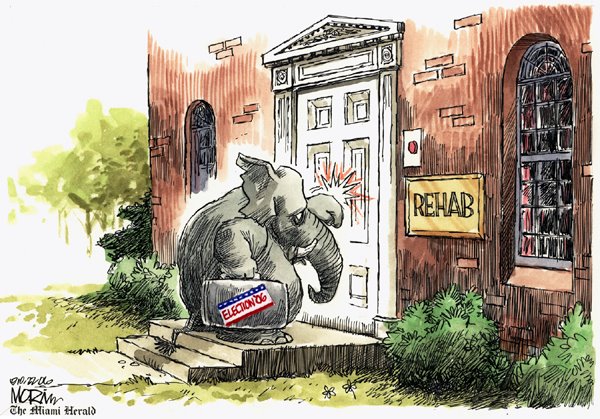
Knock, knock, can anyone help in time for the election?
We have been good people, promise we have.
Ask God, he is on our side !
Please answer the door, please !


Morning Papers - continued
Miami Herald
Weaker Paul still may bring flooding to Mexico
Hurricane Paul weakened to a tropical storm off Mexico's Pacific coast, but at least two people died in the storm.
BY MARK STEVENSON
Associated Press
SAN JOSE DEL CABO, Mexico -- Tropical Storm Paul weakened Tuesday as it headed toward the southern tip of the Baja California peninsula, still threatening to cause heavy flooding on Mexico's mainland.
A Baja California fisherman died after slipping off seabattered rocks, and rescue workers were searching for an American who they feared had drowned after being swept out to sea by the surging waves.
Paul had maximum sustained winds near 50 mph and was moving north at about 13 mph, but was expected to further weaken before slipping just south of Los Cabos early today, the U.S. National Hurricane Center in Miami said.
Forecasters, however, warned that remnants of the storm could still dump up to 10 inches of rain in the mountains on Mexico's mainland, potentially causing severe flooding.
A 23-year-old Mexican fisherman died Monday after he slipped off rocks pounded by the rough sea in Todos Santos, north of Los Cabos, according to José Gajón, the Baja California Sur state civil defense director.
http://www.miami.com/mld/miamiherald/15841189.htm
Crist, Davis aggressive in first TV debate
In a debate in Davie, gubernatorial candidate Jim Davis said he will stand up to insurers; Republican opponent Charlie Crist hit the Democrat on his House attendance record.
BY BETH REINHARD AND NOAH BIERMAN
Florida's candidates for governor got aggressive in their first head-to-head debate Tuesday night, pushing themes from their television advertisements and knocking each other as feckless leaders.
A lackluster, lopsided race picked up tempo Monday after a surprising poll showed Republican Attorney General Charlie Crist's lead over Democratic Rep. Jim Davis was tightening.
Crist didn't act like a complacent front-runner. He repeatedly took Davis to task for missing votes in Congress, accused him of wanting to raise taxes and called his insurance plan a ''risky scheme.'' He also revived an attack that dominated the Democratic primary: Davis' 1990 vote against restitution for two wrongfully convicted black men.
Crist balanced his sharp attacks with a cheery outlook for Florida's future, marveling at the balmy weather and referring to popular politicians -- even Democrats, including former Gov. Lawton Chiles.
Davis dished out just about as much as he got, accusing Crist of backing ''special interest tax giveaways.'' Referring to Florida's low graduation rates and high insurance costs, he warned voters that Crist wants to ''stay the course'' on such issues.
http://www.miami.com/mld/miamiherald/15841174.htm
Liberty Seven tipster gets 14-month sentence for gun possession
BY JAY WEAVER
A Chicago man who tipped prosecutors to the alleged plans of a local group of suspected terrorists -- the so-called Liberty Seven -- pleaded guilty to gun charges today in a Miami federal court.
Sultan Khanbey, 51, was sentenced by U.S. District Judge Marcia Cooke to 14 months in prison with credit for the time he has served since his arrest in May.
Khanbey first came to the attention of authorities last April when he was arrested by Miami police after firing a gun inside the alleged terror group's Liberty City warehouse.
Freed on bond, Khanbey was re-arrested the following month by Alcohol, Tobacco and Firearm agents and charged with being a convicted felon in possession of a gun. That's when Khanbey, who had a falling-out with certain members of the group, started cooperating with the terror investigation.
Investigators learned Khanbey was the mentor and teacher of Narseal Batiste, the Liberty Seven's alleged ringleader. Khanbey, who had first met Batiste in Chicago, accused him of allowing government informants to infiltrate the Miami group.
In June, Batiste and six other defendants were indicted on terrorism conspiracy charges in a high-profile case involving two FBI informants of Arabic descent who penetrated the Liberty City organization.
Authorities say the group wanted to blow up the tallest building in the United States -- the Sears Tower in Batiste's native Chicago -- along with the FBI headquarters in North Miami Beach and the federal courthouse complex in downtown Miami.
Seijas faces Dec. 19 recall vote
Voters in Northwest Miami-Dade will vote Dec. 19 on whether to keep a sitting commissioner -- Natacha Seijas -- in office.
BY CHARLES RABIN
crabin@MiamiHerald.com
Natacha Seijas, the pugnacious county commissioner from Northwest Miami-Dade, will face a recall vote a week before Christmas -- the first recall vote of a sitting county commissioner in more than three decades.
Tuesday morning, seated at the dais among her peers, Seijas read from a prepared statement, criticizing the citizens group that gathered signatures supporting a recall and accusing one of its organizers of attempting to take her seat on the commission.
Seijas asked for and received the unanimous support of the 13-member commission to schedule a vote for Dec. 19. Though she charged that hundreds of signatures were obtained fraudulently, she said she had decided to halt any further effort to fight the certified votes in the courts.
''I have come to respect the rulings of our judicial branch, even when I do not agree with them,'' Seijas said. ``Hopefully, the organizers of this fraud will one day be held accountable.''
`AN URGENCY'
Michael Pizzi, the attorney and Miami Lakes town councilman who Seijas believes wants her seat, wouldn't rule out a run for District 13 if Seijas were recalled. But he denied he pushed for the recall as a power grab.
http://www.miami.com/mld/miamiherald/15840956.htm
Danny Rolling is executed for Gainesville killings
BY MARC CAPUTO AND STEPHANIE GARRY
MEMORIAL: Sadie Darnell, who was the police department's spokeswoman at the time of the 1990 murders, looks at a panel on a graffiti wall with the names of the victims in Gainesville.
STARKE - Danny Rolling, the man who murdered five University of Florida students and plunged the city of Gainesville into panic in the summer of 1990 was executed tonight.
The governor's office said Rolling, 52, died around 6:13 p.m.
Rolling didn't give a last word just before he died. Instead he sang a hymn in his haunting Southern drawl. Rolling, who had a Pentecostal advisor minister to him before his execution, repeatedly sang: ``None greater than thee, O Lord, none greater than thee.''
The song also made a reference out of the New Testament book of Corinthians, about about seeing ``through a glass now darkly.''
About 15 members of the victims' families watched the execution, some stone-faced, some shaking their heads, and some grimacing and rubbing their eyes.
The five victims, students who had just arrived at UF after the summer break and were preparing for classes, were mutilated and some of the women sexually assaulted.
Rolling died after a final appeal with the U.S. Supreme Court was unsuccessful.
He pleaded guilty in 1990 to the murders of Sonja Larson, 18, Christi Powell, 17, Crista Hoyt, 18, and Tracy Paules and Manny Taboada, both 23.
During the afternoon today, about 200 people gathered outside Florida State Prison, about evenly divided between pro and anti-death penalty advocates.
Supporters of the death penalty -- among them friends of the victims -- began cheering and whistling when news that the execution had occurred leaked out.
Opponents of the death penalty stood in a circle began singing ``Amazing Grace.''
''It's just justice for the victims. It doesn't bring them back, but at least they know he's going to meet his maker,'' said Tonya Wilson, 34, who was to be the roommate of victims Sonja Larson and Christi Powell. Wilson had not had a chance to move in yet before her fellow students were slain.
Aid to Colombia will stay the same despite rights allegations
The Bush administration pledged to extend Plan Colombia for another two years, but some funding outlays are being delayed over corruption concerns.
BY SIBYLLA BRODZINSKY AND PABLO BACHELET
BOGOTA - The Bush administration plans to keep U.S. aid to the Colombian military at current levels through 2008 despite human rights and corruption scandals that already have delayed some U.S. disbursements, a top official said Tuesday.
''We intend to ask our Congress to maintain the current level of funding'' for 2007 and 2008, said Nicholas Burns, the State Department's acting No. 2 official, with the title of under secretary of political affairs.
But Burns also noted that he would raise the recent allegations of corruption scandals and human rights abuses in the army, reported by the media and non-government organizations (NGOs) here, during his two-day visit.
''We raise these issues when there are allegations made by credible NGOs,'' he told reporters on his arrival, ``and I will be raising them with Colombian officials.''
http://www.miami.com/mld/miamiherald/15841191.htm
Family killed on Turnpike buried in Texas ceremony
BY LYNN BREZOSKY
The Associated Press
BROWNSVILLE, Texas - A mariachi group played funeral songs Monday as mourners buried a family of four who were gunned down along Florida's Turnpike after pulling to the side of the road.
About 200 mourners watched as four caskets were placed side-by-side in a single grave. Some wore white T-shirts printed with family photos and the words ``In Memory of the Escobedo Family.''
Investigators believe the family's Jeep was pulled to the side of Florida's Turnpike early Oct. 13 and that someone inside the vehicle shot the family and drove away. Authorities have said the victims appeared to be lying or kneeling when shot.
There have been no arrests, and authorities have not revealed a motive for the slayings of Yessica Guerrero Escobedo, 25; her husband, Jose Luis Escobedo, 28; and the couple's toddler boys, Luis Julian, 4, and Luis Damian, 3. The family had moved from Texas to Florida just four months earlier.
Their bodies were found in a grassy area off the highway in Port St. Lucie. The couple's vehicle was found abandoned 70 miles south in West Palm Beach.
At a funeral service, Deacon Roberto Cano remembered marrying the couple in December 2002. ''They were in love. They were very ready to begin married life, to begin a family,'' he said in Spanish. ``Know that Jose Luis and Jessica are in the realm of God.''
U.N. will slam trade embargo, Cuban predicts
WASHINGTON - (AP) -- American hostility toward Cuba has reached ''unprecedented levels'' under the Bush administration, a senior Cuban official said Tuesday. He predicted that the U.N. General Assembly will deliver a sharp rebuke of U.S. policies in a resolution next month.
Cuba's chief diplomat in Washington, Dagoberto Rodríguez, said the world assembly will denounce the U.S. trade embargo against Cuba, as it has each year since the early 1990s.
''The longest running and most ruthless blockade ever known to mankind will be rejected again,'' Rodríguez said, noting that 182 countries voted to end ''this cruel and genocidal policy'' last year.
He said the United States pursues regime change in Cuba and seeks to annex the island.
The Bush administration says it is seeking, through a policy of economic denial and other means, a peaceful transition to democracy on the island.
In response to a question about the possible reinstatement of Fidel Castro, Rodríguez said, ``His health has been improving every day. He will soon be assuming his duties as president.''
A month ago, Foreign Minister Felipe Pérez Roque said Castro will take charge on Dec. 2. He relinquished power to his brother, Raúl, on July 31 after reportedly undergoing intestinal surgery.
Industry player: Stacy Frati's Hialeah factory cranks out her Sweet Pea line
BY VALERIE NAHMAD
It is the late 1990s and grunge is all the rage. We're wearing Guess jeans and skorts while watching the first season of MTV's The Real World.
Fashion agent and native New Yorker Stacy Frati has a glaring hole in her closet. She spends her days with industry insiders, but she can't find a reliable, sexy, stylish top to wear with jeans. That elusive flirty shirt nags at her.
Frustrated, ambitious and in love with third-generation Italian textiler Mario Frati, she decides to take matters into her own hands -- and head to Miami.
And so began Sweet Pea by Stacy Frati, today a player in the $92 billion women's apparel business. The popular line of tops and dresses has since permeated the retail market, distinguished by its signature nylon mesh fabric.
Her flouncy baby doll tanks, flirty halter dresses and form-framing tunics hang on racks at Nordstrom, Anthropologie and local boutiques Scarlet and IOS. Frati introduces 25 new styles and patterns each month, steadily churning out a functional, sexy and inherently wearable line.
''The clothes have flavor,'' Frati says. ``They talk to you. They tell you which shoes match, what jewelry goes. You shouldn't have to worry about how to wear them.''
Indeed, a crimson halter dress patterned with bright flowers screams flip-flops and funky necklace, while a black and white tunic calls out for ballet flats and pearls. Frati understands what the clothes say to her customers because she is one.
http://www.miami.com/mld/miamiherald/living/15834207.htm
STRAIGHT TO THE POINT
Eat your veggies
A big fear of Americans as they get older is the mental decline that often accompanies old age. Now, along comes a new research study that says consuming vegetables helps to stave off this dreaded disability.
Granted, there is no cause-and-effect proof -- yet. But the study reported in yesterday's Miami Herald offers evidence that vegetables are good for the heart and the brain.
Aging baby boomers should heed the study. It says that two vegetable servings a day can improve mental function and deliver a better lifestyle.
The study of 1,946 men and women aged 65 and older was conducted by a Chicago medical center, published in the journal Neurology, and funded by the National Institute on Aging.
All of that just to prove the truth of what Mom used to say -- eat your veggies!
Yes, expand the canal
OUR OPINION: MODERNIZED WATERWAY WILL BE A BOON TO COMMERCE
Without a doubt, the people of Panama made the right choice on Sunday by approving a $5.25 billion plan to modernize the Panama Canal by building a third set of locks on the Atlantic and Pacific sides of the waterway. This will ensure that newer container ships, cruise liners and tankers that are too wide for the canal's present dimensions will be able to navigate it in the future.
The project will double the capacity of the 50-mile canal, which remains one of the engineering marvels of the world. If completed in eight years as currently expected, the new locks could be inaugurated in time to celebrate the 100th anniversary of the canal.
Over the years, the canal has been a mainstay of Panama's economy, providing jobs and revenue. The expansion will ensure that it remains an essential route for seafaring commerce in an age when global business networks are multiplying.
It is important for the United States, as well. Roughly two-thirds of shipping traffic using the canal is destined for or originates in this country. That figure will likely rise even higher after expansion is complete.
About 18 percent of traffic through the canal comes from China, making it the second-biggest user. As a result of the expansion, the impact on Florida -- and anyone living and working on the East Coast of the United States -- will be direct and favorable.
Since taking control of the waterway in 2000, the Panama Canal Authority has run this vital shipping channel safely and efficiently. It expects to pay for the project by gradually increasing tolls, although shippers support the expansion because they see it as a boon to commerce. As U.S. Ambassador to Panama William Eaton said after the vote, transit costs from Asia will be cheaper, ``and that will have an effect on the market.''
Stand against racism
Our community owes a debt of gratitude to Rep. Gus Barreiro for his decision to speak out in what otherwise might seem a conspiracy of silence shrouding the racist epithets state Rep. Ralph Arza allegedly used.
I regret that Barreiro and his family have had to endure threats. Perhaps if there were more of a public outcry among leaders against racist speech and behavior, regardless of the offender's position of power, there would be more safety for the few who choose to do the right thing. Perhaps the few would become the many.
Such an outcry would send the clear signal that we no longer will tolerate hateful speech, not among our neighbors and certainly not among our elected leaders.
JIM HOWE, executive director, Greater Miami Region of The National Conference for Community and Justice, Miami
Blaming `emotions'
It is discouraging to hear public figures such as Ralph Arza, Johnny Winton and Mel Gibson blame alcohol and their ''emotions'' for their embarrassing tirades and actions. In the most recent example, Arza said, ''My emotions got the best of me'' and that this tends to happen when he drinks too much alcohol.
Arza's emotions are a part of who he is; they are not a distinct evil spirit that acts on a helpless person.
http://www.miami.com/mld/miamiherald/news/opinion/15841208.htm
Seoul Times
http://theseoultimes.com/ST/index.html
UK Deputy PM John Prescott to Visit Seoul
The Right Honourable John Prescott MP, the UK's Deputy Prime Minister since 1997, will arrive in Seoul on Tuesday 24th October on a two-day visit aimed at further strengthening the relationship between the UK and the Republic of Korea.
The visit demonstrates both countries' commitment to the strong bilateral relationship. Reflecting his broad range of responsibilities, the Deputy Prime Minister will pay a series of calls on high-level members of the Korean government. Meetings will be held with Prime Minister Han Myeong-sook, Foreign Minister and UN Secretary General designate Ban Ki-moon, Minister for Environment Lee Chi-beom and Minister of Commerce, Industry and Energy Chong Se-kyeon, to discuss how the two governments can collaborate more closely in a range of areas.
Strong trade and investment ties have long been the hallmark of the bilateral relationship. An increasing number of British companies are doing good business in and with Korea. On the morning of Wednesday 25th the Deputy Prime Minister will mark the arrival in Korea of one of the UK's most respected luxury car marques by opening the first official dealership for Bentley Motors Korea in Seoul.
Recognising some of the more established business relationships between the two countries, later that evening the Deputy Prime Minister will be guest of honour at the British Chamber of Commerce in Korea's (BCCK) annual awards ceremony. The BCCK awards acknowledge excellence in business relationships. The occasion will see the announcement of the winners of the hotly-contested awards in Corporate Social Responsibility, Trade and Investment between Korea and the UK, and Partnership between a Korean and UK organisation.
The visit will also include a reception for some of those who work and contribute to the bilateral relationship and an opportunity for the Deputy Prime Minister to pay his respects to UK servicemen and women who served during the Korean War.
Media Opportunities
7: 30 p.m. Tuesday 24 October. Photo opportunity at reception at Orchid Room, Westin Chosun Hotel.
7: 00 p.m. Wednesday 25 October. Photo opportunity and speech at the BCCK annual awards ceremony, Topaz room, Shilla Hotel.
For media enquiries contact Jenny Hong, British Embassy Media Officer on 02 3210 5562,
Who Is John Prescott?
John Prescott was appointed Deputy Prime Minister in 1997 and is one of the longest-serving members of Her Britannic Majesty's Government. In May 2006 the Prime Minister asked John Prescott to chair a number of major Cabinet Committees and to oversee the efficient development of Government policy.
He also asked him to continue his international role particularly with regard to China and Eastern Europe and, in recognition of his work in delivering the Kyoto Treaty, to work with the Foreign Secretary and the Secretary of State for the Environment on developing the post Kyoto agenda. This will be Mr Prescott's first visit to Korea.For over 60 years Bentley's factory in Crewe in the north of England has been producing some of the world's most luxurious and desirable cars. The luxury British car manufacturer has established Bentley Motors Korea, its official importership in the Korean market. The opening of their dealership partner Bentley Seoul in Cheongdam-dong will mark the company's first official inroads into the Korean market. The opening ceremony of Bentley Seoul is by invitation only. www.bentleyseoul.com, www.bentleymedia.com
The BCCK annual awards are now in their second year and were presented in 2005 by His Royal Highness The Duke of York. Reflecting their high-profile guests of honour, the awards have developed a reputation for recognising business excellence and highlighting the benefits that foreign investment brings to both the UK and Korea. The awards attract significant interest in the business community and attract a high standard of applications from British and Korean companies. www.bcck.or.krBritain was second only to the United States in the contribution it made to the UN effort during the Korean War. 87,000 British servicemen and women took part in the Korean conflict. 1,109 Britons lost their lives and 2,674 were wounded.
N. Korean leader told China
2nd Nuke Test Hinges on US: Sources
North Korean leader Kim Jong Il told a Chinese envoy in talks last week that while Pyongyang has no plan at the moment to carry out more nuclear tests, whether it will do so in the future hinges on U.S. policy toward the country, Kyodo News reported on Oct. 22 quoting diplomatic sources in Beijing..
In the meeting with State Councilor Tang Jiaxuan, Kim also repeated North Korea's position that it will return to the six-party nuclear talks if the United States lifts sanctions on a Macao-based bank suspected of laundering money and counterfeiting for North Korea, the sources said.
Tang visited North Korea on Wednesday and Thursday as Chinese President Hu Jintao's envoy to help resolve the standoff over North Korea's Oct. 9 nuclear test.
The content of Tang's conversation with Kim has not been made public, although Tang briefed U.S. Secretary of State Condoleezza Rice about it when they met in Beijing on Friday, and China has discussed it with some other countries.
According to the sources, Kim said that while there is no plan to hold a second nuclear test for the moment, North Korea "would have to respond if the United States continues to pressure" the country.
Kim also said he thinks the United States is trying to crush North Korea by taking a hostile policy against it, and complained about the U.S. financial sanctions, which have been in place since September 2005, the sources said.
He called the financial sanctions "an obstacle" to the six-party talks on North Korea's nuclear programs, and said that it would be possible for Pyongyang to return to the discussions if there is a guarantee that the sanctions will be lifted, according to the sources.
North Korea does not wish for a deterioration of the situation, but future developments will depend on the actions of the United States, Kim was quoted by the sources as telling Tang.
The six-party talks involving the two Koreas, the United States, China, Japan and Russia have stalled since last November, with North Korea refusing to participate until the United States lifts the financial sanctions.
The United States has rejected that demand, saying the sanctions are a law enforcement issue that should not be linked to the nuclear negotiations.
Kim's comments were made in response to a message from Hu conveyed by Tang, telling North Korea that it is important to achieve a breakthrough in the current situation through the six-party talks, the sources said.
In the talks, Tang urged Pyongyang not to go ahead with a second nuclear test, saying that North Korea should not carry out any acts that would further aggravate the situation, according to the sources.
He also told Kim that North Korea becoming a nuclear power is not beneficial either for North Korea or the East Asia region, according to the sources.
Tang, who visited the United States and Russia before visiting North Korea, conveyed to Kim the U.S. position that North Korea's nuclear test is unacceptable, and that Washington will protect Japan and South Korea in line with its bilateral treaties with the two countries, the sources said.
He also told North Korea that the United States still hopes to resolve the issue through peaceful means, and that the country wants Pyongyang to return to the six-party talks as soon as possible, according to the sources.
In response to the nuclear test, the U.N. Security Council adopted a resolution on Oct. 14 against North Korea, paving the way for economic and diplomatic sanctions against the country.
China takes tough stance on North Korea
An exasperated China took a newly tough approach to communist ally North Korea on Friday, siding with the United States in saying the North must back away from nuclear confrontation, and moving to cut Pyongyang's vital supply of hard currency, the Associated Press reported on Oct. 14 in its Beijing-datedlined dispatch.
Chinese banks have stopped financial transfers to North Korea under government orders, bank employees said Friday. And at an appearance with Secretary of State Condoleezza Rice, China's foreign minister nudged the North to resume negotiations over its nuclear program and assured Washington that China would carry out United Nations sanctions on Pyongyang.
"We hope all relevant parties will maintain coolheadedness, adopt a prudent and a responsible approach and adhere to peaceful dialogue," Li Zhaoxing said as Rice concluded crisis talks in Asia following the North's Oct. 9 nuclear test blast.
China, which is North Korea's longtime protector, has been reluctant in the past to use economic pressure for fear Kim Jung Il's government might collapse.
But Chinese leaders were stung when the North ignored their warnings not to test-fire missiles over the summer, and again when it defied Beijing by detonating the underground blast this month. China previously had reduced food aid to North Korea amid complaints that Pyongyang had ignored Chinese interests.
The move by China's banks could deal a significant blow to the already impoverished North. China is North Korea's top trading partner — accounting for more than half its total foreign trade of less than $4 billion last year — and is a key conduit for its hard currency.
China's actions are considered key to enforcing U.N. sanctions on the North over the test, and to coaxing the North to back away from the nuclear brink and rejoin talks.
Rice told reporters China has new resolve against the North that shows it has re-evaluated its relationship with Pyongyang. Last week's U.N. Security Council vote to impose sanctions on Pyongyang, which Beijing supported, proves the point, Rice said.
"In this entire 30-year history of the North Korean nuclear program, this is the first time that the international system has been able to actually impose a cost on North Korea for its nuclear behavior," Rice said. "It's able to impose that cost because China has been brought into the process in a way that China never was before."
The U.S.-backed sanctions were watered down partly at China's request, but China's vote in favor of punishment still represents a shift for Beijing.
All four major Chinese state-owned banks and British-owned HSBC Corp. have stopped financial transfers to the North, according to bank employees in Beijing and the northeastern Chinese city of Shenyang.
China has also been inspecting North Korean trucks at some points along the two nations' 880-mile border, and it dispatched a top envoy to Pyongyang this week to warn the North against a second nuclear test and try to bring it back to the arms talks.
Discussions over Pyongyang's nuclear program have been stalled for a year because of a boycott by the North over U.S. financial sanctions. The talks involve the United States, host China, the two Koreas, Japan and Russia.
Beijing was the final and most important stop on Rice's hastily arranged tour of Asian capitals. She continues to Moscow on Saturday for talks on the dual nuclear challenges posed by North Korea and Iran.
In Beijing, Rice appealed to North Korea to return without condition to stalled international talks over its nuclear program. She downplayed differences among the U.S., China and South Korea over the strength and tone of world response to Pyongyang.
The U.N. sanctions ban trade with the North in major weapons and materials that could be used by its ballistic missile and unconventional weapons programs, and in luxury goods enjoyed almost exclusively by elites around Kim.
The U.N. restrictions call for inspections of all cargo leaving and arriving in North Korea, but it is not clear how that will work in practice. Rice has stepped gingerly around that point this week, saying all nations are obligated to enforce the sanctions but leaving the details vague.
Several Defense Department officials said Friday that the U.S. Navy is tracking a North Korean cargo ship that left port and was headed south from the Korean Peninsula. One of the officials, who requested anonymity because of the sensitivity of the information, said the U.S. does not know what the ship is carrying or its destination.
South Korean news reported Friday that Kim said Pyongyang doesn't plan to carry out any more nuclear tests and expressed regret about the country's first-ever atomic detonation last week. Kim told a visiting Chinese envoy, State Councilor Tang Jiaxuan, that the North had "no plans for additional nuclear tests," Yonhap news agency reported, citing an unnamed diplomatic source in Beijing.
Rice met with Tang in Beijing on Friday and later told reporters that he had carried a "strong message to North Korea about the seriousness of what has happened."
Rice would not provide details of Kim's response, but White House press secretary Tony Snow told reporters in Washington that the North had not offered to return to six-nation arms talks stalled since late last year.
OPEC to Cut Output by 1.2 Mil bbls Per Day
DOHA (WAM) — In a surprise move, the Organization of Petroleum Exporting Countries (OPEC) announced Friday that it has decided to cut its oil output by 1.2 million barrels per day to 26.3 million bpd from November 1.
The group took the decision at a consultative meeting held in Doha on Oct.20..
Speaking at a news conference, UAE Energy Minister Mohammad bin Dhaen Al Hamli said: "We are cutting from actual production of 27.5 million. Every country is cutting production .. We are talking about the OPEC 10." The cut is the biggest since 2002 and also the first since December 2004, when oil traded slightly above US$40 a barrel.
Crude futures rose on Thursday as OPEC unexpected cut was announced.
New York's main contract, light sweet crude for delivery in November, gained 85 cents to close at 58.50 dollars a barrel. London's Brent North Sea crude for December delivery jumped 1.29 dollars to a settlement of 60.87 dollars a barrel.
The group will meet again in December 14th in the Nigerian capital of Abuja.
US Bishops Given Misleading Guidlines
Cardinal Theodore Edgar McCarrick
Catholic bishops have been mislead regarding Vatican guidelines on the reception of Holy Communion by Catholic politicians in the USA. Consider the following:
"It is sometimes claimed that dissent from the magisterium is totally compatible with being a 'good Catholic' and poses no obstacle to the reception of the sacraments. This is a grave error"
- Pope John Paul II (Los Angeles speech to U.S. bishops, Sept. 16, 1987).In June, 2004 Cardinal Ratzinger, (now Pope Benedict XVI) sent a memorandum to Cardinal McCarrick that offered guidelines to bishops for discussing the Communion/abortion issue at their meeting near Denver. However, Cardinal McCarrick did not reveal critical contents of the cover letter to the bishops, but instead suggested each bishop decide for himself the action to be taken.
Some of the key points in that cover letter:
1. In the case of abortion or euthanasia, a Catholic politician manifests "formal cooperation" in grave sins by "consistently campaigning and voting for permissive abortion and euthanasia laws."
2. The politician's pastor should "meet with him, instructing him about the Church's teaching, informing him that he is not to present himself for Holy Communion until he brings to an end the objective situation of sin, and warning him that he will otherwise be denied the Eucharist."
3. "When these precautionary measures have not had their effect or in which they were not possible, and the person in question, with obstinate persistence, still presents himself to receive the holy Eucharist, the minister of Holy Communion must refuse to distribute it."
4. "Nor is the minister of Holy Communion passing judgment on the person's subjective guilt, but rather is reacting to the person's public unworthiness to receive Holy Communion due to an objective situation of sin."
Unfortunately, a number of two-faced "Catholic" politicians (especially spiritually warped, permissive liberals in the Democratic Party) are taking advantage of this confusion.
Vincent Bemowski - Writer (U.S. Politics & World Affairs & Veteran, U.S. Army)
1325 Lucerne Dr. Apt. 12Menasha, WI 54952 USAWebsite: Catholic Messages USA http://www.catholicmessagesusa.com/ bemowskivince@sbcglobal.net
World Citizens Reject Torture: Global Poll
Special ContributionBy Doug MillerPresident of GlobeScan Incorporated
A torture scene
A majority of people around the world are opposed to torture even if its purpose is to elicit information that could save innocent lives from terrorism, according to a BBC World Service poll of more than 27,000 people in 25 different countries.
The poll shows 59 percent of the world's citizens are unwilling to compromise on the protection of human rights, however 29 percent think governments should be allowed to use some degree of torture in order to combat terrorism.
Most Americans (58%) are against any use of torture. But opposition to torture in the US is less robust than in Europe and the percentage of Americans favouring the practice in certain cases (36%) is one of the highest among the 25 countries polled.
The survey of 27,407 respondents across 25 countries was conducted for the BBC World Service by the international polling firm GlobeScan together with the Program on International Policy Attitudes (PIPA) at the University of Maryland. GlobeScan coordinated fieldwork from May through July 2006.
Steven Kull, director of the Program on International Policy Attitudes, notes, "The dominant view around the world is that terrorism does not warrant bending the rules against torture."
GlobeScan President, Doug Miller, adds, "The poll reveals a public opinion climate in which human rights violations by governments are likely to cause outrage, especially in Western Europe."
There is however somewhat less support for outlawing torture in several countries that have suffered terrorism attacks or political violence including India, where slightly more respondents (32%) favour relaxing the rules against torture than not (23%).
The largest percentage endorsing torture was found in Israel. Forty-three percent say some degree of torture should be allowed, though slightly more, (48%) think the practice should be prohibited.
Italians are the most opposed to the use of torture with 81 percent against, followed by three-quarters of respondents in Australia and France, 74 percent in Canada, 72 percent in the UK, and 71 percent in Germany.
Countries polled were Australia, Brazil, Canada, Chile, China, Egypt, France, Germany, Great Britain, India, Indonesia, Iraq, Israel, Italy, Kenya, Mexico, Nigeria, Philippines, Poland, Russia, South Korea, Spain, Turkey, Ukraine, and the US.
Respondents were asked the following question:
Most countries have agreed to rules that prohibit torturing prisoners. Which position is closer to yours?
Terrorists pose such an extreme threat that governments should now be allowed to use some degree of torture if it may gain information that saves innocent lives.
Clear rules against torture should be maintained because any use of torture is immoral and will weaken international human rights standards against torture. The poll found strong support for the latter position in favour of upholding the rule against torture with a majority in 19 countries endorsing it, plus another 5 with a plurality. There is however somewhat less support for outlawing torture in several countries that have suffered terrorist attacks or political violence including India, where a slight plurality favours relaxing the rules against torture.
All of the countries surveyed are parties to the Geneva Conventions that contain Article 3 forbidding torture as well as other forms of abuse. All countries surveyed are also parties to the more recent Convention Against Torture that goes further in how explicitly it prohibits torture, except India, which has signed but not yet ratified it.
Italians (81%) are the most opposed to the use of torture in all circumstances and the British are among the highest with 72 percent opposed and 24 percent in favor. Other countries with high numbers favouring a total ban are in Australia and France (75% in both) as well as Canada (74%) and Germany (71%). Only in India do more respondents favour allowing "some degree of torture:" Thirty-two percent say using physical coercion is sometimes permissible—a bit more than the 23 percent who say existing rules should be maintained. Nearly half of Indian respondents (45%) favour neither position or did not answer. India has a long history with terrorism and political violence, including a 2001 attack on its Parliament. This survey was completed before July 11, 2006 when terrorists bombed seven crowded commuter trains in Mumbai. Interestingly, there is no difference in the views of Hindus and Muslims in India on this question.
The largest percentage endorsing torture is found in Israel where 43 percent say that some degree of torture should be allowed, though slightly more (48%) say the practice should be prohibited. Israeli responses vary significantly by religion. A majority of Jewish respondents (53%) favour allowing governments to use torture to obtain information while 39 percent want clear rules against it. In contrast, Muslims in Israel (who represented 16 percent of total responses in that country) are overwhelmingly (87%) against any use of torture. No other country polled has a majority of any major religious subgroup that favours allowing torture.
In addition to India and Israel, there were four other countries where those rejecting torture fell short of a majority: Russia (43% reject torture, 37% accept), Nigeria (49% reject, 39% accept), China (49% reject, 37% accept), and Mexico (50% reject, 24% accept).
In the United States, most Americans (58%) oppose any use of torture. But opposition to torture in the United States is less robust than in Europe and the percentage of Americans favouring the practice in certain cases (36%) is one of the highest among the 25 countries polled.
There is little variation in the worldwide averages by income or education. But support for a ban on torture increases slightly with age: 57 percent of those younger than 35 years old were against torture compared to 61 percent of those 35 and older. Men are five points more likely to accept some use of torture than are women. As for religion, Israel is the only country where statistically significant differences exist between major religious groups on this question.
In total 27,407 citizens in Australia, Brazil, Canada, Chile, China, Egypt, France, Germany, Great Britain, India, Indonesia, Iraq, Israel, Italy, Kenya, Mexico, Nigeria, Philippines, Poland, Russia, South Korea, Spain, Turkey, Ukraine and the United States were interviewed between 26 May and 6 July 2006. Polling was conducted for the BBC World Service by the international polling firm GlobeScan and its research partners in each country. In 7 of the 25 countries, the sample was limited to major urban areas. The margin of error per country ranges from +/-2.5 to 4 percent.
For more details, please see the Methodology section or visit www.globescan.com or www.pipa.org.
For contact: Doug Miller, PresidentGlobeScan Incorporated, London+44 20 7958 1735(Mobile: +44 78 999 77 000)Doug.Miller@GlobeScan.com
The Chicago Tribune
Sensitive CT scanners offer hope to lung cancer patients
By Ronald KotulakTribune staff reporterPublished October 25, 2006, 5:47 PM CDT
A new generation of CT scanners that can detect a cancer in the lungs as small as a grain of rice -- when the tumor is still highly curable -- is raising hopes that screening may dramatically reverse the grim outlook for lung cancer just as mammography did for breast cancer.A major long-term study reported in Wednesday's issue of the New England Journal of Medicine estimated that at least 88 percent of patients whose early-stage lung cancer was detected through CT screening would survive for 10 years after the tumor was surgically removed.
The 10-year survival rate for people diagnosed with stage-one lung cancer is usually about 70 percent. But many tumors are not detected until they are more advanced and difficult to treat.
http://www.chicagotribune.com/news/local/chi-061025lungcancer,1,6362802.story?coll=chi-news-hed&ctrack=1&cset=true
New trial ordered in 1997 attack
By Maurice PossleyTribune staff reporterPublished October 25, 2006, 5:30 PM CDT
A federal judge has ordered a new trial for a man serving a 30-year prison term for a 1997 attack on a woman who was slashed in the face with a box cutter while waiting for a bus near Michael Reese Hospital.A jury convicted Robert Wilson, 51, in the Feb. 28, 1997, attack on June Siler as she stood in a bus shelter at 29th Street and King Drive.
But in a ruling signed last Friday, U.S. District Judge Ruben Castillo declared that Criminal Court Judge Kenneth Wadas had erroneously prohibited Wilson's defense lawyers from presenting evidence that another man had confessed to five similar slashing attacks in the same area. Jerryco Wagner confessed to the other attacks, which occurred shortly after Siler was slashed, saying, "God had ordered him to kill each of the victims because they were white," according to the ruling. Wagner was found mentally incompetent to stand trial and sent to a mental institution.
http://www.chicagotribune.com/news/custom/newsroom/chi-061025wilson,1,7543811.story?coll=chi-news-hed
Agents: Elmo Doll Used to Hide Drugs
By COLLEEN SLEVINAssociated Press WriterPublished October 25, 2006, 2:31 PM CDT
DENVER -- Authorities said Wednesday that they have broken up a methamphetamine ring that shipped the drug in toys including an Elmo doll. Agents said 19 people were in custody, including the alleged leader of the northern Colorado drug ring, and that they seized more than 45 pounds of what they described as high-quality methamphetamine.
Officials released photos of an Elmo doll found in a car in Barstow, Calif., with a caption saying 4 pounds of methamphetamine was found inside. Eid said he could not discuss what happened because the doll of the "Sesame Street" character was evidence in the case. Authorities said other toys also were used to hide drugs but did not elaborate. Other photos showed drugs shipped in a suitcase and tucked inside a tire. U.S. Attorney Troy Eid said the alleged ringleader, Rigoverto Valle-Sierra, was arrested Tuesday in Greeley after a yearlong investigation.
http://www.chicagotribune.com/news/nationworld/sns-ap-meth-ring,1,4523478.story?coll=chi-news-hed
Boeing income tumbles, stock loses ground
By Julie JohnssonTribune staff reporterPublished October 25, 2006, 11:23 AM CDT
Shares of Boeing Co. fell 3 percent in trading this morning after the aerospace company said its third quarter net income tumbled 31 percent to $694 million, or 89 cents a share.Contributing to the drop in profit: Boeing took a $280 million charge to shutter Connexion, its inflight broadband service, and also paid $615 million to the U.S. Department of Justice to resolve criminal and civil allegations that it rigged bids for federal contracts.Both moves had previously been disclosed by the Chicago-based company.Quarterly revenue rose 19 percent to $14.7 billion.Boeing continues to benefit as competitor Airbus SAS struggles to resolve production issues with its A380 jumbo jet.It booked 243 aircraft orders during the quarter and 730 for the first nine months of 2006. Revenues at its commercial aircraft business soared 45 percent to $6.7 billion from a year ago.Boeing expects its commercial aircraft business to buoy 2007 results, as well. The company boosted its earnings guidance for next year, saying it now expects to earn between $4.45 and $4.65, per share. That's 20 cents a share higher than its previous estimates.Jjohnsson@tribune.com
http://www.chicagotribune.com/business/chi-061025boeing,0,2654629.story?coll=chi-business-hed
Tom Cruise, Katie Holmes to Wed in Italy
By Associated PressPublished October 24, 2006, 4:42 PM CDT
NEW YORK -- Hollywood's most high-profile engaged couple have finally set a wedding date. Tom Cruise and Katie Holmes will marry in Italy on Nov. 18, Cruise's representative, Arnold Robinson, confirmed to The Associated Press on Tuesday. Holmes will wear a dress designed by Giorgio Armani, Robinson also confirmed.
The wedding date was reported by Us Weekly magazine on its Web site. Holmes, 27, and Cruise, 44, became engaged in June 2005. Their daughter, Suri, was born April 18. She made her debut on the cover of Vanity Fair magazine last month. The photo showed Suri peeking out of a jacket worn by Cruise with Holmes looking on. Cruise and Holmes were first photographed together in Rome in April 2005. Two months later, the "Mission: Impossible" actor announced he had proposed to Holmes atop the Eiffel Tower in Paris. Holmes, who starred in TV's "Dawson's Creek," was previously engaged to actor Chris Klein. Cruise, previously married to Mimi Rogers and Nicole Kidman, also had a high-profile romance with Penelope Cruz.
http://www.chicagotribune.com/entertainment/sns-ap-people-cruise-holmes-wedding,1,1690667.story?coll=chi-entertainmentfront-hed
Madonna blames media for baby furor
Published October 25, 2006
Madonna told Oprah Winfrey on Tuesday that she was surprised by the firestorm surrounding her efforts to adopt a 13-month-old boy from the African country of Malawi. And she blamed the media for it.The interview, taped via satellite from London, was to air Wednesday. It was the first time she'd spoken in depth about her adoption of David Banda.
According to a member of the "Oprah" audience, Madonna said she was startled by press reports about the boy's father, Yohane Banda, who was quoted last week as saying that he didn't realize he was signing away custody "for good.""She said she met with the father, she looked him in the eye," audience member Sheryl Lewis recounted. Madonna, Lewis added, said she acted according to the law and had "oral and written approval . . . and now the press have gotten to him."In an interview posted Tuesday on Time magazine's Web site, Banda said he will not contest the adoption."I don't want my child, who is already gone, to come back," he said. "I will be killing his future if I accept that."
continued ...
Weaker Paul still may bring flooding to Mexico
Hurricane Paul weakened to a tropical storm off Mexico's Pacific coast, but at least two people died in the storm.
BY MARK STEVENSON
Associated Press
SAN JOSE DEL CABO, Mexico -- Tropical Storm Paul weakened Tuesday as it headed toward the southern tip of the Baja California peninsula, still threatening to cause heavy flooding on Mexico's mainland.
A Baja California fisherman died after slipping off seabattered rocks, and rescue workers were searching for an American who they feared had drowned after being swept out to sea by the surging waves.
Paul had maximum sustained winds near 50 mph and was moving north at about 13 mph, but was expected to further weaken before slipping just south of Los Cabos early today, the U.S. National Hurricane Center in Miami said.
Forecasters, however, warned that remnants of the storm could still dump up to 10 inches of rain in the mountains on Mexico's mainland, potentially causing severe flooding.
A 23-year-old Mexican fisherman died Monday after he slipped off rocks pounded by the rough sea in Todos Santos, north of Los Cabos, according to José Gajón, the Baja California Sur state civil defense director.
http://www.miami.com/mld/miamiherald/15841189.htm
Crist, Davis aggressive in first TV debate
In a debate in Davie, gubernatorial candidate Jim Davis said he will stand up to insurers; Republican opponent Charlie Crist hit the Democrat on his House attendance record.
BY BETH REINHARD AND NOAH BIERMAN
Florida's candidates for governor got aggressive in their first head-to-head debate Tuesday night, pushing themes from their television advertisements and knocking each other as feckless leaders.
A lackluster, lopsided race picked up tempo Monday after a surprising poll showed Republican Attorney General Charlie Crist's lead over Democratic Rep. Jim Davis was tightening.
Crist didn't act like a complacent front-runner. He repeatedly took Davis to task for missing votes in Congress, accused him of wanting to raise taxes and called his insurance plan a ''risky scheme.'' He also revived an attack that dominated the Democratic primary: Davis' 1990 vote against restitution for two wrongfully convicted black men.
Crist balanced his sharp attacks with a cheery outlook for Florida's future, marveling at the balmy weather and referring to popular politicians -- even Democrats, including former Gov. Lawton Chiles.
Davis dished out just about as much as he got, accusing Crist of backing ''special interest tax giveaways.'' Referring to Florida's low graduation rates and high insurance costs, he warned voters that Crist wants to ''stay the course'' on such issues.
http://www.miami.com/mld/miamiherald/15841174.htm
Liberty Seven tipster gets 14-month sentence for gun possession
BY JAY WEAVER
A Chicago man who tipped prosecutors to the alleged plans of a local group of suspected terrorists -- the so-called Liberty Seven -- pleaded guilty to gun charges today in a Miami federal court.
Sultan Khanbey, 51, was sentenced by U.S. District Judge Marcia Cooke to 14 months in prison with credit for the time he has served since his arrest in May.
Khanbey first came to the attention of authorities last April when he was arrested by Miami police after firing a gun inside the alleged terror group's Liberty City warehouse.
Freed on bond, Khanbey was re-arrested the following month by Alcohol, Tobacco and Firearm agents and charged with being a convicted felon in possession of a gun. That's when Khanbey, who had a falling-out with certain members of the group, started cooperating with the terror investigation.
Investigators learned Khanbey was the mentor and teacher of Narseal Batiste, the Liberty Seven's alleged ringleader. Khanbey, who had first met Batiste in Chicago, accused him of allowing government informants to infiltrate the Miami group.
In June, Batiste and six other defendants were indicted on terrorism conspiracy charges in a high-profile case involving two FBI informants of Arabic descent who penetrated the Liberty City organization.
Authorities say the group wanted to blow up the tallest building in the United States -- the Sears Tower in Batiste's native Chicago -- along with the FBI headquarters in North Miami Beach and the federal courthouse complex in downtown Miami.
Seijas faces Dec. 19 recall vote
Voters in Northwest Miami-Dade will vote Dec. 19 on whether to keep a sitting commissioner -- Natacha Seijas -- in office.
BY CHARLES RABIN
crabin@MiamiHerald.com
Natacha Seijas, the pugnacious county commissioner from Northwest Miami-Dade, will face a recall vote a week before Christmas -- the first recall vote of a sitting county commissioner in more than three decades.
Tuesday morning, seated at the dais among her peers, Seijas read from a prepared statement, criticizing the citizens group that gathered signatures supporting a recall and accusing one of its organizers of attempting to take her seat on the commission.
Seijas asked for and received the unanimous support of the 13-member commission to schedule a vote for Dec. 19. Though she charged that hundreds of signatures were obtained fraudulently, she said she had decided to halt any further effort to fight the certified votes in the courts.
''I have come to respect the rulings of our judicial branch, even when I do not agree with them,'' Seijas said. ``Hopefully, the organizers of this fraud will one day be held accountable.''
`AN URGENCY'
Michael Pizzi, the attorney and Miami Lakes town councilman who Seijas believes wants her seat, wouldn't rule out a run for District 13 if Seijas were recalled. But he denied he pushed for the recall as a power grab.
http://www.miami.com/mld/miamiherald/15840956.htm
Danny Rolling is executed for Gainesville killings
BY MARC CAPUTO AND STEPHANIE GARRY
MEMORIAL: Sadie Darnell, who was the police department's spokeswoman at the time of the 1990 murders, looks at a panel on a graffiti wall with the names of the victims in Gainesville.
STARKE - Danny Rolling, the man who murdered five University of Florida students and plunged the city of Gainesville into panic in the summer of 1990 was executed tonight.
The governor's office said Rolling, 52, died around 6:13 p.m.
Rolling didn't give a last word just before he died. Instead he sang a hymn in his haunting Southern drawl. Rolling, who had a Pentecostal advisor minister to him before his execution, repeatedly sang: ``None greater than thee, O Lord, none greater than thee.''
The song also made a reference out of the New Testament book of Corinthians, about about seeing ``through a glass now darkly.''
About 15 members of the victims' families watched the execution, some stone-faced, some shaking their heads, and some grimacing and rubbing their eyes.
The five victims, students who had just arrived at UF after the summer break and were preparing for classes, were mutilated and some of the women sexually assaulted.
Rolling died after a final appeal with the U.S. Supreme Court was unsuccessful.
He pleaded guilty in 1990 to the murders of Sonja Larson, 18, Christi Powell, 17, Crista Hoyt, 18, and Tracy Paules and Manny Taboada, both 23.
During the afternoon today, about 200 people gathered outside Florida State Prison, about evenly divided between pro and anti-death penalty advocates.
Supporters of the death penalty -- among them friends of the victims -- began cheering and whistling when news that the execution had occurred leaked out.
Opponents of the death penalty stood in a circle began singing ``Amazing Grace.''
''It's just justice for the victims. It doesn't bring them back, but at least they know he's going to meet his maker,'' said Tonya Wilson, 34, who was to be the roommate of victims Sonja Larson and Christi Powell. Wilson had not had a chance to move in yet before her fellow students were slain.
Aid to Colombia will stay the same despite rights allegations
The Bush administration pledged to extend Plan Colombia for another two years, but some funding outlays are being delayed over corruption concerns.
BY SIBYLLA BRODZINSKY AND PABLO BACHELET
BOGOTA - The Bush administration plans to keep U.S. aid to the Colombian military at current levels through 2008 despite human rights and corruption scandals that already have delayed some U.S. disbursements, a top official said Tuesday.
''We intend to ask our Congress to maintain the current level of funding'' for 2007 and 2008, said Nicholas Burns, the State Department's acting No. 2 official, with the title of under secretary of political affairs.
But Burns also noted that he would raise the recent allegations of corruption scandals and human rights abuses in the army, reported by the media and non-government organizations (NGOs) here, during his two-day visit.
''We raise these issues when there are allegations made by credible NGOs,'' he told reporters on his arrival, ``and I will be raising them with Colombian officials.''
http://www.miami.com/mld/miamiherald/15841191.htm
Family killed on Turnpike buried in Texas ceremony
BY LYNN BREZOSKY
The Associated Press
BROWNSVILLE, Texas - A mariachi group played funeral songs Monday as mourners buried a family of four who were gunned down along Florida's Turnpike after pulling to the side of the road.
About 200 mourners watched as four caskets were placed side-by-side in a single grave. Some wore white T-shirts printed with family photos and the words ``In Memory of the Escobedo Family.''
Investigators believe the family's Jeep was pulled to the side of Florida's Turnpike early Oct. 13 and that someone inside the vehicle shot the family and drove away. Authorities have said the victims appeared to be lying or kneeling when shot.
There have been no arrests, and authorities have not revealed a motive for the slayings of Yessica Guerrero Escobedo, 25; her husband, Jose Luis Escobedo, 28; and the couple's toddler boys, Luis Julian, 4, and Luis Damian, 3. The family had moved from Texas to Florida just four months earlier.
Their bodies were found in a grassy area off the highway in Port St. Lucie. The couple's vehicle was found abandoned 70 miles south in West Palm Beach.
At a funeral service, Deacon Roberto Cano remembered marrying the couple in December 2002. ''They were in love. They were very ready to begin married life, to begin a family,'' he said in Spanish. ``Know that Jose Luis and Jessica are in the realm of God.''
U.N. will slam trade embargo, Cuban predicts
WASHINGTON - (AP) -- American hostility toward Cuba has reached ''unprecedented levels'' under the Bush administration, a senior Cuban official said Tuesday. He predicted that the U.N. General Assembly will deliver a sharp rebuke of U.S. policies in a resolution next month.
Cuba's chief diplomat in Washington, Dagoberto Rodríguez, said the world assembly will denounce the U.S. trade embargo against Cuba, as it has each year since the early 1990s.
''The longest running and most ruthless blockade ever known to mankind will be rejected again,'' Rodríguez said, noting that 182 countries voted to end ''this cruel and genocidal policy'' last year.
He said the United States pursues regime change in Cuba and seeks to annex the island.
The Bush administration says it is seeking, through a policy of economic denial and other means, a peaceful transition to democracy on the island.
In response to a question about the possible reinstatement of Fidel Castro, Rodríguez said, ``His health has been improving every day. He will soon be assuming his duties as president.''
A month ago, Foreign Minister Felipe Pérez Roque said Castro will take charge on Dec. 2. He relinquished power to his brother, Raúl, on July 31 after reportedly undergoing intestinal surgery.
Industry player: Stacy Frati's Hialeah factory cranks out her Sweet Pea line
BY VALERIE NAHMAD
It is the late 1990s and grunge is all the rage. We're wearing Guess jeans and skorts while watching the first season of MTV's The Real World.
Fashion agent and native New Yorker Stacy Frati has a glaring hole in her closet. She spends her days with industry insiders, but she can't find a reliable, sexy, stylish top to wear with jeans. That elusive flirty shirt nags at her.
Frustrated, ambitious and in love with third-generation Italian textiler Mario Frati, she decides to take matters into her own hands -- and head to Miami.
And so began Sweet Pea by Stacy Frati, today a player in the $92 billion women's apparel business. The popular line of tops and dresses has since permeated the retail market, distinguished by its signature nylon mesh fabric.
Her flouncy baby doll tanks, flirty halter dresses and form-framing tunics hang on racks at Nordstrom, Anthropologie and local boutiques Scarlet and IOS. Frati introduces 25 new styles and patterns each month, steadily churning out a functional, sexy and inherently wearable line.
''The clothes have flavor,'' Frati says. ``They talk to you. They tell you which shoes match, what jewelry goes. You shouldn't have to worry about how to wear them.''
Indeed, a crimson halter dress patterned with bright flowers screams flip-flops and funky necklace, while a black and white tunic calls out for ballet flats and pearls. Frati understands what the clothes say to her customers because she is one.
http://www.miami.com/mld/miamiherald/living/15834207.htm
STRAIGHT TO THE POINT
Eat your veggies
A big fear of Americans as they get older is the mental decline that often accompanies old age. Now, along comes a new research study that says consuming vegetables helps to stave off this dreaded disability.
Granted, there is no cause-and-effect proof -- yet. But the study reported in yesterday's Miami Herald offers evidence that vegetables are good for the heart and the brain.
Aging baby boomers should heed the study. It says that two vegetable servings a day can improve mental function and deliver a better lifestyle.
The study of 1,946 men and women aged 65 and older was conducted by a Chicago medical center, published in the journal Neurology, and funded by the National Institute on Aging.
All of that just to prove the truth of what Mom used to say -- eat your veggies!
Yes, expand the canal
OUR OPINION: MODERNIZED WATERWAY WILL BE A BOON TO COMMERCE
Without a doubt, the people of Panama made the right choice on Sunday by approving a $5.25 billion plan to modernize the Panama Canal by building a third set of locks on the Atlantic and Pacific sides of the waterway. This will ensure that newer container ships, cruise liners and tankers that are too wide for the canal's present dimensions will be able to navigate it in the future.
The project will double the capacity of the 50-mile canal, which remains one of the engineering marvels of the world. If completed in eight years as currently expected, the new locks could be inaugurated in time to celebrate the 100th anniversary of the canal.
Over the years, the canal has been a mainstay of Panama's economy, providing jobs and revenue. The expansion will ensure that it remains an essential route for seafaring commerce in an age when global business networks are multiplying.
It is important for the United States, as well. Roughly two-thirds of shipping traffic using the canal is destined for or originates in this country. That figure will likely rise even higher after expansion is complete.
About 18 percent of traffic through the canal comes from China, making it the second-biggest user. As a result of the expansion, the impact on Florida -- and anyone living and working on the East Coast of the United States -- will be direct and favorable.
Since taking control of the waterway in 2000, the Panama Canal Authority has run this vital shipping channel safely and efficiently. It expects to pay for the project by gradually increasing tolls, although shippers support the expansion because they see it as a boon to commerce. As U.S. Ambassador to Panama William Eaton said after the vote, transit costs from Asia will be cheaper, ``and that will have an effect on the market.''
Stand against racism
Our community owes a debt of gratitude to Rep. Gus Barreiro for his decision to speak out in what otherwise might seem a conspiracy of silence shrouding the racist epithets state Rep. Ralph Arza allegedly used.
I regret that Barreiro and his family have had to endure threats. Perhaps if there were more of a public outcry among leaders against racist speech and behavior, regardless of the offender's position of power, there would be more safety for the few who choose to do the right thing. Perhaps the few would become the many.
Such an outcry would send the clear signal that we no longer will tolerate hateful speech, not among our neighbors and certainly not among our elected leaders.
JIM HOWE, executive director, Greater Miami Region of The National Conference for Community and Justice, Miami
Blaming `emotions'
It is discouraging to hear public figures such as Ralph Arza, Johnny Winton and Mel Gibson blame alcohol and their ''emotions'' for their embarrassing tirades and actions. In the most recent example, Arza said, ''My emotions got the best of me'' and that this tends to happen when he drinks too much alcohol.
Arza's emotions are a part of who he is; they are not a distinct evil spirit that acts on a helpless person.
http://www.miami.com/mld/miamiherald/news/opinion/15841208.htm
Seoul Times
http://theseoultimes.com/ST/index.html
UK Deputy PM John Prescott to Visit Seoul
The Right Honourable John Prescott MP, the UK's Deputy Prime Minister since 1997, will arrive in Seoul on Tuesday 24th October on a two-day visit aimed at further strengthening the relationship between the UK and the Republic of Korea.
The visit demonstrates both countries' commitment to the strong bilateral relationship. Reflecting his broad range of responsibilities, the Deputy Prime Minister will pay a series of calls on high-level members of the Korean government. Meetings will be held with Prime Minister Han Myeong-sook, Foreign Minister and UN Secretary General designate Ban Ki-moon, Minister for Environment Lee Chi-beom and Minister of Commerce, Industry and Energy Chong Se-kyeon, to discuss how the two governments can collaborate more closely in a range of areas.
Strong trade and investment ties have long been the hallmark of the bilateral relationship. An increasing number of British companies are doing good business in and with Korea. On the morning of Wednesday 25th the Deputy Prime Minister will mark the arrival in Korea of one of the UK's most respected luxury car marques by opening the first official dealership for Bentley Motors Korea in Seoul.
Recognising some of the more established business relationships between the two countries, later that evening the Deputy Prime Minister will be guest of honour at the British Chamber of Commerce in Korea's (BCCK) annual awards ceremony. The BCCK awards acknowledge excellence in business relationships. The occasion will see the announcement of the winners of the hotly-contested awards in Corporate Social Responsibility, Trade and Investment between Korea and the UK, and Partnership between a Korean and UK organisation.
The visit will also include a reception for some of those who work and contribute to the bilateral relationship and an opportunity for the Deputy Prime Minister to pay his respects to UK servicemen and women who served during the Korean War.
Media Opportunities
7: 30 p.m. Tuesday 24 October. Photo opportunity at reception at Orchid Room, Westin Chosun Hotel.
7: 00 p.m. Wednesday 25 October. Photo opportunity and speech at the BCCK annual awards ceremony, Topaz room, Shilla Hotel.
For media enquiries contact Jenny Hong, British Embassy Media Officer on 02 3210 5562,
Who Is John Prescott?
John Prescott was appointed Deputy Prime Minister in 1997 and is one of the longest-serving members of Her Britannic Majesty's Government. In May 2006 the Prime Minister asked John Prescott to chair a number of major Cabinet Committees and to oversee the efficient development of Government policy.
He also asked him to continue his international role particularly with regard to China and Eastern Europe and, in recognition of his work in delivering the Kyoto Treaty, to work with the Foreign Secretary and the Secretary of State for the Environment on developing the post Kyoto agenda. This will be Mr Prescott's first visit to Korea.For over 60 years Bentley's factory in Crewe in the north of England has been producing some of the world's most luxurious and desirable cars. The luxury British car manufacturer has established Bentley Motors Korea, its official importership in the Korean market. The opening of their dealership partner Bentley Seoul in Cheongdam-dong will mark the company's first official inroads into the Korean market. The opening ceremony of Bentley Seoul is by invitation only. www.bentleyseoul.com, www.bentleymedia.com
The BCCK annual awards are now in their second year and were presented in 2005 by His Royal Highness The Duke of York. Reflecting their high-profile guests of honour, the awards have developed a reputation for recognising business excellence and highlighting the benefits that foreign investment brings to both the UK and Korea. The awards attract significant interest in the business community and attract a high standard of applications from British and Korean companies. www.bcck.or.krBritain was second only to the United States in the contribution it made to the UN effort during the Korean War. 87,000 British servicemen and women took part in the Korean conflict. 1,109 Britons lost their lives and 2,674 were wounded.
N. Korean leader told China
2nd Nuke Test Hinges on US: Sources
North Korean leader Kim Jong Il told a Chinese envoy in talks last week that while Pyongyang has no plan at the moment to carry out more nuclear tests, whether it will do so in the future hinges on U.S. policy toward the country, Kyodo News reported on Oct. 22 quoting diplomatic sources in Beijing..
In the meeting with State Councilor Tang Jiaxuan, Kim also repeated North Korea's position that it will return to the six-party nuclear talks if the United States lifts sanctions on a Macao-based bank suspected of laundering money and counterfeiting for North Korea, the sources said.
Tang visited North Korea on Wednesday and Thursday as Chinese President Hu Jintao's envoy to help resolve the standoff over North Korea's Oct. 9 nuclear test.
The content of Tang's conversation with Kim has not been made public, although Tang briefed U.S. Secretary of State Condoleezza Rice about it when they met in Beijing on Friday, and China has discussed it with some other countries.
According to the sources, Kim said that while there is no plan to hold a second nuclear test for the moment, North Korea "would have to respond if the United States continues to pressure" the country.
Kim also said he thinks the United States is trying to crush North Korea by taking a hostile policy against it, and complained about the U.S. financial sanctions, which have been in place since September 2005, the sources said.
He called the financial sanctions "an obstacle" to the six-party talks on North Korea's nuclear programs, and said that it would be possible for Pyongyang to return to the discussions if there is a guarantee that the sanctions will be lifted, according to the sources.
North Korea does not wish for a deterioration of the situation, but future developments will depend on the actions of the United States, Kim was quoted by the sources as telling Tang.
The six-party talks involving the two Koreas, the United States, China, Japan and Russia have stalled since last November, with North Korea refusing to participate until the United States lifts the financial sanctions.
The United States has rejected that demand, saying the sanctions are a law enforcement issue that should not be linked to the nuclear negotiations.
Kim's comments were made in response to a message from Hu conveyed by Tang, telling North Korea that it is important to achieve a breakthrough in the current situation through the six-party talks, the sources said.
In the talks, Tang urged Pyongyang not to go ahead with a second nuclear test, saying that North Korea should not carry out any acts that would further aggravate the situation, according to the sources.
He also told Kim that North Korea becoming a nuclear power is not beneficial either for North Korea or the East Asia region, according to the sources.
Tang, who visited the United States and Russia before visiting North Korea, conveyed to Kim the U.S. position that North Korea's nuclear test is unacceptable, and that Washington will protect Japan and South Korea in line with its bilateral treaties with the two countries, the sources said.
He also told North Korea that the United States still hopes to resolve the issue through peaceful means, and that the country wants Pyongyang to return to the six-party talks as soon as possible, according to the sources.
In response to the nuclear test, the U.N. Security Council adopted a resolution on Oct. 14 against North Korea, paving the way for economic and diplomatic sanctions against the country.
China takes tough stance on North Korea
An exasperated China took a newly tough approach to communist ally North Korea on Friday, siding with the United States in saying the North must back away from nuclear confrontation, and moving to cut Pyongyang's vital supply of hard currency, the Associated Press reported on Oct. 14 in its Beijing-datedlined dispatch.
Chinese banks have stopped financial transfers to North Korea under government orders, bank employees said Friday. And at an appearance with Secretary of State Condoleezza Rice, China's foreign minister nudged the North to resume negotiations over its nuclear program and assured Washington that China would carry out United Nations sanctions on Pyongyang.
"We hope all relevant parties will maintain coolheadedness, adopt a prudent and a responsible approach and adhere to peaceful dialogue," Li Zhaoxing said as Rice concluded crisis talks in Asia following the North's Oct. 9 nuclear test blast.
China, which is North Korea's longtime protector, has been reluctant in the past to use economic pressure for fear Kim Jung Il's government might collapse.
But Chinese leaders were stung when the North ignored their warnings not to test-fire missiles over the summer, and again when it defied Beijing by detonating the underground blast this month. China previously had reduced food aid to North Korea amid complaints that Pyongyang had ignored Chinese interests.
The move by China's banks could deal a significant blow to the already impoverished North. China is North Korea's top trading partner — accounting for more than half its total foreign trade of less than $4 billion last year — and is a key conduit for its hard currency.
China's actions are considered key to enforcing U.N. sanctions on the North over the test, and to coaxing the North to back away from the nuclear brink and rejoin talks.
Rice told reporters China has new resolve against the North that shows it has re-evaluated its relationship with Pyongyang. Last week's U.N. Security Council vote to impose sanctions on Pyongyang, which Beijing supported, proves the point, Rice said.
"In this entire 30-year history of the North Korean nuclear program, this is the first time that the international system has been able to actually impose a cost on North Korea for its nuclear behavior," Rice said. "It's able to impose that cost because China has been brought into the process in a way that China never was before."
The U.S.-backed sanctions were watered down partly at China's request, but China's vote in favor of punishment still represents a shift for Beijing.
All four major Chinese state-owned banks and British-owned HSBC Corp. have stopped financial transfers to the North, according to bank employees in Beijing and the northeastern Chinese city of Shenyang.
China has also been inspecting North Korean trucks at some points along the two nations' 880-mile border, and it dispatched a top envoy to Pyongyang this week to warn the North against a second nuclear test and try to bring it back to the arms talks.
Discussions over Pyongyang's nuclear program have been stalled for a year because of a boycott by the North over U.S. financial sanctions. The talks involve the United States, host China, the two Koreas, Japan and Russia.
Beijing was the final and most important stop on Rice's hastily arranged tour of Asian capitals. She continues to Moscow on Saturday for talks on the dual nuclear challenges posed by North Korea and Iran.
In Beijing, Rice appealed to North Korea to return without condition to stalled international talks over its nuclear program. She downplayed differences among the U.S., China and South Korea over the strength and tone of world response to Pyongyang.
The U.N. sanctions ban trade with the North in major weapons and materials that could be used by its ballistic missile and unconventional weapons programs, and in luxury goods enjoyed almost exclusively by elites around Kim.
The U.N. restrictions call for inspections of all cargo leaving and arriving in North Korea, but it is not clear how that will work in practice. Rice has stepped gingerly around that point this week, saying all nations are obligated to enforce the sanctions but leaving the details vague.
Several Defense Department officials said Friday that the U.S. Navy is tracking a North Korean cargo ship that left port and was headed south from the Korean Peninsula. One of the officials, who requested anonymity because of the sensitivity of the information, said the U.S. does not know what the ship is carrying or its destination.
South Korean news reported Friday that Kim said Pyongyang doesn't plan to carry out any more nuclear tests and expressed regret about the country's first-ever atomic detonation last week. Kim told a visiting Chinese envoy, State Councilor Tang Jiaxuan, that the North had "no plans for additional nuclear tests," Yonhap news agency reported, citing an unnamed diplomatic source in Beijing.
Rice met with Tang in Beijing on Friday and later told reporters that he had carried a "strong message to North Korea about the seriousness of what has happened."
Rice would not provide details of Kim's response, but White House press secretary Tony Snow told reporters in Washington that the North had not offered to return to six-nation arms talks stalled since late last year.
OPEC to Cut Output by 1.2 Mil bbls Per Day
DOHA (WAM) — In a surprise move, the Organization of Petroleum Exporting Countries (OPEC) announced Friday that it has decided to cut its oil output by 1.2 million barrels per day to 26.3 million bpd from November 1.
The group took the decision at a consultative meeting held in Doha on Oct.20..
Speaking at a news conference, UAE Energy Minister Mohammad bin Dhaen Al Hamli said: "We are cutting from actual production of 27.5 million. Every country is cutting production .. We are talking about the OPEC 10." The cut is the biggest since 2002 and also the first since December 2004, when oil traded slightly above US$40 a barrel.
Crude futures rose on Thursday as OPEC unexpected cut was announced.
New York's main contract, light sweet crude for delivery in November, gained 85 cents to close at 58.50 dollars a barrel. London's Brent North Sea crude for December delivery jumped 1.29 dollars to a settlement of 60.87 dollars a barrel.
The group will meet again in December 14th in the Nigerian capital of Abuja.
US Bishops Given Misleading Guidlines
Cardinal Theodore Edgar McCarrick
Catholic bishops have been mislead regarding Vatican guidelines on the reception of Holy Communion by Catholic politicians in the USA. Consider the following:
"It is sometimes claimed that dissent from the magisterium is totally compatible with being a 'good Catholic' and poses no obstacle to the reception of the sacraments. This is a grave error"
- Pope John Paul II (Los Angeles speech to U.S. bishops, Sept. 16, 1987).In June, 2004 Cardinal Ratzinger, (now Pope Benedict XVI) sent a memorandum to Cardinal McCarrick that offered guidelines to bishops for discussing the Communion/abortion issue at their meeting near Denver. However, Cardinal McCarrick did not reveal critical contents of the cover letter to the bishops, but instead suggested each bishop decide for himself the action to be taken.
Some of the key points in that cover letter:
1. In the case of abortion or euthanasia, a Catholic politician manifests "formal cooperation" in grave sins by "consistently campaigning and voting for permissive abortion and euthanasia laws."
2. The politician's pastor should "meet with him, instructing him about the Church's teaching, informing him that he is not to present himself for Holy Communion until he brings to an end the objective situation of sin, and warning him that he will otherwise be denied the Eucharist."
3. "When these precautionary measures have not had their effect or in which they were not possible, and the person in question, with obstinate persistence, still presents himself to receive the holy Eucharist, the minister of Holy Communion must refuse to distribute it."
4. "Nor is the minister of Holy Communion passing judgment on the person's subjective guilt, but rather is reacting to the person's public unworthiness to receive Holy Communion due to an objective situation of sin."
Unfortunately, a number of two-faced "Catholic" politicians (especially spiritually warped, permissive liberals in the Democratic Party) are taking advantage of this confusion.
Vincent Bemowski - Writer (U.S. Politics & World Affairs & Veteran, U.S. Army)
1325 Lucerne Dr. Apt. 12Menasha, WI 54952 USAWebsite: Catholic Messages USA http://www.catholicmessagesusa.com/ bemowskivince@sbcglobal.net
World Citizens Reject Torture: Global Poll
Special ContributionBy Doug MillerPresident of GlobeScan Incorporated
A torture scene
A majority of people around the world are opposed to torture even if its purpose is to elicit information that could save innocent lives from terrorism, according to a BBC World Service poll of more than 27,000 people in 25 different countries.
The poll shows 59 percent of the world's citizens are unwilling to compromise on the protection of human rights, however 29 percent think governments should be allowed to use some degree of torture in order to combat terrorism.
Most Americans (58%) are against any use of torture. But opposition to torture in the US is less robust than in Europe and the percentage of Americans favouring the practice in certain cases (36%) is one of the highest among the 25 countries polled.
The survey of 27,407 respondents across 25 countries was conducted for the BBC World Service by the international polling firm GlobeScan together with the Program on International Policy Attitudes (PIPA) at the University of Maryland. GlobeScan coordinated fieldwork from May through July 2006.
Steven Kull, director of the Program on International Policy Attitudes, notes, "The dominant view around the world is that terrorism does not warrant bending the rules against torture."
GlobeScan President, Doug Miller, adds, "The poll reveals a public opinion climate in which human rights violations by governments are likely to cause outrage, especially in Western Europe."
There is however somewhat less support for outlawing torture in several countries that have suffered terrorism attacks or political violence including India, where slightly more respondents (32%) favour relaxing the rules against torture than not (23%).
The largest percentage endorsing torture was found in Israel. Forty-three percent say some degree of torture should be allowed, though slightly more, (48%) think the practice should be prohibited.
Italians are the most opposed to the use of torture with 81 percent against, followed by three-quarters of respondents in Australia and France, 74 percent in Canada, 72 percent in the UK, and 71 percent in Germany.
Countries polled were Australia, Brazil, Canada, Chile, China, Egypt, France, Germany, Great Britain, India, Indonesia, Iraq, Israel, Italy, Kenya, Mexico, Nigeria, Philippines, Poland, Russia, South Korea, Spain, Turkey, Ukraine, and the US.
Respondents were asked the following question:
Most countries have agreed to rules that prohibit torturing prisoners. Which position is closer to yours?
Terrorists pose such an extreme threat that governments should now be allowed to use some degree of torture if it may gain information that saves innocent lives.
Clear rules against torture should be maintained because any use of torture is immoral and will weaken international human rights standards against torture. The poll found strong support for the latter position in favour of upholding the rule against torture with a majority in 19 countries endorsing it, plus another 5 with a plurality. There is however somewhat less support for outlawing torture in several countries that have suffered terrorist attacks or political violence including India, where a slight plurality favours relaxing the rules against torture.
All of the countries surveyed are parties to the Geneva Conventions that contain Article 3 forbidding torture as well as other forms of abuse. All countries surveyed are also parties to the more recent Convention Against Torture that goes further in how explicitly it prohibits torture, except India, which has signed but not yet ratified it.
Italians (81%) are the most opposed to the use of torture in all circumstances and the British are among the highest with 72 percent opposed and 24 percent in favor. Other countries with high numbers favouring a total ban are in Australia and France (75% in both) as well as Canada (74%) and Germany (71%). Only in India do more respondents favour allowing "some degree of torture:" Thirty-two percent say using physical coercion is sometimes permissible—a bit more than the 23 percent who say existing rules should be maintained. Nearly half of Indian respondents (45%) favour neither position or did not answer. India has a long history with terrorism and political violence, including a 2001 attack on its Parliament. This survey was completed before July 11, 2006 when terrorists bombed seven crowded commuter trains in Mumbai. Interestingly, there is no difference in the views of Hindus and Muslims in India on this question.
The largest percentage endorsing torture is found in Israel where 43 percent say that some degree of torture should be allowed, though slightly more (48%) say the practice should be prohibited. Israeli responses vary significantly by religion. A majority of Jewish respondents (53%) favour allowing governments to use torture to obtain information while 39 percent want clear rules against it. In contrast, Muslims in Israel (who represented 16 percent of total responses in that country) are overwhelmingly (87%) against any use of torture. No other country polled has a majority of any major religious subgroup that favours allowing torture.
In addition to India and Israel, there were four other countries where those rejecting torture fell short of a majority: Russia (43% reject torture, 37% accept), Nigeria (49% reject, 39% accept), China (49% reject, 37% accept), and Mexico (50% reject, 24% accept).
In the United States, most Americans (58%) oppose any use of torture. But opposition to torture in the United States is less robust than in Europe and the percentage of Americans favouring the practice in certain cases (36%) is one of the highest among the 25 countries polled.
There is little variation in the worldwide averages by income or education. But support for a ban on torture increases slightly with age: 57 percent of those younger than 35 years old were against torture compared to 61 percent of those 35 and older. Men are five points more likely to accept some use of torture than are women. As for religion, Israel is the only country where statistically significant differences exist between major religious groups on this question.
In total 27,407 citizens in Australia, Brazil, Canada, Chile, China, Egypt, France, Germany, Great Britain, India, Indonesia, Iraq, Israel, Italy, Kenya, Mexico, Nigeria, Philippines, Poland, Russia, South Korea, Spain, Turkey, Ukraine and the United States were interviewed between 26 May and 6 July 2006. Polling was conducted for the BBC World Service by the international polling firm GlobeScan and its research partners in each country. In 7 of the 25 countries, the sample was limited to major urban areas. The margin of error per country ranges from +/-2.5 to 4 percent.
For more details, please see the Methodology section or visit www.globescan.com or www.pipa.org.
For contact: Doug Miller, PresidentGlobeScan Incorporated, London+44 20 7958 1735(Mobile: +44 78 999 77 000)Doug.Miller@GlobeScan.com
The Chicago Tribune
Sensitive CT scanners offer hope to lung cancer patients
By Ronald KotulakTribune staff reporterPublished October 25, 2006, 5:47 PM CDT
A new generation of CT scanners that can detect a cancer in the lungs as small as a grain of rice -- when the tumor is still highly curable -- is raising hopes that screening may dramatically reverse the grim outlook for lung cancer just as mammography did for breast cancer.A major long-term study reported in Wednesday's issue of the New England Journal of Medicine estimated that at least 88 percent of patients whose early-stage lung cancer was detected through CT screening would survive for 10 years after the tumor was surgically removed.
The 10-year survival rate for people diagnosed with stage-one lung cancer is usually about 70 percent. But many tumors are not detected until they are more advanced and difficult to treat.
http://www.chicagotribune.com/news/local/chi-061025lungcancer,1,6362802.story?coll=chi-news-hed&ctrack=1&cset=true
New trial ordered in 1997 attack
By Maurice PossleyTribune staff reporterPublished October 25, 2006, 5:30 PM CDT
A federal judge has ordered a new trial for a man serving a 30-year prison term for a 1997 attack on a woman who was slashed in the face with a box cutter while waiting for a bus near Michael Reese Hospital.A jury convicted Robert Wilson, 51, in the Feb. 28, 1997, attack on June Siler as she stood in a bus shelter at 29th Street and King Drive.
But in a ruling signed last Friday, U.S. District Judge Ruben Castillo declared that Criminal Court Judge Kenneth Wadas had erroneously prohibited Wilson's defense lawyers from presenting evidence that another man had confessed to five similar slashing attacks in the same area. Jerryco Wagner confessed to the other attacks, which occurred shortly after Siler was slashed, saying, "God had ordered him to kill each of the victims because they were white," according to the ruling. Wagner was found mentally incompetent to stand trial and sent to a mental institution.
http://www.chicagotribune.com/news/custom/newsroom/chi-061025wilson,1,7543811.story?coll=chi-news-hed
Agents: Elmo Doll Used to Hide Drugs
By COLLEEN SLEVINAssociated Press WriterPublished October 25, 2006, 2:31 PM CDT
DENVER -- Authorities said Wednesday that they have broken up a methamphetamine ring that shipped the drug in toys including an Elmo doll. Agents said 19 people were in custody, including the alleged leader of the northern Colorado drug ring, and that they seized more than 45 pounds of what they described as high-quality methamphetamine.
Officials released photos of an Elmo doll found in a car in Barstow, Calif., with a caption saying 4 pounds of methamphetamine was found inside. Eid said he could not discuss what happened because the doll of the "Sesame Street" character was evidence in the case. Authorities said other toys also were used to hide drugs but did not elaborate. Other photos showed drugs shipped in a suitcase and tucked inside a tire. U.S. Attorney Troy Eid said the alleged ringleader, Rigoverto Valle-Sierra, was arrested Tuesday in Greeley after a yearlong investigation.
http://www.chicagotribune.com/news/nationworld/sns-ap-meth-ring,1,4523478.story?coll=chi-news-hed
Boeing income tumbles, stock loses ground
By Julie JohnssonTribune staff reporterPublished October 25, 2006, 11:23 AM CDT
Shares of Boeing Co. fell 3 percent in trading this morning after the aerospace company said its third quarter net income tumbled 31 percent to $694 million, or 89 cents a share.Contributing to the drop in profit: Boeing took a $280 million charge to shutter Connexion, its inflight broadband service, and also paid $615 million to the U.S. Department of Justice to resolve criminal and civil allegations that it rigged bids for federal contracts.Both moves had previously been disclosed by the Chicago-based company.Quarterly revenue rose 19 percent to $14.7 billion.Boeing continues to benefit as competitor Airbus SAS struggles to resolve production issues with its A380 jumbo jet.It booked 243 aircraft orders during the quarter and 730 for the first nine months of 2006. Revenues at its commercial aircraft business soared 45 percent to $6.7 billion from a year ago.Boeing expects its commercial aircraft business to buoy 2007 results, as well. The company boosted its earnings guidance for next year, saying it now expects to earn between $4.45 and $4.65, per share. That's 20 cents a share higher than its previous estimates.Jjohnsson@tribune.com
http://www.chicagotribune.com/business/chi-061025boeing,0,2654629.story?coll=chi-business-hed
Tom Cruise, Katie Holmes to Wed in Italy
By Associated PressPublished October 24, 2006, 4:42 PM CDT
NEW YORK -- Hollywood's most high-profile engaged couple have finally set a wedding date. Tom Cruise and Katie Holmes will marry in Italy on Nov. 18, Cruise's representative, Arnold Robinson, confirmed to The Associated Press on Tuesday. Holmes will wear a dress designed by Giorgio Armani, Robinson also confirmed.
The wedding date was reported by Us Weekly magazine on its Web site. Holmes, 27, and Cruise, 44, became engaged in June 2005. Their daughter, Suri, was born April 18. She made her debut on the cover of Vanity Fair magazine last month. The photo showed Suri peeking out of a jacket worn by Cruise with Holmes looking on. Cruise and Holmes were first photographed together in Rome in April 2005. Two months later, the "Mission: Impossible" actor announced he had proposed to Holmes atop the Eiffel Tower in Paris. Holmes, who starred in TV's "Dawson's Creek," was previously engaged to actor Chris Klein. Cruise, previously married to Mimi Rogers and Nicole Kidman, also had a high-profile romance with Penelope Cruz.
http://www.chicagotribune.com/entertainment/sns-ap-people-cruise-holmes-wedding,1,1690667.story?coll=chi-entertainmentfront-hed
Madonna blames media for baby furor
Published October 25, 2006
Madonna told Oprah Winfrey on Tuesday that she was surprised by the firestorm surrounding her efforts to adopt a 13-month-old boy from the African country of Malawi. And she blamed the media for it.The interview, taped via satellite from London, was to air Wednesday. It was the first time she'd spoken in depth about her adoption of David Banda.
According to a member of the "Oprah" audience, Madonna said she was startled by press reports about the boy's father, Yohane Banda, who was quoted last week as saying that he didn't realize he was signing away custody "for good.""She said she met with the father, she looked him in the eye," audience member Sheryl Lewis recounted. Madonna, Lewis added, said she acted according to the law and had "oral and written approval . . . and now the press have gotten to him."In an interview posted Tuesday on Time magazine's Web site, Banda said he will not contest the adoption."I don't want my child, who is already gone, to come back," he said. "I will be killing his future if I accept that."
continued ...
Wednesday, October 25, 2006
Seoul Unwilling to Abandon Geumgang Tourism (click on)

Mt. Geumgang or Diamond Mountain in North Korea
South Korea is unwilling to give up its tourism project under way at North Korea's Mount Geumgang despite some concerns that the inter-Korean project may undermine international efforts to terminate the North's nuclear weapons program, Yonhap News quoted a top aide to South Korean President Roh Moo-hyun as having indicated on Oct. 18.
Song Min-soon, chief presidential secretary for security, said the government will consider implementing systematic changes for the tours and an inter-Korean industrial park in the North Korean city of Kaesong in accordance with the U.N. weapons and economic sanctions on the communist state, according to Yonhap.
"We'll heed demands from the international community in seeking to change operational methods for the Geumgang and Kaesong projects," Song said at a security forum in Seoul. "But the government has never expressed an intention to shut down the Kaesong and Geumgang projects."
Song's remarks came one day after U.S. Assistant Secretary of State Christopher Hill indirectly urged the South Korean government to abandon the Mount Geumgang tourism project.
On arriving in Seoul Tuesday, Hill said the tourism project seemed to be "more designed to give money to the North Korean authorities."
However, the U.S. official said the industrial project in Kaesong, where South Koreans have opened plants to take advantage of cheap North Korean labor, represents Seoul's efforts toward economic reform in the communist North. He also made clear that North Korea would have to pay for going ahead with its nuclear test despite international objections.
Commenting on Hill's remarks, Song said, "We are not simply swayed by other countries' opinions. We'll have to maintain balance and direction in circumstances to play an important role in the international society."
Referring to Washington's move to press Seoul to more actively participate in the Proliferation Security Initiative (PSI), a measure aimed at interdicting vessels believed to be carrying weapons of mass destruction or related materials, Song said the government will consider expanding its participation in the PSI "to an appropriate and necessary level" in accordance with the U.N. sanctions.
"The participation of South Korea and China in the PSI will have different meaning for the (U.S.-led) nonproliferation initiative. Thus we'll closely examine the contents of the PSI and inter-Korean maritime accords before finalizing our stance," he said.
Song was asked about North Korea's reported move to conduct another nuclear test but refused to give a clear answer. He also said that the government will continue to push ahead with the "common and broad approach" towards North Korean problems, as the new approach is believed to comprise efforts to resume the six-party talks.
U.S. Secretary of State Condoleezza Rice is scheduled to visit Seoul Thursday for meetings with President Roh, Foreign Minister Ban Ki-moon and other government officials.
She is expected to ask the South Korean government to take stronger measures against North Korea in line with the U.N. Security Council resolution imposing sanctions on the communist state for its declared nuclear bomb test.

A surreal scene - It's a true photograph

October 23, 2006
Berkley, California
Photographer states :: Fog City - Taken from Tilden in the East Bay hills
Subscribe to:
Posts (Atom)